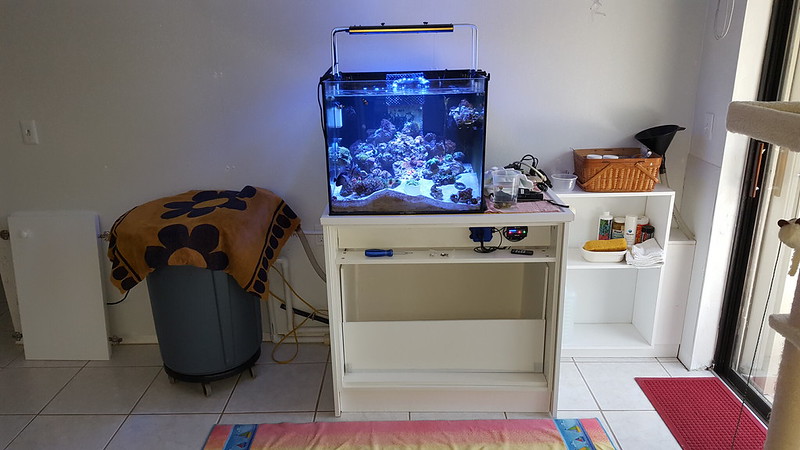
I don't use a skimmer, the survey asked
"please discuss in thread why not".
Two reasons for using a skimmer.
1 - the removal of organic matter, both disolved & particulate.
2 - Aeration of the water.
1. (I use activated carbon & sponges)
Feature Article: Bacterial Counts in Reef Aquarium Water: Baseline Values and Modulation by Carbon Dosing, Protein Skimming, and Granular Activated Carbon Filtration
By Ken S. Feldman, Allison A. Place, Sanjay Joshi, Gary White
Our earlier research on the topic of carbon nutrient levels in marine aquaria (Feldman, 2008; Feldman, 2009; Feldman, 2010) has provided
experimental documentation for four conclusions that impact on TOC management in our reef tanks:
* Protein skimming (i.e., bubbles)
is not very effective at removing TOC from aquarium water, depleting typical reef tank water of only ~
20 - 35% of the post-feeding TOC present.
* G
ranulated Activated Carbon filtration is quite effective at stripping reef tank water of its TOC load, removing
60 - 85% of the TOC present.
* And, quite intriguingly, the
natural biological filtration, which starts with bacteria and other microbes, is remarkable in its capacity to remediate reef tank water of TOC, easily removing
50% or more of the post-feeding TOC increase in tank water.
2. (I grow algae)
From Eric Borneman articles – The need to breathe Parts 1, 2, & 3. oxygenation experiments-
Conclusions and Recommendations
- Aquaria can and do become saturated or supersaturated with oxygen during the day, and this is a result of oxygen resulting from irradiance
of photosynthetic organisms. In no case was saturation or supersaturation measured
without photosynthesis.
- Air stones and skimmers appear to be a very effective means of oxygenating small water volumes. Their effect on
larger water volumes appears to be
less. While the effect may be relative, the larger tanks and systems described here utilized powerful skimming or air pumps, and to gain an equivalent amount of oxygen as occurs in small water volumes would likely require air pumps or skimmers
far larger than those commonly employed by aquarists. This
includes data from a coral farm where
very large commercial sized skimmers and high surface area/volume ratios failed to produce water even nearly saturated with oxygen at night with a heavy coral population.
- Using algae in reverse daylight tanks appears to be an effective means of keeping oxygen levels at normoxic levels at night
. This effect is pronounced even in tanks and systems that employ protein skimmers and airstones.
I'll add that in a room full of people, unflued gas heaters & cooking, etc, where co2 levels can be 1000ppm, this is what a skimmer is pumping into the water.




















 20180622_143629