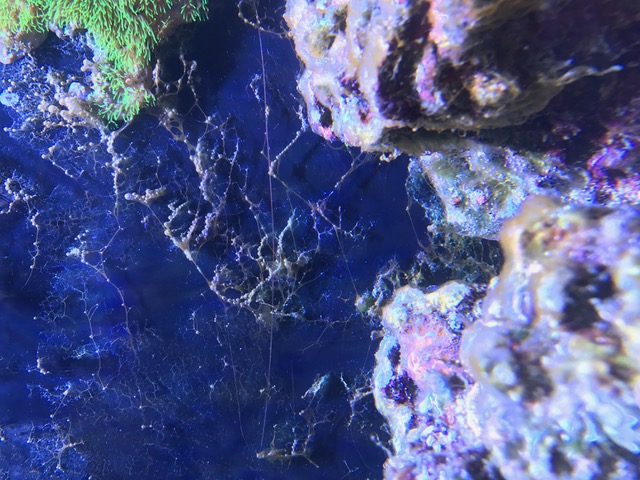
Red/orange algae ID (currently treating with chemiclean)

  • Thread starter Thread starter NickE
  • Start date Start date
  • Tagged users None

NickE

Community Member
View Badges
Joined
Feb 5, 2021
Messages
35
Reaction score
58
Location
Colorado
What state or country do you live in
Colorado
Rating - 0%
0   0   0
Hey all,

I'm dealing with something, maybe you can help me out. Here's a little backstory.

Early August I went on vacation and had a light get stuck on for about a week and a half. I came home to the left side of my tank having what appeared to be cyano (red looking algae with a slime coating) and a GHA outbreak. My nitrates were around 15 and phosphates around 0.07. I have a small fuge with chaeto and started running some GFO and scaled back feeding to see if it would help.

I manually removed the GHA and tried to suck up as much cyano as possible. GHA has been doing significantly better but cyano was still there. I was in the process of redoing my aquascape and added in about 20 lbs of marco rock and removed about 10 lbs of liverock. Before I added the rock I cured the rock in old tank water with a heater and powerhead for 3 weeks. Phosphates of the curing water were around 0.03.

I put the rock in the tank and for a few weeks everything seemed fine. I had small patch of GHA and what appeared to be cyano. I went on another vacation and came back and the new rock was basically orange/red with some bubbling from algae. I decided to treat for cyano.

I am currently in the process of a chemiclean treatment (just past 48 hour mark, going to go for one more day). Prior to treatment Nitrates around 15, phosphates around 0.04. I just got past the 48 hour mark and seeing only a marginal improvement (slime is gone but more of an orange hue compared to previous red). At this point I am not sure it is cyano. I also noticed some wiry algae as well (see last picture). I should have waited to clear up the algae problem BEFORE I added the new rock but I was impatient. Anyways take a look and tell me what you think.

All pictures under white light. System is about 15 months old. There was some bubbling prior to treatment and you will also see some bubbles due to airstone and skimmer without top to promote oxygenation with chemiclean treatment.


This is the original rock with orangish algae.


IMG_9344.png


New Rock pictures

IMG_9343.png


IMG_9345.png


IMG_9347.png


IMG_9346.png


Thanks!

Nick
 
Hey all,

I'm dealing with something, maybe you can help me out. Here's a little backstory.

Early August I went on vacation and had a light get stuck on for about a week and a half. I came home to the left side of my tank having what appeared to be cyano (red looking algae with a slime coating) and a GHA outbreak. My nitrates were around 15 and phosphates around 0.07. I have a small fuge with chaeto and started running some GFO and scaled back feeding to see if it would help.

I manually removed the GHA and tried to suck up as much cyano as possible. GHA has been doing significantly better but cyano was still there. I was in the process of redoing my aquascape and added in about 20 lbs of marco rock and removed about 10 lbs of liverock. Before I added the rock I cured the rock in old tank water with a heater and powerhead for 3 weeks. Phosphates of the curing water were around 0.03.

I put the rock in the tank and for a few weeks everything seemed fine. I had small patch of GHA and what appeared to be cyano. I went on another vacation and came back and the new rock was basically orange/red with some bubbling from algae. I decided to treat for cyano.

I am currently in the process of a chemiclean treatment (just past 48 hour mark, going to go for one more day). Prior to treatment Nitrates around 15, phosphates around 0.04. I just got past the 48 hour mark and seeing only a marginal improvement (slime is gone but more of an orange hue compared to previous red). At this point I am not sure it is cyano. I also noticed some wiry algae as well (see last picture). I should have waited to clear up the algae problem BEFORE I added the new rock but I was impatient. Anyways take a look and tell me what you think.

All pictures under white light. System is about 15 months old. There was some bubbling prior to treatment and you will also see some bubbles due to airstone and skimmer without top to promote oxygenation with chemiclean treatment.


This is the original rock with orangish algae.


IMG_9344.png


New Rock pictures

IMG_9343.png


IMG_9345.png


IMG_9347.png


IMG_9346.png


Thanks!

Nick
This is cyano bacteria. Cyano blooms typically start when water nutrient concentrations of phosphate, nitrate and other organic compounds are too high.
Some of the most common causes include:
- Protein skimmer which fills water with tiny air bubbles. As bubbles form from the reaction chamber, dissolved organic compound molecules stick to them. Foam forms at the surface of the water and is then transferred to a collection cup, where it rests as skimmate. When the protein skimmer does not output the best efficiency or you do not have the suitable protein skimmer to cover the tank, the air bubbles created by the skimmer might be insufficient. And this insufficiency of air bubbles can trigger the cyano to thrive.
- Overstocking / overfeeding, your aquarium with nutrients is often the culprit of a cyano bloom
- Adding live rock that isn’t completely cured which acts like a breeding ground for red slime algae
- If you don’t change your water with enough frequency, you’ll soon have a brightly colored red slime algae bloom. Regular water changes dilute nutrients that feed cyanobacteria and keeps your tank beautifully clear
- Using a water source with nitrates or phosphates is like rolling out the welcome mat for cyano. Tap water is an example
- Inadequate water flow, or movement, is a leading cause of cyano blooms. Slow moving water combined with excess dissolved nutrients is a recipe for pervasive red slime algae development

I recommend to reduce white light intensity or even turn them off for 5-7 days. Add liquid bacteria daily for a week during the day at 1.5ml per 10 gallons. Add Hydrogen peroxide at night at 1ml per 10 gallons. Add a pouch of chemipure Elite which will balance phos and nitrate and keep them in check.

After the week, add a few snails such as cerith, margarita, astrea and nassarius plus 6-8 blue leg hermits to take control.
 
This is cyano bacteria. Cyano blooms typically start when water nutrient concentrations of phosphate, nitrate and other organic compounds are too high.
Some of the most common causes include:
- Protein skimmer which fills water with tiny air bubbles. As bubbles form from the reaction chamber, dissolved organic compound molecules stick to them. Foam forms at the surface of the water and is then transferred to a collection cup, where it rests as skimmate. When the protein skimmer does not output the best efficiency or you do not have the suitable protein skimmer to cover the tank, the air bubbles created by the skimmer might be insufficient. And this insufficiency of air bubbles can trigger the cyano to thrive.
- Overstocking / overfeeding, your aquarium with nutrients is often the culprit of a cyano bloom
- Adding live rock that isn’t completely cured which acts like a breeding ground for red slime algae
- If you don’t change your water with enough frequency, you’ll soon have a brightly colored red slime algae bloom. Regular water changes dilute nutrients that feed cyanobacteria and keeps your tank beautifully clear
- Using a water source with nitrates or phosphates is like rolling out the welcome mat for cyano. Tap water is an example
- Inadequate water flow, or movement, is a leading cause of cyano blooms. Slow moving water combined with excess dissolved nutrients is a recipe for pervasive red slime algae development

I recommend to reduce white light intensity or even turn them off for 5-7 days. Add liquid bacteria daily for a week during the day at 1.5ml per 10 gallons. Add Hydrogen peroxide at night at 1ml per 10 gallons. Add a pouch of chemipure Elite which will balance phos and nitrate and keep them in check.

After the week, add a few snails such as cerith, margarita, astrea and nassarius plus 6-8 blue leg hermits to take control.

-This is my first tank and I know I was overfeeding when I first started the tank. I was also using primarily pellets during my vacation with an autofeeder. I mostly feed frozen LRS with 15 pellets on an autofeeder daily. The clowns, blenny and wrasse eat them all.

- I thought the marco rock was cured long enough but maybe not. Probably adding to the problem.

- I do daily water changes (10% weekly total).

- I use a RODI system but I'll go ahead and test the RODI water for phosphates.

- It's a waterbox 90 (60 gallon display) with a gyre that has a flow overtop and curls back under towards sandbed. I did notice that the algae appears mostly on sides that seem to get MORE flow (direct flow from gyre and backside where the water current flows down). I'm not sure if that is an indication of anything.

- Here is my current lighting schedule (10am to 7pm). I'll reduce white light to 0 for now.


IMG_9351.png


IMG_9352.png


Current CUC consists of
- 1 urchin
- 2 red hermits
- 1 halloween hermit
- 8 trochus
- 2 astrea
- 1 turbo
- 2 conchs
- 1 emerald crab
- 1 cleaner shrimp
- 1 peppermint shrimp
- ~20 nassarius snails (sand bed doesn't really have any algae)


Thanks for the input.
 
Hey all,

I'm dealing with something, maybe you can help me out. Here's a little backstory.

Early August I went on vacation and had a light get stuck on for about a week and a half. I came home to the left side of my tank having what appeared to be cyano (red looking algae with a slime coating) and a GHA outbreak. My nitrates were around 15 and phosphates around 0.07. I have a small fuge with chaeto and started running some GFO and scaled back feeding to see if it would help.

I manually removed the GHA and tried to suck up as much cyano as possible. GHA has been doing significantly better but cyano was still there. I was in the process of redoing my aquascape and added in about 20 lbs of marco rock and removed about 10 lbs of liverock. Before I added the rock I cured the rock in old tank water with a heater and powerhead for 3 weeks. Phosphates of the curing water were around 0.03.

I put the rock in the tank and for a few weeks everything seemed fine. I had small patch of GHA and what appeared to be cyano. I went on another vacation and came back and the new rock was basically orange/red with some bubbling from algae. I decided to treat for cyano.

I am currently in the process of a chemiclean treatment (just past 48 hour mark, going to go for one more day). Prior to treatment Nitrates around 15, phosphates around 0.04. I just got past the 48 hour mark and seeing only a marginal improvement (slime is gone but more of an orange hue compared to previous red). At this point I am not sure it is cyano. I also noticed some wiry algae as well (see last picture). I should have waited to clear up the algae problem BEFORE I added the new rock but I was impatient. Anyways take a look and tell me what you think.

All pictures under white light. System is about 15 months old. There was some bubbling prior to treatment and you will also see some bubbles due to airstone and skimmer without top to promote oxygenation with chemiclean treatment.


This is the original rock with orangish algae.


IMG_9344.png


New Rock pictures

IMG_9343.png


IMG_9345.png


IMG_9347.png


IMG_9346.png


Thanks!

Nick
The golden color resembles diatoms and dinoflagellates. Diatoms grow on new surfaces. Are the pictures of the ne2 rock recently added?
 
The golden color resembles diatoms and dinoflagellates. Diatoms grow on new surfaces. Are the pictures of the ne2 rock recently added?
The top picture is the original rock, all the others are the new rock. The color has changed though, it was a deeper red PRIOR to the Chemiclean treatment.

I plan on doing my 20% water change tomorrow and skimming out the rest of the Chemiclean. After that I'll hook up my Carbon/GFO reactor, add some Blue hermits and check it out in a few days to see how it responded to treatment.

Maybe I'll do another treatment after that.
 
The top picture is the original rock, all the others are the new rock. The color has changed though, it was a deeper red PRIOR to the Chemiclean treatment.

I plan on doing my 20% water change tomorrow and skimming out the rest of the Chemiclean. After that I'll hook up my Carbon/GFO reactor, add some Blue hermits and check it out in a few days to see how it responded to treatment.

Maybe I'll do another treatment after that.
Interesting color change. Microorganisms can live as mixed communities. If the golden color persists, the red community might have been a mix.
 
The top picture is the original rock, all the others are the new rock. The color has changed though, it was a deeper red PRIOR to the Chemiclean treatment.

if the golden color persists, the red community might have been a mix.
Yep, that's what might be expected if there was a cyano/dino/diatom mix that was treated with chemi-clean.
Sometimes you can see mats that have patches that are more or less red / brown depending on local abundance of cyano vs others.
 
Update:

I finished the Chemiclean treatment, added 10 blue leg hermits and gave it ~two weeks. The cyano has started to fade. It's not slimy but still has a orangish color to it. The CuC is starting to nibble at it and cleaning the rocks, I'm seeing white spots all over the new marco rock. Nitrates and Phosphates are 0 now. I siphoned out the rest of the GHA and have very little in the tank. I'm happy... for now.
 
Update:

I finished the Chemiclean treatment, added 10 blue leg hermits and gave it ~two weeks. The cyano has started to fade. It's not slimy but still has a orangish color to it. The CuC is starting to nibble at it and cleaning the rocks, I'm seeing white spots all over the new marco rock. Nitrates and Phosphates are 0 now. I siphoned out the rest of the GHA and have very little in the tank. I'm happy... for now.
I would venture a guess that if the cuc is eating it, it's not cyano.

Be careful about bottoming out your nutrients - that's a recipe for dinos...
 
I would venture a guess that if the cuc is eating it, it's not cyano.

Be careful about bottoming out your nutrients - that's a recipe for dinos...


I know blue leg hermits are known to eat cyano. I'm fairly confident I had cyano on part of my rocks because it was slimy. They're eating the leftovers of what ever it was though.

Yea I'm over feeding and dosing more AB+ and reef chili to try to raise it. I also stopped using GFO. There is a fine line I am trying to find haha
 
I know blue leg hermits are known to eat cyano. I'm fairly confident I had cyano on part of my rocks because it was slimy. They're eating the leftovers of what ever it was though.

Yea I'm over feeding and dosing more AB+ and reef chili to try to raise it. I also stopped using GFO. There is a fine line I am trying to find haha
Gotcha. I didn't realize blue legs ate cyano... I guess the ones I had were lazy! (Or mislabeled...they were pretty tiny, lol)
 
Gotcha. I didn't realize blue legs ate cyano... I guess the ones I had were lazy! (Or mislabeled...they were pretty tiny, lol)
The only thing my urchin seems to enjoy is my beautiful coralline algae. Needless to say, I have a lot of white spots everywhere now. haha
 
Be careful bottoming out nitrate and phosphate, because you limit competition. That is a recipe to encourage dinoflagellate.

Also, when you do partial water changes, vacuum sandbed.
 
that's not cyano, that's diatons, just wait no need to dose anything
Diatoms are powdery brown.

John Mahoney at ReefCleaners describes dinoflagellate:


Dinoflagellates

dinoflagellates 300x225


This light brownish menace feels like snot growing up from the rock or sand, with trapped air bubbles in it. Not to be confused with algae that has an air bubble that has landed on it, dinos make them. Not all species of dinos are bad the one pictured is though, and has caused many aquarists to tear down their tanks. If you are in doubt as to what you have send us a picture, there are many similar looking species that are easily removed.

@NickE
Which do you have? You don’t need a microscope to identify what you have.
 
Last edited:

IF YOU HAD TO TAKE A REEFING EXAM, WOULD YOU PASS?

  • Yes!

    Votes: 32 45.7%
  • Not yet, but I have one that I want to buy in mind!

    Votes: 9 12.9%
  • No.

    Votes: 26 37.1%
  • Other (please explain).

    Votes: 3 4.3%
Back
Top