1. I get smaller the deeper one goes in the ocean
2. Some reefers prefer me small, and some prefer me larger (compared to most reefers today, Randy prefers larger ones)
3. I can cause a lot of disappointment when buying corals online
What am i?
Good luck!
PS
keep it clean, we don't want the thread closed lol
Reef Chemistry Puzzle #10 A word scramble. All words relate to reef chemistry. Some are harder than others. I had pH in the list and decided to remove it. lol See how many you can get before running out of patience! ITTNERA CIITRC UMLCICA KVAOD AHOTSHEPP TALYINLAKI AESMMNIGU NGCORAINI...
Light wavelength might work. It technically grows narrower as you go deeper, the tree is super ultra blue (full spectrum is better, fight me), and shady vendors use UV to make their boring coral look $$$.
I agree 100% with your explanations on these things. I was a lazy student, perhaps distracted is a better term but the grades and comprehension have been bleak in many situations and I am glad you are available to fill in the gaps when I find myself struggling with the reef chemistry challenges!
I thought light absorption was more physics than chemistry but the intersection of knowledge is more complex than I can imagine
The lamps are several years old, and whenever I replace one, I prefer the older look better as they are warmer and I'm not a fan of intense blue lighting.
1. I get smaller the deeper one goes in the ocean
2. Some reefers prefer me small, and some prefer me larger (compared to most reefers today, Randy prefers larger ones)
3. I can cause a lot of disappointment when buying corals online
What am I?
Average wavelength of light.
Blue light has a shorter (smaller) wavelength.
The ambient light in the ocean gets bluer as you go deeper.
I personally prefer more yellow lighting of a reef, matching surface sunshine, not the blue look. But more folks seem to prefer blue.
Many folks (including myself) have been disappointed with online purchases that are photographed in heavy blue lighting that does not match my tank.
Folks did a great job on this one!
This is a curiously complicated question to fully understand, despite the relatively common knowledge by reefers that light gets bluer as you go deeper. Why does it?
First, I'll note that absorbance and scattering by molecules and particles other than water are excluded from this discussion. It relates to water only. Obviously, organic molecules and whole organisms also absorb light and impact the color of the ocean in different locations differently
Second, the reason the ocean looks blue from above is not the same reason it gets bluer as you go deeper.
The ocean looks blue from above due to:
1. Reflectance of the blue sky
2. Scattering of blue light more effectively than redder light, causing the scattered light coming back up to carry a bluer tint than the ambient sunshine. This effect is really clear in a block of ice like a glacier or iceberg where the water is quite pure (although absorption can play a role here).
If those effects (1 and 2 above) were all that happened, light remaining at higher depths would be redder than ambient, since blue is scattered away more. Why isn't it?
Understanding the absorbance of visible light by water is an intense chemical problem. I won't go into the details, but there are many sources that cover it in great detail. Water has a variety of vibrational states that it can be in, and when light is absorbed, it can jump from one vibration state to a higher energy vibration state.
The strongest vibrational absorbance bands involve jumping from one vibration state to the next higher energy level. None of these exist for water in the visible spectrum, which is why water generally looks colorless. Jumping up more than one level at a time is "forbidden" by simple models of oscillating vibrations, but real molecules are not exactly modeled properly by simple quadratic spring oscillations, and jumps can happen over multiple vibrational levels in a single jump, giving rise to rare but not impossible absorbance in the visible spectrum. A combination of level jumps can also happen from a single photon.
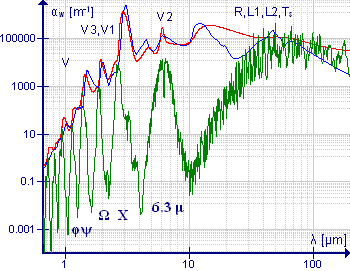
This the absorbance of visible light is very low, but real and measurable. The absorbance is stronger in the red part of the spectrum and weaker in the blue section of the spectrum, making light bluer and bluer as you go deeper.
This wikipedia entry is certainly thorough enough for us. It shows a spectrum of visible light absorbance by water and explains the process a bit. Note that absorbance at 700 nm (red) is nearly 100 times more than at 450 nm. We can calculate from this graph that red light (absorbance = 1) loses just over 2% of its intensity through 1 meter of depth, while blue light (absorbance 0.01) loses only 0.02% of its intensity over 1 meter.






 www.reef2reef.com



 I'll have to think a bit out of the box.