ROCK POOL REEF KEEPERS GROUP

Status
Not open for further replies.
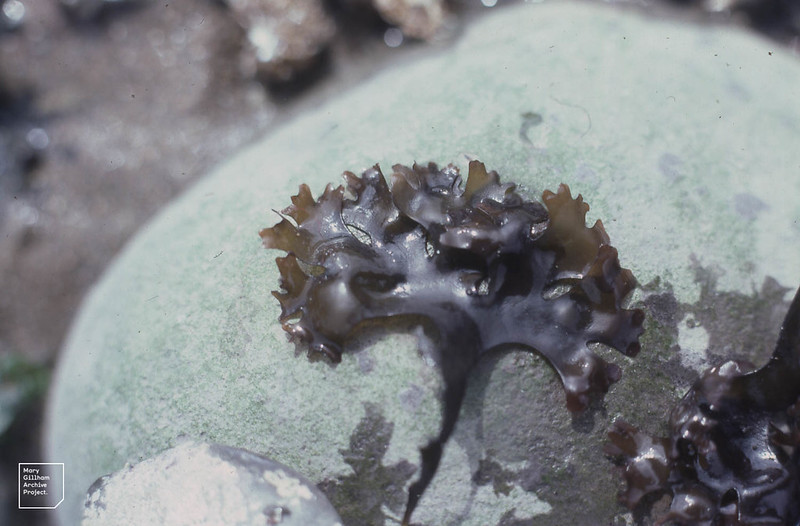
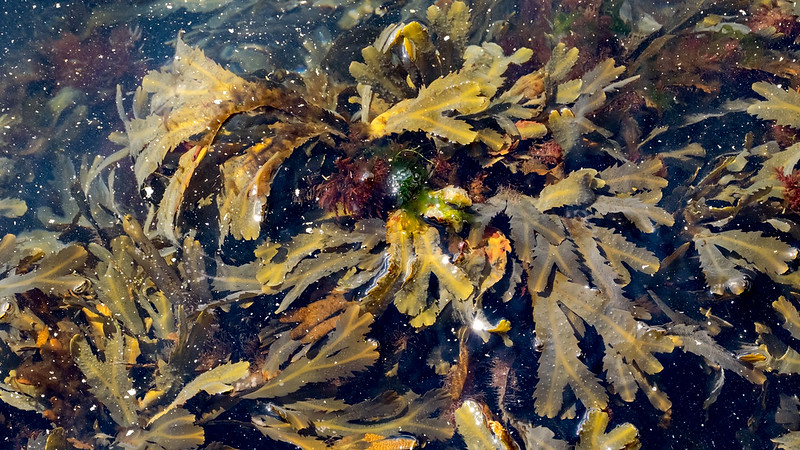
I picked up some seaweed in the Atlantic. The stuff is all over the place but doesn't last long in a tropical tank.

Seaweed.JPG


I got it here.
Orient Point Park.JPG
 

Seaweed Identification​


Luanne Wilkes

Luanne Wilkes
27th July 2020
ID guide Starting out Botany Aquatic ecology
Header-image.jpg
Seaweeds by Windel Oskay via Flickr
Seaweeds, or marine macroalgae, are plant-like organisms that live in coastal areas, usually attached to rocks or other substrates. They are divided into three taxonomic groups: brown, red and green. Broadly speaking, species fall into the group that most closely matches their colour. However, the groups also differ in more complex structural and biochemical features, such as their photosynthetic pigments and cell structure. While green and red seaweeds are classified in the Kingdom Plantae, which also includes all of the world’s land plants, brown seaweeds belong to the Kingdom Chromista and are more related to algae, diatoms and protozoans.
British and Irish seas are home to more than 600 species of seaweed; this is more than 6% of the known species globally. They are incredibly important ecologically and provide both food and shelter for numerous other creatures. In fact, one of the great pleasures of studying seaweeds is the many other species that you find along the way.
If you find yourself enjoying your seaweed studies, why not contribute to the Natural History Museum’s Big Seaweed Search. It only takes around an hour and will provide valuable data that can be used to research the effects of environmental change on our seashore communities.

When and where to find seaweed​

Seaweed is present all year round. At low tide, more of the shore will be exposed which means that you are likely to find a greater range of species. This is also the only time that you are likely to spot a glimpse of those seaweeds that thrive in the lower intertidal zone. Sheltered shores tend to provide a better location for many species, as most cannot survive the battering of the waves in more exposed locations. However, there are a few species that are specially adapted to live on exposed shores so it’s always worth a look there. Similarly, as most species require a firm substrate to anchor to, rocky shores will be home to more seaweeds than sandy or muddy ones.

Ten common species to look for​

Brown seaweeds:

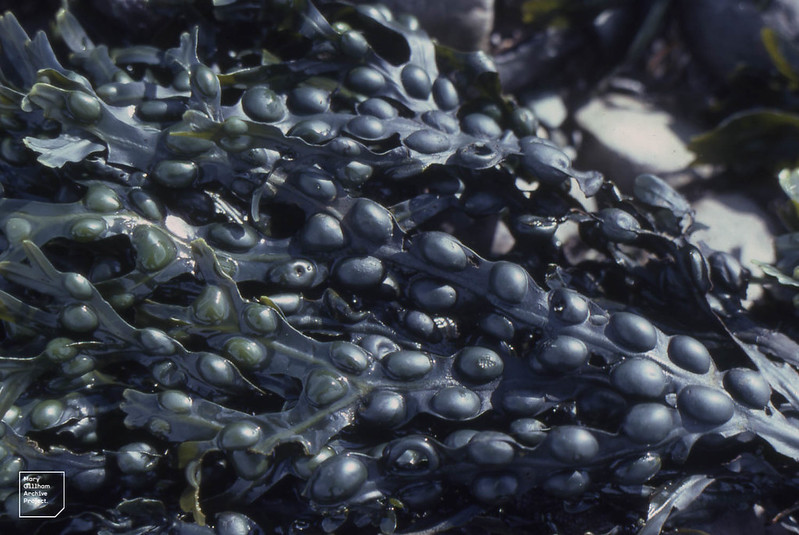
Bladder wrack (Fucus vesiculosus)

Fucus-vesiculosus.jpg
Bladderwrack from the Dr. Mary Gillham Archive Project via Flickr.
ID notes: An olive-brown seaweed that has branching fronds with smooth edges. Paired air-filled bladders run along the length of the fronds on either side of the central rib. 15-100cm in length. The number of bladders present is related to the exposure of the shore; in very exposed places this species may grow without any bladders and will also be much reduced in length.
Distribution: Found on rocky shores between the high and low water line.

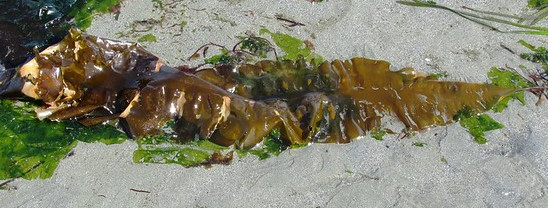
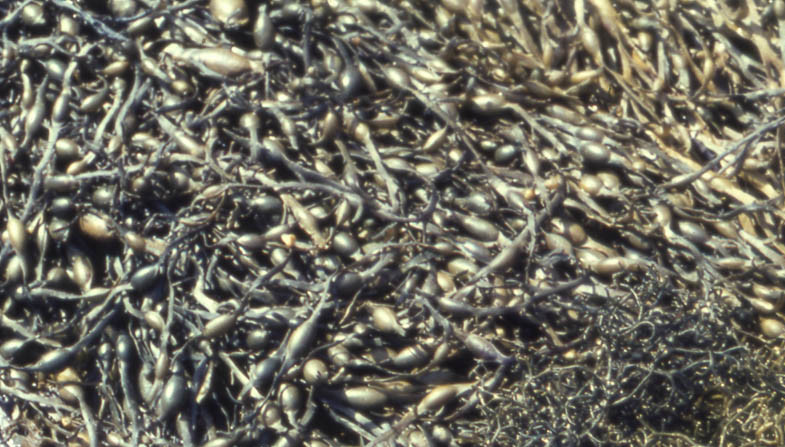
Knotted wrack (Ascophylum nodosum)

Knotted-wrack.jpg
Knotted wrack from the Dr Mary Gillham Archive Project via Flickr.
Also known as: Egg wrack
ID notes: This yellow-brown seaweed has long fronds reaching up to two metres in length. Single large air bladders appear at regular intervals along its length.
Distribution: Found on the mid-shore on sheltered rocky coasts. Knotted wrack is very long-lived (up to 15 years) in comparison to other algae; this allows it to become dominant on many sheltered coastlines. When the tide goes out it often forms huge piles.

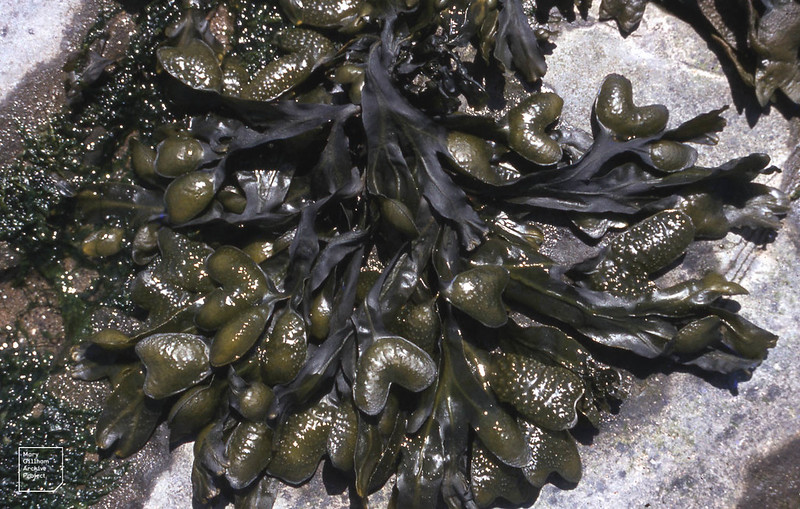
Spiral wrack (Fucus spiralis)

Spiral-wrack.jpg
Spiral wrack from the Dr Mary Gillham Archive Project via Flickr
Also known as: Twisted wrack
ID notes: Spiral wrack is generally a pale olive-brown and grows up to 40cm. As the name would suggest, fronds are generally (although not always) twisted and have smooth edges and a distinct central rib. When mature, fronds have yellowish, paired swollen tips; these are the reproductive structures.
Distribution: Found high on the rocky shore, just below the high-water mark.

Serrated wrack (Fucus serratus)

Serrated-wrack.jpg
Serrated wrack by aka CJ via Flick
Also known as: Toothed wrack or saw wrack
ID notes: This brown seaweed forms branched fronds 50 to 80cm in length. Edges are serrated.
Distribution: Found on sheltered and semi-exposed rocky shores just above the low water mark. Fucus serratus is often the dominant algal species found at this point on the shoreline.

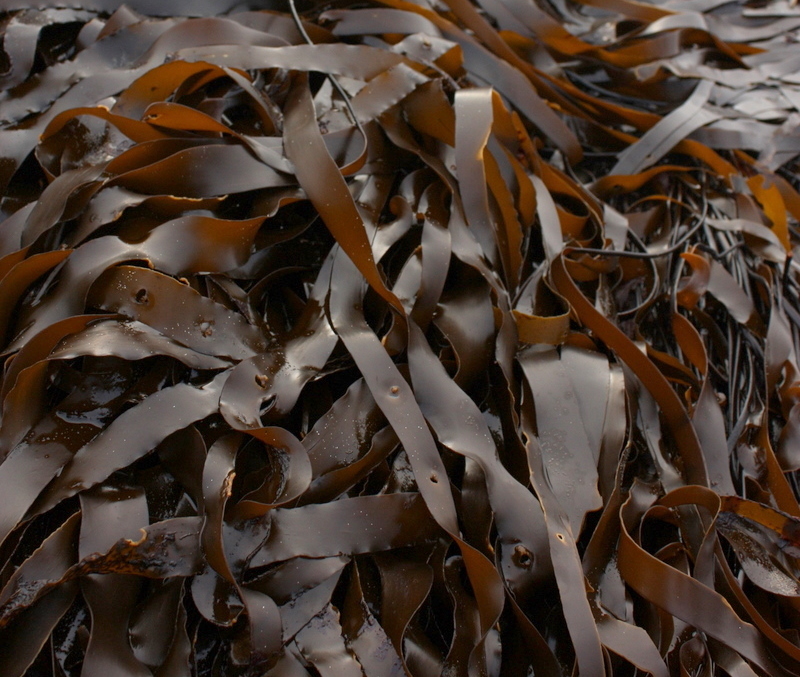
Oarweed (Laminaria digitata)

Oarweed.jpg
Oarweed by Leslie Seaton via Flickr
ID notes: Oarweed has dark brown-green fronds that are up to two metres in length and split into long finger-like blades. Attaches to the rock with a claw-like holdfast which allows it to survive in rough subtidal conditions.
Distribution: Grows in dense beds in the lower intertidal and shallow subtidal zones (at a depth of up to 20m). Often all that can be seen of this species are the tops of the fronds during low tide.

Sugar kelp (Saccharina latissimi)

Sugar-kelp.jpg
Sugar kelp by brewbooks via Flickr
Also known as: Sea belt
ID notes: Forms long undivided blades that are yellow-brown in colour and have ruffled sides. Grows up to five metres in length.
Distribution: Found on the lower shore and in deep rock pools. Mostly on sheltered shores and can be found up to a depth of 30m.

Green seaweeds:

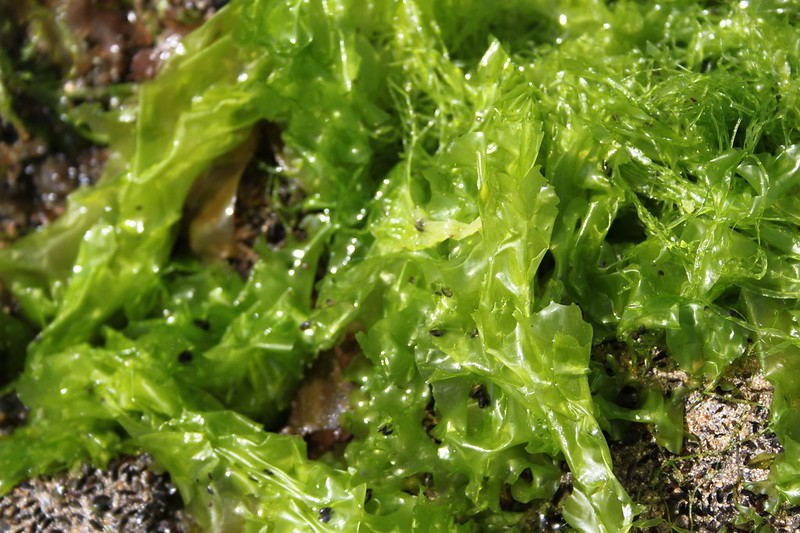
Sea lettuce (Ulva lactua)

Sea-lettuce.jpg
Sea lettuce by seaspicegirls via Flickr
ID notes: Sheet-like light green seaweed which grows up to 25cm in length and 30cm in width. Very delicate and almost translucent; almost like floppy lettuce leaves.
Distribution: Found attached to rocks or floating in rock pools.

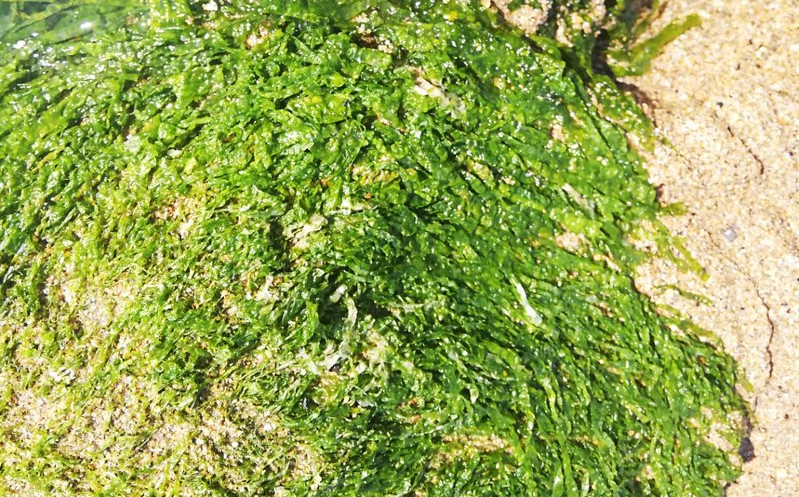
Gutweed (Ulva intestinalis)

Gutweed.jpg
Gutweed by AuT CRONE via Flickr
Also known as: Grass kelp
ID notes: As the Latin name would suggest, gutweed resembles the intestines of mammals and consists of inflated hollow fronds which have bubbles of air trapped along them. Bright green and grows up to 40cm in length.
Distribution: Occurs in a wide range of intertidal habitats including rockpools and on sand or mud. Can also be found growing on shells or other seaweeds.

Red seaweeds:

Carrageen (Chondrus crispus)

Carrageen.jpg
Carrageen from the Dr Mary Gillham Archive Project via Flickr
Also known as: Irish moss
ID notes: Dark reddish-purple branching seaweed which appears iridescent when submerged. Turns green with exposure to bright sunlight.
Distribution: Rocky shores and estuaries, on rocks and in pools in the lower intertidal and upper subtidal zones.

Purple laver (Porphyra umbilicalis)

Purple-laver.jpg
Purple laver from the Dr Mary Gillham Archive Project via Flickr
ID notes: Forms fronds of variable shape which are thin and membranous. Olive to purple-brown in colour and up to two metres in length.
Distribution: Found in the mid to upper shore, generally on mussel-covered rocks. Common on exposed coastlines.

Further reading

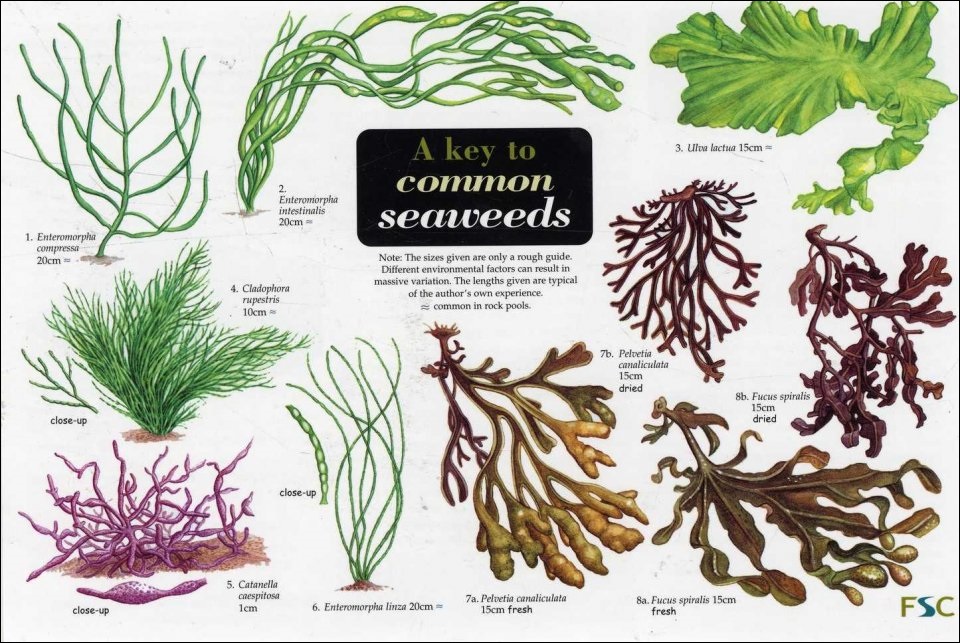
A Key to Common Seaweeds
#118696
This laminated guide from the FSC will help you to identify 36 of the most common seaweeds.


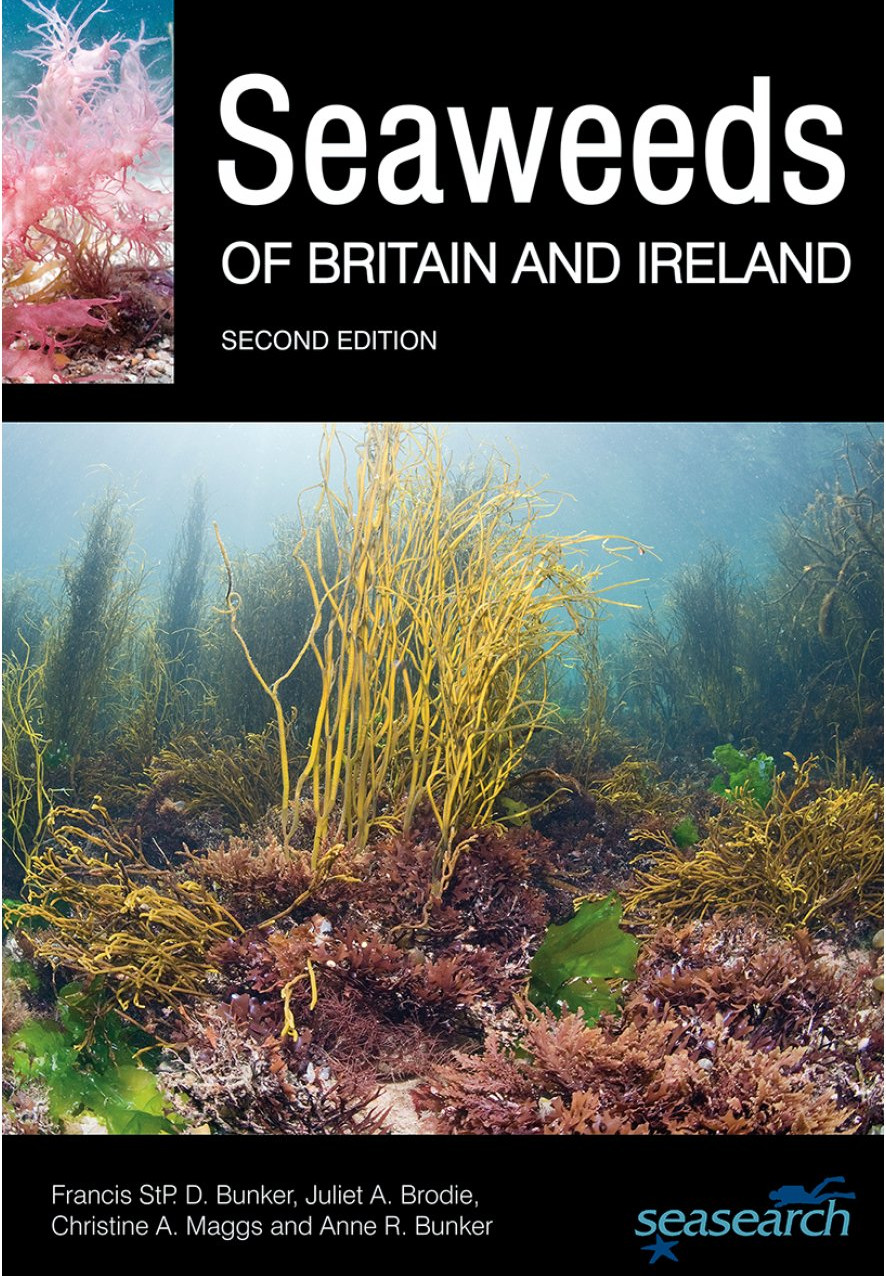
Seaweeds of Britain & Ireland
#235692
This photographic guide aims to demystify seaweed identification for the non-specialist. Over 235 species are described in detail, with colour photographs, information on habitat, distribution and confusion species.
 
I like it! I never knew cold water tanks like that existed. They are so different than the everyday. I keep thinking, oh yeah there’s that chiller in the attic.
Are there laws in the UK that restrict harvest of some species or is it game on?
Over here in Florida, state laws regulates what can be harvested and has bag limits. Some areas are restricted to collect anything. Most everything can be purchased on line and the rest is illegal to harvest.
 
I like it! I never knew cold water tanks like that existed. They are so different than the everyday. I keep thinking, oh yeah there’s that chiller in the attic.
Are there laws in the UK that restrict harvest of some species or is it game on?
Over here in Florida, state laws regulates what can be harvested and has bag limits. Some areas are restricted to collect anything. Most everything can be purchased on line and the rest is illegal to harvest.
Yes and there getting more and more protection which I don't have a problem with indangered species. But my Anemones have breed so the young are captive bred also growing seaweeds are growing and having to split them so are they called captive bred.
My shrimps are breeding so would they be classed as captive bred not wild. They have just brought out a new law your not to take peebles off the beach or you will be fined. JOKE
But I can buy a fishing rod and catch wrasse /Rock gunnels /Pollock and all other species and not a word said but yes your correct about laws but at some point you will be not allowed to touch anything in the sea
Or people will still have theses tanks and just keep them private. Can you imagine if the laws went as far as are hobby no wild fish everything had to be captive bred hope it never happens but you never know
 
Yes and there getting more and more protection which I don't have a problem with indangered species. But my Anemones have breed so the young are captive bred also growing seaweeds are growing and having to split them so are they called captive bred.
My shrimps are breeding so would they be classed as captive bred not wild. They have just brought out a new law your not to take peebles off the beach or you will be fined. JOKE
But I can buy a fishing rod and catch wrasse /Rock gunnels /Pollock and all other species and not a word said but yes your correct about laws but at some point you will be not allowed to touch anything in the sea
Or people will still have theses tanks and just keep them private. Can you imagine if the laws went as far as are hobby no wild fish everything had to be captive bred hope it never happens but you never know
Thanks, I get why the laws were made but some are not well thought out. You can collect 5 individual polyps of Zoanthid with a 2” max flexible flat blade. I will kill 20 to get a good 5. Yet you can collect an octocoral with 1” of substrate attached. Why not cut the octo off and let the base re grow.
FWC will bust my chops when I pull into the dock wanting to see inside the cooler. Yet, off to the sides of the ramp someone will be fishing with a bucket full of short snapper.
FWC can confiscate your short fish, the equipment you used to catch the fish, the boat you used to get to the fish and the vehicle you towed the boat with. Then slap you with a big fat fine and possible imprisonment. You really gotta be f in up for that to happen. The laws wouldn’t be like that if it didn’t happen.
 
Take the family and enjoy the day


https://www.countryfile.com/
GettyImages-734166165-0a31785.jpg


Rockpooling guide: how to get started, where to go, and essential equipment​

Rockpooling is a traditional summertime seaside activity, but you can explore the hidden world of the sea's fascinating creatures at anytime of the year. Discover how to get started, essential equipment and the best places to go in our expert guide.

Save 36% when you subscribe to BBC Countryfile Magazine plus, get a copy of Be a Birder by Hamza Yassin!
Carys Matthews

Published: August 8, 2022 at 2:20 pm

Rockpooling is a fantastic activity that people of all ages can enjoy. Summer is a great time to visit the coast to take full advantage of the British coastline. Leaning over the small pools of water that form on the rocky shoreline, you can find a huge range of creatures that you might otherwise never know were there.

The seas around the UK have the potential to be amongst the most productive and wildlife-rich on earth. Hidden beneath the surface are landscapes every bit as varied and beautiful as those we see on land, with undersea cliffs, caves, chasms, mountains, dunes and plains. But it is not until the waves have retreated and the tide is low that we get a glimpse of this mysterious world and the weird and wonderful wildlife that inhabits it.

Here is our selection of the best rockpools in Britain, including all the essential equipment you'll need for a successful day of rockpooling.
Fancy a day on the beach? We have also rounded up some of the best beaches in the UK, including the best family-friendly beaches.
GettyImages-534455120-2cbab72.jpg
Rockpools on a sandy beach in Croyde Bay, Devon/Credit: Getty Images
More related content:

How to go rockpooling​

Slowly submerge a bucket into the water and see what's inside when you pull it back up again. Once you're done observing, slowly push the bucket back into the water, returning the creatures to their home. Nets aren't recommended when rockpooling as most of the creatures are small and getting stuck in the net which can seriously harm them.
GettyImages-719872367-35a2f21.jpg
Rockpooling is a fantastic family activity/Credit: Getty Images
You need to get stuck in to have the best chance of spotting something. Pick up rocks to see if there's a crab underneath. Inspect seaweed to try and find what creatures are living within in it.
Investigate crevices in the rocks to find shellfish, but make sure you return them once you've observed them.

Where to go rockpooling​

The best places to find interesting creatures are fairly sheltered rocky shores, on shingle or sandy beaches. You could also search around boulders, piers and pontoons which often contain interesting nooks and crannies for wildlife to hide in.
Spring tides are best as they reveal the very best pools and the best wildlife – species which you normally only find underwater, such as lobsters, spider crabs and small fish. Here are some of the best spots for rockpooling in the UK:
GettyImages-95007081_1-de9b3ed.jpg
Rhossili Bay, Gower, South Wales/Credit: Getty Images

Best places to go rockpooling in the UK​

Wembury, Plymouth​

Bill Oddie voted Wembury his top spot for rockpooling in the UK – and it’s easy to see why. Look out for the intriguing beadlet anemones, which reproduce by spitting out perfect baby anemones that float around until they find a rock to attach to; cushion starfish, which feed by pushing out their stomachs through their mouths to engulf food.
Wembury-Point-d7a5729.jpg
Beach at Wembury point, It was part of the Royal Navy shore establishment HMS Cambridge, Formerly named HM Gunnery School, now owned by the Nation Trust, Devon, UK. (Getty Images)

Rhossili Bay, Gower​

If you fancy getting more than your feet wet in Britain’s rockpools, just around the corner from the Gower you’ll find a perfectly round, deep plunge pool. Nearby, you can explore a series of sea arches called the Three Chimneys as well as ancient caves that reportedly contain gold coins from a Portuguese wreck.

GettyImages-95007081_1-de9b3ed.jpg
A view of Rhossili Bay, Gower, South Wales in beautiful late sunlight/Credit: Getty Images

The Brough of Birsay, off the coast of Orkney​

The Brough of Birsay is a small island off the Orkney mainland, scattered with the remains of Pictish and Norse settlements. Low tide exposes a causeway to the island, along with a medley of rockpools. Keep your eyes peeled and your buckets ready, as you’re likely to find the popular groatie buckies (cowrie shells), starfish, anemones and crabs.
Coastline-259453a.jpg
Brough Of Birsay, off the coast of Orkney, Scotland (Getty)

Hope Gap, Sussex​

Beneath the chalky face of the Seven Sisters, Hope Gap offers plenty of rewards for rockpoolers. It’s also beautifully eerie at sunset, when the moon-like landscape turns pink in the changing light. Watch out for strawberry anemones, with speckled spots like berry pips, and velvet swimming crabs, which have paddle-like hind legs to scull away from predators.
Hope-Gap-Seven-Sisters-8d90f5e.jpg
The Seven Sisters and Hope Gap where chalk meets the sea at Cuckmere Haven. (Getty)

Treyarnon Cove, Cornwall​

When the tide draws out on Treyarnon Cove on the Cornish coast, it reveals a natural tidal pool that’s 9m long and 2.5m deep in the centre. Snorkelling in this renowned swimming spot, formed with a little help from a concrete dam at one end, provides an alternative perspective on the marine life within.

GettyImages-569027951-8332b30.jpg
Treyarnon Bay, Cornwall/Credit: Getty Images

What to look out for when rockpooling​

Wildlife including crabs, shrimps, anemones, limpets, snails and starfish can all commonly be seen in rockpools around the coast.
Highlights of a good day out can include a mermaid’s purse (dogfish eggs that are like a tiny womb – hold them up to the light and you can see the developing embryo inside), squat lobsters and crabs hiding under rocks, common prawns darting about in the open water, blennies changing colour to match their background, cushion stars and starfish.
GettyImages-844389202-8d7c4dd.jpg
Hermit crab ©Getty
Beautiful beadlet anemones can only feed when their entire body is covered by water. Find one and watch it feeding – you may even tempt it if you dangle a bit of bacon in front of it. Then there’s the aptly named butterfish, found under rocks and seaweed, which is very slippery and a difficult one to catch. Look for limpets that are underwater and see if they have moved from their mark on the rocks to feed on the surrounding algae.
Also keep a lookout for dogwhelks near mussels and check the mussels for holes – this is how the whelks feed, by drilling a hole in the mussel shell and sucking out the contents.

What species can I see in rockpools?​

Hermit Crab Pagurus bernhardus

This soft-bodied crab lives in an empty spiral shell, moving up sizes as it grows. When inside, its right pincer seals the entrance.
Hermit20Crab20Pagurus20bernhardusOS001b-3f01809.png

Common Starfish Asterias rubens

Although the common starfish is usually orange in colour, it can also be brownish or purple. It is instantly recognisable from its five-armed shape, with some individuals having six arms. Starfish can regenerate missing arms – in fact they can become whole again from just one arm and part of the central body! Average size is 20cm across. Learn more about starfish species found in the UK.
Starfish20Commonsterias20rubens20002-fcdf44d.png

Shanny Lipophrys pholis

Britain’s most common blenny is often found in rockpools or under rocks on the shore line, and varies in colour from grey to brown. Up to 13cm (5in) long.
Shanny20Lipophrys20pholis-939dc5e.png

What equipment do you need for rockpooling?​

Your bucket would ideally be transparent so you can can observe the critters closely from below. You can also use clear tupperware as an alternative.
GettyImages-562478497-f5a3742.jpg
Take extra care when searching along the edge of slippery rockpools/Getty Images
When searching for the best rockpool, you'll need a sturdy pair of waterproof shoes as the rocks will inevitably be slippery, sharp and therefore very dangerous.
If you're lucky enough to be rockpooling beneath beaming sunshine, make sure you wearing sufficient sun-cream and a hat in order to avoid sunburn.

How to go crabbing​

1

Find an easily accessible rockpool​

It needs to be full of sea creatures and safe for you to visit. Children will love scrambling over rocks and gazing in pools but take note of incoming tides.
2

Gather your equipment​

You will need: some string or handline, a bucket, a small fishing net, an old washing tablet bag and the bait – crabs are particular to fish and bacon.
153052240-4beda1c.jpg
Common Shore Crab
3

Fill a bucket​

Before you begin crabbing, fill the bucket with seawater, seaweed and some pebbles - this helps mimic a crab's natural environment and relieves stress. Then put the bait in the old washing tablet bag and tie it to the string. Then simply drop the bait into the water and let it hit the seabed. It’s a good idea to wrap a little bit of the line loosely around your finger so that you can feel the crabs pulling on it.
97770866-38a60dc.jpg
Bucket and net beside a rockpool
4

Wait for a crab to nibble​

When you feel the crabs nibble, lift the line out of the water and put the net underneath so that it doesn’t fall back in. Then carefully place the crab in the bucket. Try not to have a gang of more then 10 in each bucket. Then see if you can identify all of the different crab species you've found.

5

Observe and then carefully release your crabs​

Be careful when handling the crabs - if they pinch it is very hard to make them let go. If you do want to pick them up, make sure you hold the crab with your finger and thumb on either side of the shell, behind the pincers, so that they cannot reach you with them and so that you don’t hurt the crab, either. Once you've finished with your crabs, carefully release them back into the sea near the waters’ edge.

What crabs can I find in rockpools?​

These characterful crustaceans are a highlight of any rock pooling expedition. Our expert crab and crustacean guide will help you identify common British crab species and the best places to find them.
Guide to Britain’s crab species: how to identify and where to find
Velvet-swimming-crab-de5b5d9.jpg
A velvet swimming crab, Necora puber, also known as the devil crab/Credit: Getty images

Share this article​

carysprofile-08c5c59-1.jpg

Carys Matthews
Group Digital Editor
Carys is the Group Digital Editor of countryfile.com and discoverwildlife.com and writes regular features for the print magazine. Away from the desk, she enjoys trail running, hiking, outdoor swimming and cycling in the British countryside and beyond.










 
Last edited:
Just press on which one you want info on
Skip to main content

marlin-logo.png
The Marine Life Information Network​


Information on the biology of species and the ecology of habitats found around the coasts and seas of the British Isles​

Navigation​

Toggle navigation

  1. Home
  2. Species list
  3. Sponges (Porifera)

Sponges (Porifera)​

= MarESA review. = MarLIN review.

Species List​

[Show more]Homoscleromorpha 1​

Oscarella lobularis

Lobate fig sponge (Oscarella lobularis)

[Show more]Siliceous sponges (Demospongiae) 26​

Adreus fascicularis

A sponge (Adreus fascicularis)
Amphilectus fucorum

Shredded carrot sponge (Amphilectus fucorum)
Axinella damicornis

Crumpled duster sponge (Axinella damicornis)
Axinella dissimilis

Yellow staghorn sponge (Axinella dissimilis)
Axinella infundibuliformis

Prawn cracker sponge (Axinella infundibuliformis)
Chelonaplysilla noevus missing

A sponge (Chelonaplysilla noevus)
Ciocalypta penicillus

Cored chimney sponge (Ciocalypta penicillus)
Cliona celata

Boring sponge (Cliona celata)
Desmacidon fruticosum

A sponge (Desmacidon fruticosum)
Dysidea fragilis

Goosebump sponge (Dysidea fragilis)
Halichondria (Halichondria) bowerbanki

Bowerbank's halichondria (Halichondria (Halichondria) bowerbanki)
Halichondria (Halichondria) panicea

Breadcrumb sponge (Halichondria (Halichondria) panicea)
Haliclona (Haliclona) oculata

Mermaid's Glove (Haliclona (Haliclona) oculata)
Haliclona (Reniera) cinerea

Mudflat sponge (Haliclona (Reniera) cinerea)
Hemimycale columella

Crater sponge (Hemimycale columella)
Homaxinella subdola

A sponge (Homaxinella subdola)
Hymeniacidon perlevis

Crumb-of-bread sponge (Hymeniacidon perlevis)
Pachymatisma johnstonia

Elephant hide sponge (Pachymatisma johnstonia)
Phakellia ventilabrum

Chalice sponge (Phakellia ventilabrum)
Polymastia boletiformis

Yellow hedgehog sponge (Polymastia boletiformis)
Polymastia mamillaris

Papillate sponge (Polymastia mamillaris)
Suberites carnosus

A sponge (Suberites carnosus)
Suberites ficus

Sea orange (Suberites ficus)
Suberites massa

A sponge (Suberites massa)
Tethya aurantium

Golf ball sponge (Tethya aurantium)
Tethya hibernica missing

A sponge (Tethya hibernica)

[Show more]Calcareous sponges (Calcarea) 2​

Leucosolenia botryoides

Organ pipe sponge (Leucosolenia botryoides)
Sycon ciliatum

Purse sponge (Sycon ciliatum)
Marine Biological Association
 
If your hungry and eat sea food
The natural way of harvesting from uk shores
 
Hi everyone just a safety reminder when rock pooling or tide pooling
1 Tell someone the place your going at what time you will be there and what time leave in. And a call to say your on your way home
2 Good waterproof jacket with a hood
3 Very good foot wear something that has a good grip and supports your ankle
4 Check tide time very important because if you get caught out you could be cut off from safe ground.
5 Take a small bright torch for when you are in a emergency situation flashing the light may get someone’s attention
6 small ruck sack so you can stuff what your not using unless in a emergency
7 mobile phone for calling for help also a handy thing is a battery pack so you can recharge your phone
8 Ideally you should go rock pooling in twos if one has a bad fall the other one can get help
9 put the local coast guard number in your mobile contacts you never know when you might need it to save a life yours or someone else’s

I go all the time alone well with the dog but she is a emergency in her self lol . But seriously be careful out on the rock pools there is plenty of danger . Watch the tides and the weather and the condition of things you are climbing about on
 
Status
Not open for further replies.

IF YOU HAD TO TAKE A REEFING EXAM, WOULD YOU PASS?

  • Yes!

    Votes: 32 45.7%
  • Not yet, but I have one that I want to buy in mind!

    Votes: 9 12.9%
  • No.

    Votes: 26 37.1%
  • Other (please explain).

    Votes: 3 4.3%
Back
Top