Should we banish Nitrate dosing?

Marc Pardon

Community Member
View Badges
Joined
Aug 25, 2019
Messages
87
Reaction score
63
Location
Belgium
Rating - 0%
0   0   0
If we read this investigation : http://cris.leibniz-zmt.de/id/eprint/4590/1/Zhao 2021.pdf and read the conclusion of HW Balling in case of STN/RTN :

Schermafbeelding 2021-11-01 om 07.39.32.png

Shouldn't we all stop dosing nitrates? I have a sps dominated tank for 5 years now and I only lost a few colonies during the few months I started dosing nitrates in combination with a refugium and I am looking for some possible causes .....

Recap investigation:
Ocean warming has severe impacts on coral reef ecosystems with frequent incidences of coral bleaching. In ad- dition, eutrophication poses an increasing threat to coral reef environments and has been found to increase the vulnerability of corals to thermal bleaching. Eutrophication has accelerated in recent years with coastal nutrient loads expected to continue to increase under global change. However, the mechanisms by which nutrient pollu- tion affects corals and coral reefs are still under debate, in particular with regard to nitrogen. The main objective of this paper is to review mechanisms by which nitrogen pollution affects coral health and corresponding strat- egies to reduce the impact of nitrogen pollution. Different coral species possess varying tolerance thresholds for nitrogen enrichment and corals show differential responses to enrichment with nitrate and ammonium. Nitrate assimilation increases oxidative stress in corals, promotes growth of the phototrophic symbionts in corals, and induces phosphate starvation in these symbionts, which further impairs the symbiosis. In contrast, a moderate supply of ammonium is mostly beneficial for coral development. In addition, combined nitrogen and phosphorous enrichment can indirectly compromise coral health by enhancing macroalgae growth and increas- ing the incidence of coral diseases caused by predation on corals. It must be realized that both levels of nutrient pollution and the stoichiometric ratios of C: N: P: Fe availabilities determine the ultimate effect of nutrients on coral health. We confirm the strategy to conserve coral reefs via coral-targeted water quality management, in particular by including a reduction of the nitrate influx and by proper management of fish stocks to facilitate healthy reef ecology.
 
Last edited:

I see no reason to stop dosing nitrate, nor any reef tank evidence that it is an issue. I'm not sure how it could be different than maintaining nitrate at detectable levels. If you want to suggest no detectable nitrate is desirable, that might have more traction, but carries other issues, such as supplying N other ways, potential for dinos, etc.

That said, ammonia dosing might be more beneficial, as might dosing amino acids.
 
Schermafbeelding-2021-09-21-om-11-40-25.jpg


Yes I agree with the ammonia and amino dosing is more useful. But I don't see any reason why the diagram from above would not occur in our tanks. I run a refugium in a very stable Kh and Phosphate system and lost 2 big colonies of acropora in the time I have tried dosing nitrates. Entering food in the system and nitrate decreasing works different than entering only nitrate don't you think? It is a complete different balance and you miss a huge part of the chain reaction in my opinion ...
 
Last edited:
no dosing nitrates for me, I’ll feed heavier before I go that route. Tried it once, lost a couple pieces, see no reason for it. It’s a fad imop we’ll look back on it and shake our heads at. The theory / paper science might be there but it screams to me as one of those times where we are looking for cause and effect and conflating the two.
 
I'm afraid we're mixing up things here.
Corals in coral reefs get carbon from photoautotrophic zooxanthellae, and phosphorus and nitrogen from plankton. An increase in dissolved nitrate and phosphate does not mean that corals have more food but rather eutrophication, which means more food for algae, cyanobacteria, etc.,
In reef aquaria we can not provide plankton in the amounts needed for corals in nature. That's why we have to provide some phosphorus and nitrogen as "nutrients" in the water column (either as nitrate, phosphate, ammonium, amino acids, etc.). However, the threshold between amounts useful as nutrients ands amounts inducing the responses showed in Table 1 of the article is tiny and differs from one coral species to others (as also showed in Table 1).
 
Well this is confusing me even more. I am keeping higher nitrates and higher phosphates and my corals looks good and I am getting what seems like decent growth. The question is is there underlying problem that I am creating by dosing nitrates? Idk
 
Schermafbeelding-2021-09-21-om-11-40-25.jpg


Yes I agree with the ammonia and amino dosing is more useful. But I don't see any reason why the diagram from above would not occur in our tanks. I run a refugium in a very stable Kh and Phosphate system and lost 2 big colonies of acropora in the time I have tried dosing nitrates. Entering food in the system and nitrate decreasing works different than entering only nitrate don't you think? It is a complete different balance and you miss a huge part of the chain reaction in my opinion ...

Hypothesized diagrams or not, dosing nitrate has not been associated with bleaching corals in reef tanks, while excessively low nutrients has been associated with problems. :)
 
Well this is confusing me even more. I am keeping higher nitrates and higher phosphates and my corals looks good and I am getting what seems like decent growth. The question is is there underlying problem that I am creating by dosing nitrates? Idk

No. There's no evidence of concern.

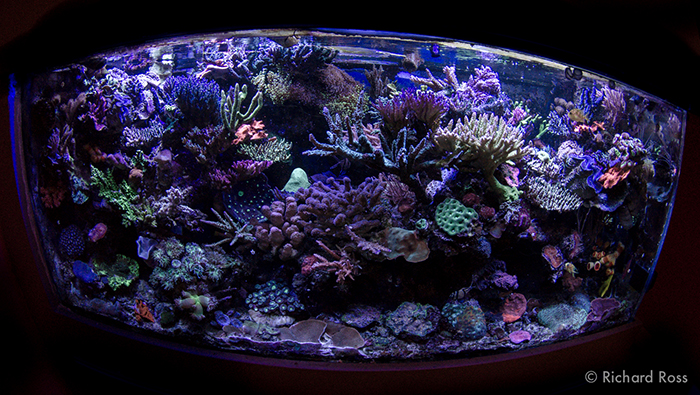
At the time of this photo, this tank had about 1 ppm phosphate and 50 ppm nitrate:


Rich’s 150 gallon display, on a 300 gallon system, is running a phosphate level of 1.24 ppm, a level at 24.8 times higher than the often recommended .05 ppm. Photo by Richard Ross.

1635941206521.png
 
Well this is confusing me even more. I am keeping higher nitrates and higher phosphates and my corals looks good and I am getting what seems like decent growth. The question is is there underlying problem that I am creating by dosing nitrates?
No. There's no evidence of concern.

At the time of this photo, this tank had about 1 ppm phosphate and 50 ppm nitrate:


Rich’s 150 gallon display, on a 300 gallon system, is running a phosphate level of 1.24 ppm, a level at 24.8 times higher than the often recommended .05 ppm. Photo by Richard Ross.

1635941206521.png
But I am not debating about the absolute level which is an consequence of feeding (introducing N and P in the food). By dosing Nitrate alone there are other competitors in the thank who has more advantage on the nitrate then the corals and introduce what they call "phosphate starvation" in the investigation (link above).....
 
But I am not debating about the absolute level which is an consequence of feeding (introducing N and P in the food). By dosing Nitrate alone there are other competitors in the thank who has more advantage on the nitrate then the corals and introduce what they call "phosphate starvation" in the investigation .....

If you are proposing not doing it, what bad outcome are you suggesting it causes?
 
I have a sps dominated tank for 5 years now (Kh steady) and I only lost a few colonies during the few months I started dosing nitrates in combination with a refugium and I am looking for some possible causes ..... bleaching occurs when phosphate levels decrease rapidly .... if you have a fuge and you dose nitrate, you boost the growth of the cheato. The availability of the phosphorus drops and there u go ..... you go in the part of HW Balling (quote picture above)
 
But I am not debating about the absolute level which is an consequence of feeding (introducing N and P in the food). By dosing Nitrate alone there are other competitors in the thank who has more advantage on the nitrate then the corals and introduce what they call "phosphate starvation" in the investigation (link above).....
I think I get what you are saying but the direct cause of the coral demise is a lack of available phosphate, not the nitrate dose itself.

Yes, dosing nitrate to a depleted system will almost always cause available PO4 to drop. That is a pretty well known association and certainly holds true in both my systems. That is why I always keep available PO4. If I was low on both, I would dose up PO4 first before dosing NO3. But it is more fun just to add another fish feeding cycle.

Lastly to the cause of "dosing nitrate to a depleted system will almost always cause available PO4 to drop", I always thought that was due to enhanced bacterial consumption. I don't have a fuge on my display, but the pattern still holds.
 
I think I get what you are saying but the direct cause of the coral demise is a lack of available phosphate, not the nitrate dose itself.

Yes, and it wouldn't be different if you dosed other forms of N, such as ammonia.

Seems like blaming a car for hitting a pothole. lol
 
Yes, and it wouldn't be different if you dosed other forms of N, such as ammonia.

Seems like blaming a car for hitting a pothole. lol
Randy are you aware of any research that supports my THEORY about why PO4 falls???

This theory: "dosing nitrate to a depleted system will almost always cause available PO4 to drop", I always thought that was due to enhanced bacterial consumption. I don't have a fuge on my display, but the pattern still holds."
 
Randy are you aware of any research that supports my THEORY about why PO4 falls???

This theory: "dosing nitrate to a depleted system will almost always cause available PO4 to drop", I always thought that was due to enhanced bacterial consumption. I don't have a fuge on my display, but the pattern still holds."

I certainly agree and expect that a tank with organisms whose growth is nitrogen limited (algae, corals, diatoms, etc.) will show an increased growth and uptake of phosphate when more N is added in some fashion. That's essentially what being nitrogen limited means, and even in the ocean, some algae are nitrogen limited and some are phosphate limited (and some may be iron limited).

Not all aquaria are nitrogen limited, but if nitrate is undetectable, they certainly may be, especially if there is detectable phosphate and sufficient trace elements.
 

IF YOU HAD TO TAKE A REEFING EXAM, WOULD YOU PASS?

  • Yes!

    Votes: 32 45.7%
  • Not yet, but I have one that I want to buy in mind!

    Votes: 9 12.9%
  • No.

    Votes: 26 37.1%
  • Other (please explain).

    Votes: 3 4.3%
Back
Top