OP
OP

Of course.
We have long talked about this but I will briefly describe the main elements of shooting an aquarium and then, if you like, we will go into them.
It is right that the most important element should exist between the viewfinder and neck.
Second in importance is the quality of the camera
I use Nikon D600, lens: nikon 105/f 2.8, 24-70/f 2.8 and 50/f 1.8
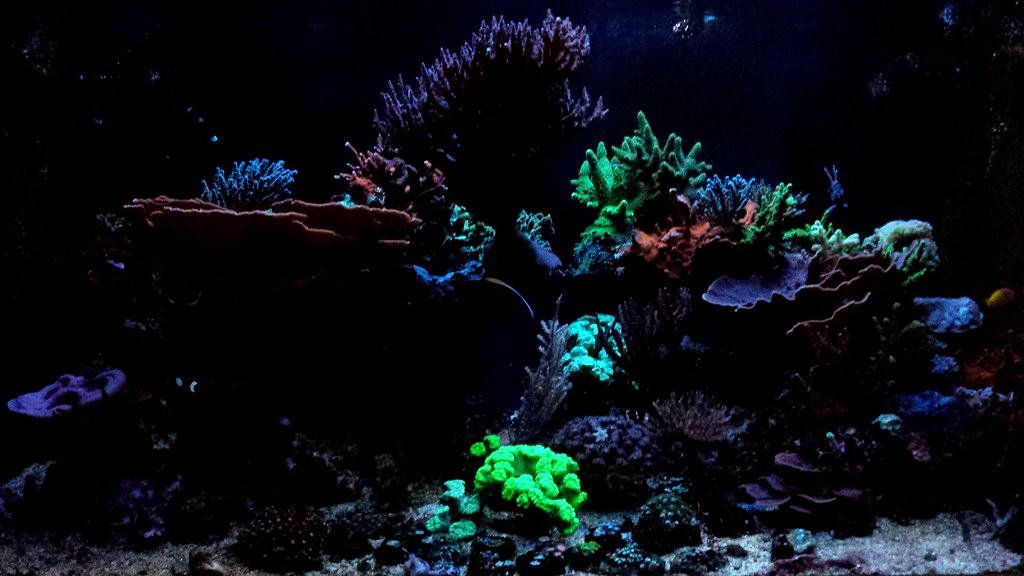
1. WB (white balance), white must be white, black....black. If properly adjusted this element, the colors of creatures will approach to what you see in the tank.
Unfortunately, depending on the type of light you have, rarely will be the colors exactly as we see in the ocean, exemple: if you have LEDs, royal blue and blue have a distinct ultra-fluorescent appearance less natural.
To corect WB I use a white plexiglass submerged in water and I tell to my camera: "My dear, that's white !"
(Read your camera's manual how to talk to her, not only for this reason but for in-depth understanding of its functioning)
2. Shoot perpendicular to the glass, avoiding distortions made by glass, if you have curved glass look for the flat part section.
Also you can use a viewing box made from acrilic for top down shots. I use a cilindrical tube box.
3. Use a remote shutter release to avoid touching the camera, low light + lens movement = blur
4. Use a tripod or a supporting point.
5. Find the best analogy between aperture, shutter speed, and ISO (noise ON/OFF, desired blur effect, depth of field effect, etc)`
If you have questions I will gladly answer them
We have long talked about this but I will briefly describe the main elements of shooting an aquarium and then, if you like, we will go into them.
It is right that the most important element should exist between the viewfinder and neck.
Second in importance is the quality of the camera
I use Nikon D600, lens: nikon 105/f 2.8, 24-70/f 2.8 and 50/f 1.8
1. WB (white balance), white must be white, black....black. If properly adjusted this element, the colors of creatures will approach to what you see in the tank.
Unfortunately, depending on the type of light you have, rarely will be the colors exactly as we see in the ocean, exemple: if you have LEDs, royal blue and blue have a distinct ultra-fluorescent appearance less natural.
To corect WB I use a white plexiglass submerged in water and I tell to my camera: "My dear, that's white !"
(Read your camera's manual how to talk to her, not only for this reason but for in-depth understanding of its functioning)
2. Shoot perpendicular to the glass, avoiding distortions made by glass, if you have curved glass look for the flat part section.
Also you can use a viewing box made from acrilic for top down shots. I use a cilindrical tube box.
3. Use a remote shutter release to avoid touching the camera, low light + lens movement = blur
4. Use a tripod or a supporting point.
5. Find the best analogy between aperture, shutter speed, and ISO (noise ON/OFF, desired blur effect, depth of field effect, etc)`
If you have questions I will gladly answer them