Spectral differences in white LEDs VS RGB

MoshJosh

2500 Club Member
View Badges
Joined
Jan 27, 2022
Messages
3,968
Reaction score
4,419
Location
Grand Junction
What state or country do you live in
Colorado
Rating - 100%
1   0   0
I am trying out an RGB light and it had me wondering. . .

You can tune a RGB light/fixture to look white, however, as far as I understand it, the light is still only producing light in the specific red green and blue wavelengths of the LEDs, none of the wavelengths in between (even if our eyes interpret them as a uniform white color). Is this correct?

If so how does that compare to a white LEDs? Are they producing a few specific wavelengths as well, or are they running the gamut of wavelengths. . .

Also, does it matter to corals? would producing light waves at 450-470nm be better than just 460nm

keep in mind I am not a rocket surgeon so I could be misunderstanding. . . like a lot

 
1686501572913.png
 
Thanks! Follow up question, using red and blue to make visible violet is not actually producing purple wavelengths of light right?

So 460nm + 660nm does NOT equally 400nm (purple). 460nm + 660nm equals 460nm and 660nm and the human eye sees purple????
 
I am trying out an RGB light and it had me wondering. . .

You can tune a RGB light/fixture to look white, however, as far as I understand it, the light is still only producing light in the specific red green and blue wavelengths of the LEDs, none of the wavelengths in between (even if our eyes interpret them as a uniform white color). Is this correct?

If so how does that compare to a white LEDs? Are they producing a few specific wavelengths as well, or are they running the gamut of wavelengths. . .

Also, does it matter to corals? would producing light waves at 450-470nm be better than just 460nm

keep in mind I am not a rocket surgeon so I could be misunderstanding. . . like a lot
So, for LED's specifically, to tell what wavelengths are being produced, you need to look at the individual diodes (LED = Light-Emitting Diode) in the light fixture. Whatever wavelengths those diodes produce are the wavelengths that the fixture can put out; so, yes, an RGB LED fixture would only be able to produce whatever wavelengths its diodes can put out no matter how the light looks to our eyes when we mix and match the lights.

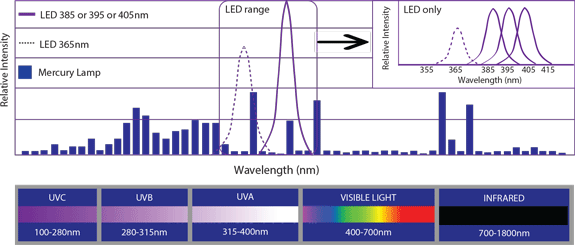
As mentioned in the other thread (quoted below), they don't just produce one wavelength, but a small window of wavelengths (so a 460nm diode may produce 445-475nm wavelengths, for example):
There's some variance in each individual diode of the LED (my understanding is that they typically have a variance of +/- 10 or 15nm, but in the yellow/green range can vary by up to +/- 35nm; so if you have a 395nm LED, the light produced would range from ~380-410nm), so if the light you're working with has multiple different wavelengths of diodes (say, five 395nm diodes and ten 465nm diodes), then each different diode will produce their own spread (so the 395 would spread as mentioned from ~380-410nm, and the 465 would spread from ~450-480nm).*

To quote from the first link below (this is basically just the fancy way of saying what I said above):
"The full width at half maximum (FWHM; bandwidth) of a typical quasi-monochromatic LED varies between 20 and 70 nanometers (see Figure 1),"

Just as a note, though, 400nm would be violet bordering on UV, not red light.

*Sources:
Specific wavelengths are more useful to things (such as corals) than other wavelengths, but that gets pretty complicated pretty fast when you start talking about which is better and which is not. For an oversimplification, see the quote below and note that corals generally don't like red light much, but they do like blue light and are okay with white light (speaking overly generally here, blue light is better for coral growth, white light is better for photosynthesis/oxygen production):
"The absorption peaks for the coral symbionts are in in the blue (440–480 nm range) due to chlorophyll a, chlorophyll c2 and carotenoids, and at 662 nm due to chlorophyll a (Halldal, 1968; Prézelin et al., 1976; Dustan, 1982; Kuhl et al., 1995; Levy et al., 2003; Hennige et al., 2009; Niedzwiedzki et al., 2014; Szabó et al., 2014; Wangpraseurt et al., 2014c). "*

*Source:
And a post by Dana Riddle that may help you in your decision:
Thanks! Follow up question, using red and blue to make visible violet is not actually producing purple wavelengths of light right?

So 460nm + 660nm does NOT equally 400nm (purple). 460nm + 660nm equals 460nm and 660nm and the human eye sees purple????
Correct, mixing red and blue producing diodes will not make the light produce violet wavelengths (though it may look violet to our eyes). The wavelengths produced will always be red and blue if that's what the diodes are made to produce.
 

IF YOU HAD TO TAKE A REEFING EXAM, WOULD YOU PASS?

  • Yes!

    Votes: 32 45.7%
  • Not yet, but I have one that I want to buy in mind!

    Votes: 9 12.9%
  • No.

    Votes: 26 37.1%
  • Other (please explain).

    Votes: 3 4.3%
Back
Top