SPS Light Acclimation with PAR meter

Ashish Patel

2500 Club Member
View Badges
Joined
Feb 9, 2017
Messages
3,302
Reaction score
2,618
Location
Marlboro NJ
Rating - 0%
0   0   0
I just feel there is not enough practical advice out for acclimating SPS corals to light; besides the gradual movement to its final spot in 2-4 weeks. This to me makes no sense because the PAR jump from 150 on the sand to 200-350 PAR on the rock (Plus I have to glue corals with my open aquascape).. I bet every hobbyist who bought their first SPS just put it in the final spot and hoped for the best - Or just let it sit on the sand because they where to tired to glue it after a long acclimation and dipping process (this would be me)..

I estimate that most healthy SPS come from at least 200 PAR so wouldn't this be a good starting point to start acclimating? If I start of lower range then I am just getting the coral used to lower PAR! I think Worldwidecorals acclimates their corals with a large rack and drops it down gradually overtime. I feel this method seems most effective - lower you go down the glass the more PAR!

So far I have the Seneye Par meter and I can honestly say I have not made good use of it in regards to acclimation. Any suggestions on this would be helpful?
 
Last edited:
50 par is a very small jump. Also it's time on the bottom is a rest period for the coral. It slows the metabolism is the common thought. Allowing time to acclimate to the tank chemistry.

Fwiw, I've regularly taken corals from the bottom of my tank and put it at the highest point of the tank with no problems save a few that were in very poor heath.

If your increasing intensity overall, pick one constant spot to test and increase in intensity slowly over several weeks. 50 or so.

But yeas you are also correct imo. As many old school guys took acros right off the boat and blasted them with MH with great results.

So it's quite possible we today are a bit too carful. And/or quite often never know how much light a coral came form before we got it. (Unless you take a lux meter to the lfs like I do. )
 
For frags not under LED, I just put them where I want them. They are always fine, but I don't try and put a deepwater right under a MH at 550 PAR, nor do I put a high-light acro 24" deep off to the side - it helps to know about what kinds might want what level of light. They usually are encrusting nicely in 10-14 days and the color never gets worse.

I try and avoid LED frags if they need to be shipped, but if I get some, I let them sit in a frag rack for about a month while slowly moving them from the top to the middle of the front glass (top is off to the side at about 125 PAR and middle is about 375 where more light hits them). They nearly never encrust in this time. If I am more aggressive, they bleach out. They need babied quite a bit.

Keep in mind that the type of par meter and type of light will be different. On older PAR meters (non Apogee 510), Flourescent and MH will be 10-20 higher output than LED since the PAR meter won't get low enough to measure the blue, purple and UV output. Apogee 510 does get a bit more of this spectrum, but still not as much of it as 450-700.

I know that nobody wants to hear this, but light quality is not the same from any different source, bulb or tube. Please use PAR as a factor, but not the end-game for decisions.
 
One neat idea is to take a very small magnetic frag rack and stick it on the front glass. You put the frag in the rack and slowly move it up the front glass until the light is about the same as were it is going. Then you can just glue it in place.

I use the glue and hope method, but I might try this in the future.

Whiskey
 
One neat idea is to take a very small magnetic frag rack and stick it on the front glass. You put the frag in the rack and slowly move it up the front glass until the light is about the same as were it is going. Then you can just glue it in place.

I use the glue and hope method, but I might try this in the future.

Whiskey

Yeah I m gonna do this next time with eggcrate and some plastic chains.. starting on the bottom has more light than top so going from top to bottom makes more sense.
will start of at 200 adjust until its close enough to final spot of majority of corals.
 
50 par is a very small jump. Also it's time on the bottom is a rest period for the coral. It slows the metabolism is the common thought. Allowing time to acclimate to the tank chemistry.

Fwiw, I've regularly taken corals from the bottom of my tank and put it at the highest point of the tank with no problems save a few that were in very poor heath.

If your increasing intensity overall, pick one constant spot to test and increase in intensity slowly over several weeks. 50 or so.

But yeas you are also correct imo. As many old school guys took acros right off the boat and blasted them with MH with great results.

So it's quite possible we today are a bit too carful. And/or quite often never know how much light a coral came form before we got it. (Unless you take a lux meter to the lfs like I do. )


I know.. I've been pretty lucky with having them adjust to the tank sitting on the sand then moving to their final place. Granted I know the PAR is not over 250 so I am not overly concerned with bleaching. However, I know if we spend more time acclimating this will reduce stress and likely increase the growth and survival. Who knows sometimes coral just crap out after few months for no reasons, could be the acclimation to light when all other things are stable.
 
I know.. I've been pretty lucky with having them adjust to the tank sitting on the sand then moving to their final place. Granted I know the PAR is not over 250 so I am not overly concerned with bleaching. However, I know if we spend more time acclimating this will reduce stress and likely increase the growth and survival. Who knows sometimes coral just crap out after few months for no reasons, could be the acclimation to light when all other things are stable.
Yea sometimes the just plain crap out.

I've been experimenting with placement a lot lately with my accidental frags. Very few show much difference in placement. I see more differences in growth and color from tank to tank however. Honestly now I just pull the piece and toss it in the other tank. Science!

That's spectrum baby!
 
Yeah I m gonna do this next time with eggcrate and some plastic chains.. starting on the bottom has more light than top so going from top to bottom makes more sense.
will start of at 200 adjust until its close enough to final spot of majority of corals.

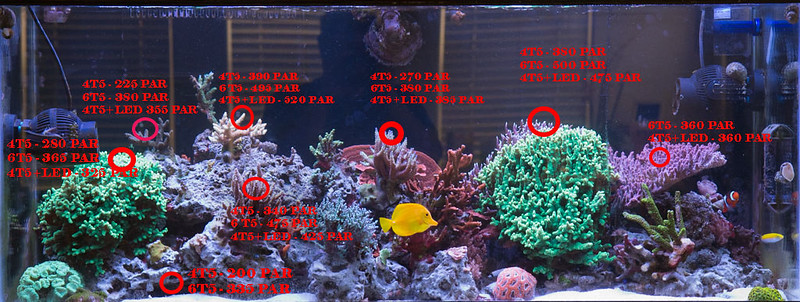
That's bizarre. My tank has much more light at the top than at the bottom. Do you use LED fixtures that have all the LED's clustered in the middle of the tank? That's the only thing I can think of that would cause that.

Here's an idea of my PAR:
PAR-READINGSLEDT56T5 by Wiskey2727, on Flickr

This is showing by the corals, but at the glass yields similar results.

Whiskey
 
That's bizarre. My tank has much more light at the top than at the bottom. Do you use LED fixtures that have all the LED's clustered in the middle of the tank? That's the only thing I can think of that would cause that.

Here's an idea of my PAR:
PAR-READINGSLEDT56T5 by Wiskey2727, on Flickr

This is showing by the corals, but at the glass yields similar results.

Whiskey
With a lot of smaller leds , kessil, radion etc with lenses , the beam doesn't hit the sides the way most folks mount them. Very different than a big MH reflector and t5.
"Spotlighting"
So a few inches from the center of the beam at the top of the water it's possible to have basically no light.

It's why I generally reccomend to aim for the top of the tank and not the bottom.
 
Even under my MH, the top has very little... now 6" down, it goes up quite a bit. Even in half way down it only hits about 375 whereas I get near 500 in the middle of the tank.

I always start near the top and lower them.
 
Even under my MH, the top has very little... now 6" down, it goes up quite a bit. Even in half way down it only hits about 375 whereas I get near 500 in the middle of the tank.

I always start near the top and lower them.
Yea I have MH pendant that's like a death ray. Huge hot spot in the middle.

What kind is yours?
 
Yea sometimes the just plain crap out.

I've been experimenting with placement a lot lately with my accidental frags. Very few show much difference in placement. I see more differences in growth and color from tank to tank however. Honestly now I just pull the piece and toss it in the other tank. Science!

That's spectrum baby!
That's bizarre. My tank has much more light at the top than at the bottom. Do you use LED fixtures that have all the LED's clustered in the middle of the tank? That's the only thing I can think of that would cause that.

Here's an idea of my PAR:
PAR-READINGSLEDT56T5 by Wiskey2727, on Flickr

This is showing by the corals, but at the glass yields similar results.

Whiskey


Thanks for your chart, this helps.
this is an older picture but you get the point with spread. I noticed the seaswirl was blocking a lot of light in below picture configuration so I've moved the left side fixture going side to side. The PAR on the Gen4s are very good Its pretty consistent but since they go strait down you'll get dark spots on the top of the cone.

20170716_144416.jpg
 
This gives you an idea of the side profile... the Par towards the top is much less then 12" down so ideally I would assume starting from the top and working your way down would yield good results? The position of the coral in regard to light is also importan I try and orientation to the light source. Pretty easy when they are dark and brown on the under side but assuming this is also a factor. If you give the dark side any PAR when its used to maybe Par of 50 chances are you bleach it.

Screenshot_2017-05-30-13-48-45.png
 

IF YOU HAD TO TAKE A REEFING EXAM, WOULD YOU PASS?

  • Yes!

    Votes: 32 45.7%
  • Not yet, but I have one that I want to buy in mind!

    Votes: 9 12.9%
  • No.

    Votes: 26 37.1%
  • Other (please explain).

    Votes: 3 4.3%
Back
Top