Navigation
Install the app
How to install the app on iOS
Follow along with the video below to see how to install our site as a web app on your home screen.
Note: This feature may not be available in some browsers.
More options
You are using an out of date browser. It may not display this or other websites correctly.
You should upgrade or use an alternative browser.
You should upgrade or use an alternative browser.
SPS Question
- Thread starter Insane320
- Start date
- Tagged users None



Most likely it's low light or low flow unless some major change in your phosphate.
OP
OP

I know it is not a flow problem, Lighting is Orphek. Looks like it is getting eaten slowly over 1 month.Most likely it's low light or low flow unless some major change in your phosphate.


Need parameters...
SG, alk, calcium, mag, nitrates, Phosphates. Have any fish or inverts died lately? Could be a million things and nobody will be able to tell just by looking at a picture of skeleton.
SG, alk, calcium, mag, nitrates, Phosphates. Have any fish or inverts died lately? Could be a million things and nobody will be able to tell just by looking at a picture of skeleton.
OP
OP
Ok, I agree just checking to see if it was a bug. I will post some stats tomorrow.Need parameters...
SG, alk, calcium, mag, nitrates, Phosphates. Have any fish or inverts died lately? Could be a million things and nobody will be able to tell just by looking at a picture of skeleton.

That’s totally normal. All corals will recede from the base up as the upper branches grow and shadow out the base. Happens to every big colony I have ever had. Shouldn’t be anything to worry about.

OP
OP
Thank you, scared meThat’s totally normal. All corals will recede from the base up as the upper branches grow and shadow out the base. Happens to every big colony I have ever had. Shouldn’t be anything to worry about.
Thank you, scared me
I actually disagree. Plenty of light should be making it to the base of that coral considering it isn't even a table. Even tabling acros don't always die off at that base until they are HUGE. This type of death could easily be parameters or metal contamination.


Death on the bottom is not normal. This is mostly from point-source or single directional lights... used to happen with small/no-reflector MH, but happens more now with LEDs shining one way only. T5s can help and this is a reason why people use them. This can also happen from pests - are you totally sure that you do not have any AEFW?
I have never had this happen and all of my colonies have live tissue even on the bottom. Something is causing this and I would look for the solution.
I have never had this happen and all of my colonies have live tissue even on the bottom. Something is causing this and I would look for the solution.

My opinion is that stark white base that has developed rapidly is likely a low Alk event or lack of flow. I agree that large colonies can and will have visible dead skeleton underneath but in this instance the “stark” white is what’s telling me that is not the case here. I have had large colonies in the past that will gradually get paler and paler underneath as the structure slowly shades it completely, with a result that is very much whitish tissue, but his happens over time and the “white” slowly fades to coralline as the tissue finally recedes away. I have a frisbee size colony doing this now and the underside slowly regresses, but certainly does not have a “patch” of stark white. @Softhammer ’s pic is typical of what will happen with a larger colony, but also different in the sense that @Insane320 ‘s does not show enough coverage to have totally shaded it, along with the obviously rapid progression otherwise there would be secondary life/coralline on the skeleton.
My thought is low Alk that may have already been corrected, or something nearby stinging it (at night), or low flow.
I will try to take some pics of my examples for comparison sake.
Hope that helps,
Ed
My thought is low Alk that may have already been corrected, or something nearby stinging it (at night), or low flow.
I will try to take some pics of my examples for comparison sake.
Hope that helps,
Ed

In my experience rapid recession from the base that is not actual RTN and also not attributable to stinging has almost always been a low Alk event.
Thanks,
Ed
Acro ed I agree completely with you. I also have a hard time hearing the expert advice from folks preaching gospel with their largest coral being 2 inches. That isn’t a reef. I have dove many real reefs with 20 foot acroporas. The bases die. That’s what makes a reef.
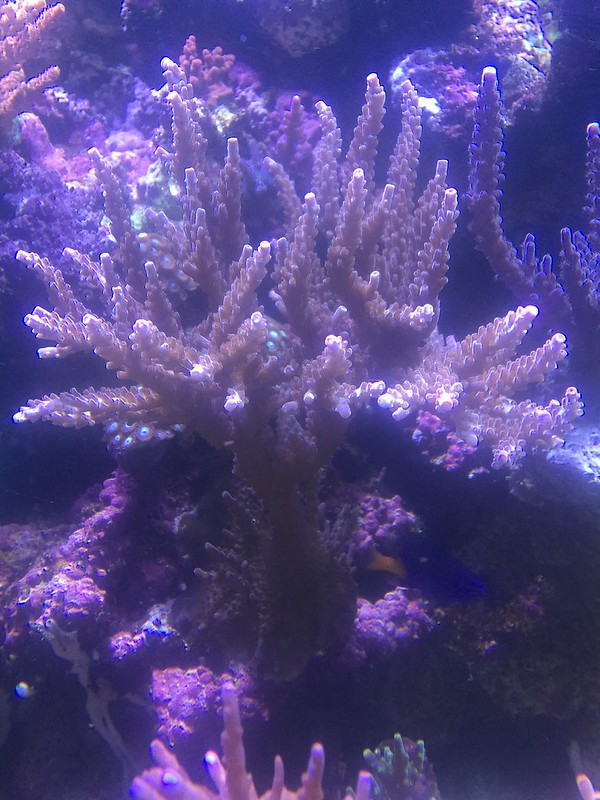
This is not huge at 10x12 inches, and probably small for some of you, but this is how bases should look. I tried to pick a stag since the OP showed a stag.


- Joined
- Aug 27, 2017
- Messages
- 1,106
- Reaction score
- 1,465
Where are you diving????17 years of experience and over 300 dives in most major real coral reefs tells me otherwise.

Sorry, but that comment is outrageous.. Definitely not "normal" in anyway whatsoever, especially comparing to natural reefs.
Relax.Acro ed I agree completely with you. I also have a hard time hearing the expert advice from folks preaching gospel with their largest coral being 2 inches. That isn’t a reef. I have dove many real reefs with 20 foot acroporas. The bases die. That’s what makes a reef.
The picture that the OP posted is a colony that is NOWHERE NEAR large enough or dense enough to cause the base to die due to lack of light. I'm glad you have tons of years diving... congrats. That has nothing to do with the situation that the OP has. The fact that the die off is that white and that large means that it happened faster than algae could inhabit and discolor it. This is NOT a shading issue. There are tanks with large tabling acros that completely shade themselves but still have tissue all the way to the base. It's not even a debate.