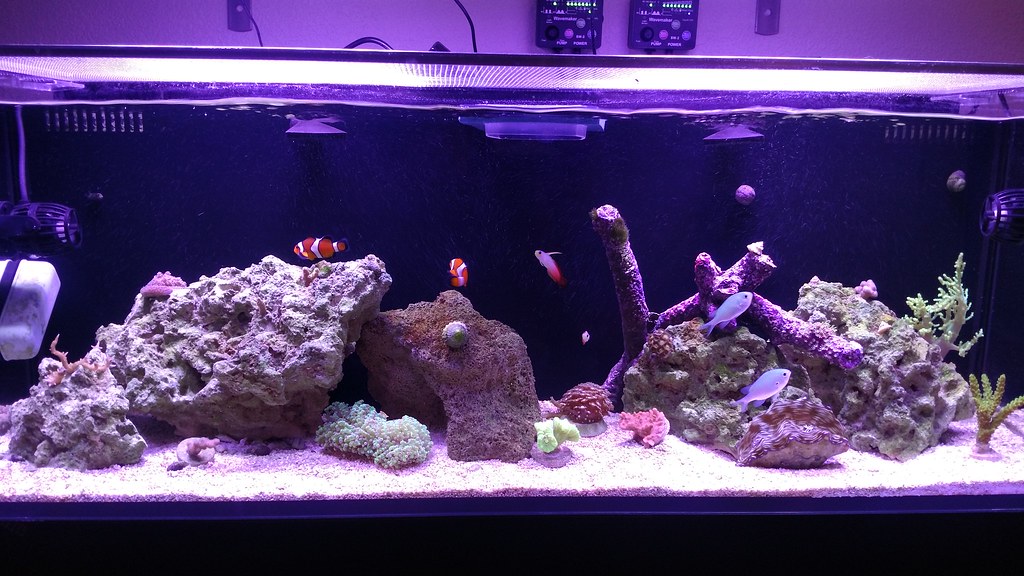
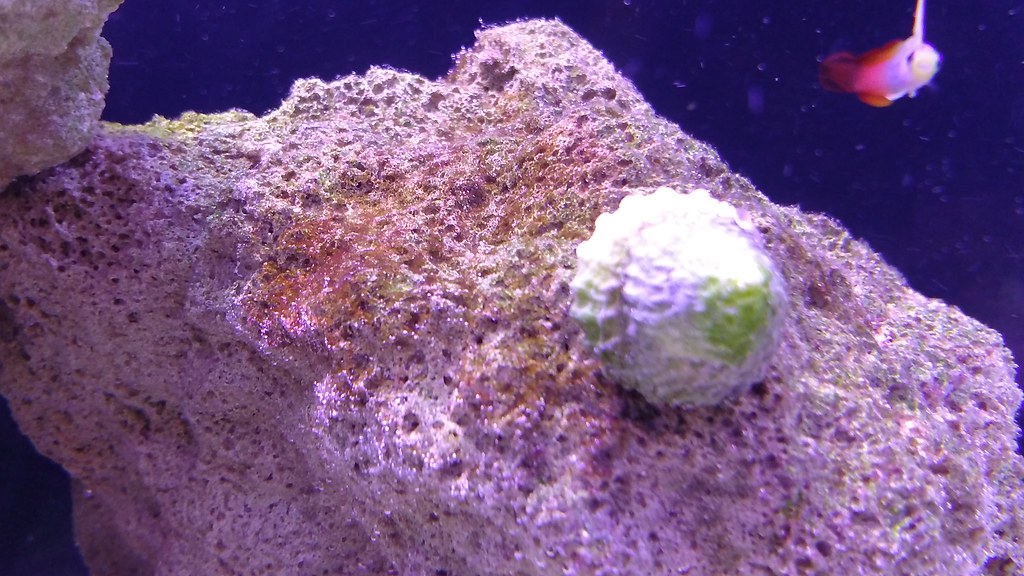
Stringy brown diatoms. How to remove silicates without removing po4

I
The best products I use for my RO/DI system are the GE RO Save.Z 1-micron sediment filter from BRS. It lasts twice as long as cheaper filters and with minimal pressure drops.

The carbon block is the Matrikx CTO Plus carbon block at 0.6-microns. BRS also sells a universal block if you have chloramines.

Then I finish it off with a Spectrapure High Capacity Silicabuster DI cartridge from Marine Depot. It removes all Silicates, Phosphates and Nitrates from RO water.

Just some helpful items I know work great. Because with 50 tds from the tap, which is low, you shouldn't even be close to anything above zero after the DI. If your membrane got dried out or tainted with chlorine or chloramines, it will ruin it.

Also, and I was reading about this a few days ago, most all salt mixes use silicates. I found a chart that listed 10 different brands and had all of the major elements listed for each salt, not just the major 3, and whether it was low, equivalent, high, or really high in comparison to what it should be, including Nitrogen and Phosphates. I can't find it, but Silicates could also be coming from the salt mix

+1, I just have a couple extra on this one because I'm paranoid. I use the same brands, the mentioned chloramine specific, and BRS color changing resin prior to the silicabuster to take out as much as possible so the silicabuster lasts longer.
 
FWIW, I also switched to a salt known to not have Si. Aquaforest probiotic reef salt. I actually really like it and I'm going to stick with it as to not change things up.
 
The best products I use for my RO/DI system are the GE RO Save.Z 1-micron sediment filter from BRS. It lasts twice as long as cheaper filters and with minimal pressure drops.

The carbon block is the Matrikx CTO Plus carbon block at 0.6-microns. BRS also sells a universal block if you have chloramines.

Then I finish it off with a Spectrapure High Capacity Silicabuster DI cartridge from Marine Depot. It removes all Silicates, Phosphates and Nitrates from RO water.

Just some helpful items I know work great. Because with 50 tds from the tap, which is low, you shouldn't even be close to anything above zero after the DI. If your membrane got dried out or tainted with chlorine or chloramines, it will ruin it.

Also, and I was reading about this a few days ago, most all salt mixes use silicates. I found a chart that listed 10 different brands and had all of the major elements listed for each salt, not just the major 3, and whether it was low, equivalent, high, or really high in comparison to what it should be, including Nitrogen and Phosphates. I can't find it, but Silicates could also be coming from the salt mix

RO membranes are 2 dow filmtec 75gpd piggybacked and brand new (3 months old)

I'm going to piggyback another di and see if that helps
 
RO membranes are 2 dow filmtec 75gpd piggybacked and brand new (3 months old)

I'm going to piggyback another di and see if that helps
Get the silicabuster from spectrapure. Put that after your Current DI.

You can get a cheap pressure gauge if you don't have one. Should be 90 psi or more for good rejection. You might need a booster. Do you flush the membrane regularly?

Piggy backing doesn't necessarily work any better if you don't have the system just right. You might as well run them in parallel at that point. All depends on the system. Adam at @Battlecorals educated someone on this which is where I learned it.
 
Piggy backing doesn't necessarily work any better if you don't have the system just right. You might as well run them in parallel at that point. All depends on the system. Adam at @Battlecorals educated someone on this which is where I learned it.

I can't imagine a scenario where running two DI in parallel makes sense. I think it way better to run them in series.
 
RO membranes are 2 dow filmtec 75gpd piggybacked and brand new (3 months old)

I'm going to piggyback another di and see if that helps

You might measure to see if there is much silicate in the effluent, but two DI is series is a good plan. Replace the first one when depleted, and swap the second one into its place.
 
You might measure to see if there is much silicate in the effluent, but two DI is series is a good plan. Replace the first one when depleted, and swap the second one into its place.
It depends on the restrictor in the system that effects their behavior.
 
RO membranes are 2 dow filmtec 75gpd piggybacked and brand new (3 months old)

I'm going to piggyback another di and see if that helps

Do you have a flow restrictor installed? Because I have 50-75 tds from the tap as well, and after the membrane, when I'm flushing it with the restrictor opened up, it's 4 tds. Once I turn the flow restrictor back on, forcing the water through the membrane, it lowers to 1-2 tds exiting the membrane. So the DI only has to deal with 1-2 tds and comes out at zero. But I also use a single 150gpd membrane instead of the 2 piggybacked 75 membranes. That first membrane is sending super concentrated tds to the 2nd membrane, making flushing more important. It saves water, but is tougher to get cleaner water from the 2nd membrane.

You shouldn't even need a second DI canister at all with tds that low. Something along the setup isn't right.

Whether you don't have a FLOW RESTRICTOR for 75gpd, Glycerin Filled Pressure Gauge right before the membrane, or aren't flushing the membrane enough. Does your area use chlorine or chloramines? Because those are 2 different carbon blocks. You need the pressure gauge to know how many psi you have going into the membrane and it also lets you know when your filters start to clog up by showing a pressure drop. If your pressure is too low the water won't go through the membranes, it'll go around them.

This VALVE is great to flush your membrane. You just cut the product water line exiting out of the membrane in the middle and you add your product water line to the input side and the other clipped end that goes to the DI on one output side of the valve. The other side you put another piece of tubing and connect it to your waste water line that goes to the drain with this 2 Input to 1 Output Adapter. It's actually a divider, but you use it backwards for this purpose.

So before you use the unit, you turn the valve to the waste water side so all water from the membrane, both waste & product, goes down the drain. Leave the flow restrictor opened so water just freely passes over it. This eliminates tds creep. Because even though you have 50 from the tap, tds will be over 100 inside the membrane canister because the tds leeches out of the membrane when it sits. So you need to flush that out before making water or you're sending 100+ tds to the DI. Flushing extends the life of the membrane by almost double and saves you a lot in DI resin.

You should also have this TDS Monitor so you know when the tds is all flushed out and can start making water. It may have come with your unit, but if it didn't, it's pretty necessary.

They sell a KIT with the restrictor, glycerin gauge, and inline tds meter. All the things I linked to above, minus the 3-way valve.

If you use these items and the other filters I linked to, you don't need a second DI unit. That's more money over time and more maintenance. Also, using 1 membrane, usually 100gpd based on your water pressure, is a better way to go then dual stacked membranes, imo.
 
I already have the flush unit. But had read you only need to do it once every few months. I replaced the di with fresh resin and back to 4ppm lol. Starting to think my meter is off by 4. Too much of a coincidence.
 
It depends on the restrictor in the system that effects their behavior.

With two 75gpd membranes, that water saver setup, you still use only a 75gpd restrictor. Personally, I don't care for piggybacked membranes because you're taking all of the high tds waste water and sending it through the 2nd membrane. That makes it more difficult for that membrane to filter the water properly. So you save some water, but are sending high tds water to the DI.
 
With two 75gpd membranes, that water saver setup, you still use only a 75gpd restrictor. Personally, I don't care for piggybacked membranes because you're taking all of the high tds waste water and sending it through the 2nd membrane. That makes it more difficult for that membrane to filter the water properly. So you save some water, but are sending high tds water to the DI.

I used to think that way but after watching the video on brsTV i was sold. People succeeded with tap water for couple decades before all this so I don't really think the few tds could make that much of a difference o_O maybe? idk I guess time will tell.

 
I used to think that way but after watching the video on brsTV i was sold. People succeeded with tap water for couple decades before all this so I don't really think the few tds could make that much of a difference o_O maybe? idk I guess time will tell.

Absolutely! My first salt tank was a 72 bow and used just tap with stress coat and never had algae issues. But that was 20 years ago. Now, in my area, the municipalities are getting in trouble for dumping chemicals on county property and it seeped into peoples' water. So I do it mainly for that. But if you're running an RODI system, the point is to remove the impurities because you don't know what's in the tds. And that could be fueling the algae. To each his own ;)
 
I already have the flush unit. But had read you only need to do it once every few months. I replaced the di with fresh resin and back to 4ppm lol. Starting to think my meter is off by 4. Too much of a coincidence.

No, you're actually supposed to flush before and after every use. Definitely before though. Don't know where you read every few months, but that's off by a mile. Did you calibrate the tds meter? Because they rarely come properly calibrated, especially the $15 ones. I started with that version and it would give me a different reading every time with the calibration fluid.
 
No, you're actually supposed to flush before and after every use. Definitely before though. Don't know where you read every few months, but that's off by a mile. Did you calibrate the tds meter? Because they rarely come properly calibrated, especially the $15 ones. I started with that version and it would give me a different reading every time with the calibration fluid.

;ShamefullyembarrasedI bought the $6 cheap yellow one lol no way to calibrate. I drop tons of money into these things and sometime SOMETIMES the cheapo inside me takes root lol
 
BEFORE 2 days of UV, 100 micron pads changed every 3-4 hours, wet skimming

After only 2 days and nights- water is crystal clear! Only some slight shading on sand in lower flow areas (one of my pumps is in warranty service) plus 2 threads I pulled out.
35394645364_ea67c30ccc_b.jpg


36062469302_55601652b1_b.jpg


35394644694_d157e528ca_b.jpg
 
and no water changes for 14 days. Going to go another month and a half with that and uv
 
Many will tell you that UV will have no effect. I can tell you they are wrong if you have a strain that goes into the water column at night. Mine was 95% gone the morning after UV and 100% gone within 72 hours. I've also done a 20% water change and dosed aminos to challenge the dinos as these two things seem to bring them back, but there wasn't even a hint of them coming back.

Here's my thread: https://www.reef2reef.com/threads/i...gellates-overnight.316126/page-3#post-3906415
What amino have you used? I've never heard of that method
 

IF YOU HAD TO TAKE A REEFING EXAM, WOULD YOU PASS?

  • Yes!

    Votes: 32 45.7%
  • Not yet, but I have one that I want to buy in mind!

    Votes: 9 12.9%
  • No.

    Votes: 26 37.1%
  • Other (please explain).

    Votes: 3 4.3%
Back
Top