Test if it is possible to explain the know ORP reduction when adding H2O2 into a saltwater

  • Thread starter Thread starter Lasse
  • Start date Start date
  • Tagged users None
hey @Lasse what happens if you add a couple of drops of tank conditioner/dechlorinator (thiosulphate) ?
It ought to drop ORP a large amount (it does in my tank) and be pretty independent of probe surface effects (I think) . Might be another check of water mixing and confirmation of Probe response. Meaning, how long does it take for the probes to semi-agree that the tank water has dropped in ORP by a certain amount?

 
Good move on copper addition. How about Fe (II)?
good idea. now for the dumb Qs. What source/ method can I ensure the Fe added is Fe(II) and not Fe(III)? I have an additive - brightwell ferrion - that is Fe+ edta ("sodium feredetate"), also some FeNO3 solution, and I think I have fergon tablets I could dissolve.
 
Lasse this is really good work.

my interpretation of your last round of data - Probe D (for dud) is not measuring anything.

Probe A and C are really showing out. I did not fully appreciate that you were seeing a drop of multiple hundreds of mv with h2o2 addition.


Probe A and C together make a really good case that the ORP moves with h2o2 that are seen in a tank are hyper-local effects between water chemistry and the Probe surface itself.
The feeding: at first glance looks like the new probe is super sensitive to the feeding and the old one barely cares - but If you think about the timing and location, the discrepancy shrinks. Probe C sees ORP drops with feeding of ~100mv, but the recovery is fast, maybe 80% recovered in 20 min. Given where the feeding happens and the mixing between sump and display, probe A and C are probably both accurately reflecting the effect of the feeding at their locations in the tank. You can see this in that the long term cumulative effect of the feeding from 10:00 to 18:00 is a drop of ~40mV and both probes A & C show this.


Nice demonstration. Probe B is waking up perhaps.

I wonder if probe C and A together are telling us that the h2o2 indeed causes substances measured by ORP to be chemically reduced in the water, but that over time "conditioning" of the probe accumulates these reducible substances to higher concentration on the probes themselves. But again, that idea implies that there is some cleaning/dissolving routine that could be done to an old probe to make it act like a new one - much less responsive to h2o2.
How do we eliminate the possibility of interaction between the probes?
 
good idea. now for the dumb Qs. What source/ method can I ensure the Fe added is Fe(II) and not Fe(III)? I have an additive - brightwell ferrion - that is Fe+ edta ("sodium feredetate"), also some FeNO3 solution, and I think I have fergon tablets I could dissolve.
I would go with the label as the first level of identification. Fe(III) salts can be quite insoluble.

Check out Fenton chemistry
 
How do we eliminate the possibility of interaction between the probes?
A and D in the sump - 5 cm apart and connected to computer 1. B and C - tight together in the display and connected to computer 2. i really doubt that interference between A and C can happens - if we not have come into quantum mechanics :D

Sincerely Lasse
 
hey @Lasse what happens if you add a couple of drops of tank conditioner/dechlorinator (thiosulphate) ?
It ought to drop ORP a large amount (it does in my tank) and be pretty independent of probe surface effects (I think) . Might be another check of water mixing and confirmation of Probe response. Meaning, how long does it take for the probes to semi-agree that the tank water has dropped in ORP by a certain amount?
Maybe further on but for the moment - I have a plan :p

By the way - probe D may be defect - we will see.

Sincerely Lasse
 
A and D in the sump - 5 cm apart and connected to computer 1. B and C - tight together in the display and connected to computer 2. i really doubt that interference between A and C can happens - if we not have come into quantum mechanics :D

Sincerely Lasse
Yes...Quantum entanglement...I have suspected it all along...
 
A and D in the sump - 5 cm apart and connected to computer 1. B and C - tight together in the display and connected to computer 2. i really doubt that interference between A and C can happens - if we not have come into quantum mechanics :D

Sincerely Lasse
I mention it because I came across but did not study further the problem of multi-probe interference. So, I don’t know if it is physical or electronic in nature. I‘ll go do some reading.
 
The B probe start to adapt itself :p Redmarking shows the effects when automatically rinse my container for the zooplankton feed,

1629668150496.png


Sincerely Lasse
 
The B probe start to adapt itself :p Redmarking shows the effects when automatically rinse my container for the zooplankton feed,

1629668150496.png


Sincerely Lasse
I have a question concerning biofilms formation and equilibrating ORP probes.

Could you avoid biofilm formation but still equilibrate an ORP probe in aquarium water by storing the probe in heat sterilized tank water, even just bringing the water to boiling point and cooling it?

I am also thinking about enhancing biofilm growth to magnify the effect without waiting a month. Storing the probe in a sample of aquarium water in the dark that is dosed with fish food.
I´m not sure yet that it is a biofilm response even if it looks like age of use is important. It could be a question of adaption between external and internal fluids. The C probe comes from the bucket with old aquarium water.

There is one very important thing to say about redox probes. When it was developed many years ago - it was because people want to know if there was an aerobic or anaerobic process taking place in sediment. It was never meant to be used in free water. However - with time - it was discovered that it was very helpful to use in open water if you want to manage highly oxidizing things like bleach and ozone in water treatment. If you have 1000 oranges and one peach in a basket - you can use the round form in order to count the content in the basket - at least between the thumb and index finger so to say.

But - if it is a biofilm reaction - it can be very useful tool - in order to understand the realizationship between anaerobic and aerobic action in most biofilms in the aquarium - IMO

Sincerely Lasse
 
My old Redox probe - biofilm ..... he he he he. Its a living system:D

1629735072458.png

​
It is cleaned with a toothbrush now - not sterilized. That will be next step

Sincerely Lasse
 
Last edited:
Do you think the ORP probe can detect changes in the ratio of transition metal oxidation states at the ppb level? I would say lack of sensitivity and stability of the ORP probe is an even stronger case against a transition metal effect.

That speculation doesn't seem to reflect what is known, IMO.

According to Pankow in "Aquatic Chemsitry Concepts", page 499:

"In natural waters, the group of elements that can play a controlling (his italics) role in determining the redox conditions is rather small. This group includes carbon, oxygen, hydrogen, nitrogen, iron, sulfur, and manganese."
 
*raises hand* Everyone but me observes the dip in tank water. My tank water ORP goes up with an h2o2 dose. Part of my interest in the mechanism is that it doesn't happen in my tank water, and I couldn't get it to happen.
More interestingly, the effect in my tank water is variable:

It would be nice to know if that reflects the chemistry of your tank, the chemistry of your peroxide solution, or soem aspect of the measurement device.
 
It is measuring in mV and 1 mV is probably equal to x transitions as I can understand. What x is - no idea.

Sincerely Lasse

The mv reading is not an indication of the number of transitions happening at all. It is a measure of the driving force for those transitions. The driving force is determined by the chemical nature of the redox halves, and the relative (not absolute) concentrations.
 
The redox went down when I put it back but it is climbing again . No erratic climb just a steady and slow climb.

I will test H2O2 addition when it has stabilize itself.

The mv reading is not an indication of the number of transitions happening at all. It is a measure of the driving force for those transitions. The driving force is determined by the chemical nature of the redox halves, and the relative (not absolute) concentrations.
OK - but is it not that way that the driving force is in one or another way proportionally to the amount of transitions? Higher potential differences more transitions or the other way around?

Sincerely Lasse
 
1629737120499.png


This is a rather normal way how my redox probes reacts - a change -> fast reaction; back in normal situations -> a slow recovery.

Sincerely lasse
 
@Randy Holmes-Farley I want to sterilize my probe in order to know if it is a biofilm reaction or not. But if I use a liquid to this (eg. ethanol) I maybe change the equilibrium between the internal fluid and the environment and can´t be sure that (if it react as the new probes) if it because of no biofilm or change in the equilibrium. Do you now a "dry" way to sterilize the probe?

Sincerely Lasse
 
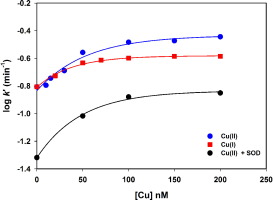
I still think it likely that the hydrogen peroxide-induced drops and rises relate to variable effects on trace metals, and haven't seen an experiment that shows otherwise.

This article details the complexity, and also the fact that H2O2 oxidizes iron and reduces copper in seawater, and the effect on ORP may relate to the concentrations and speciation of these (and maybe other) trace metals before the peroxide is added.


IF YOU HAD TO TAKE A REEFING EXAM, WOULD YOU PASS?

  • Yes!

    Votes: 30 44.8%
  • Not yet, but I have one that I want to buy in mind!

    Votes: 9 13.4%
  • No.

    Votes: 25 37.3%
  • Other (please explain).

    Votes: 3 4.5%
Back
Top