Here's some data which anyone is free to disregard as unreliable noise. My tank water is anomalous in the hobby with regards to h2o2. I put the probe in, and h2o2
increases ORP of my tank water (almost always - one time it did not). The ORP rose whether I put the probe in scrubbed and new or left it in for weeks.
here's my tank water (1L, glass beaker, stirrer) 0.1mL h2O2 added at 7.5 min.
Here's two metals additions to my tank water. Red line is an hour after recommended dose of Seachem Reef Trace (contains a bunch of things except Fe). Tan yellow Line is same but with brightwell Ferrion (Fe edta). Neither seems to dramatically change the ORP response.
0.1mL H2O2 in 1L, added at ~7 min, (and a 2nd again at ~15min that had no additional effect)
here's ingredients for Reef Trace
Then, attempting to flip the ORP effect and make h2o2 lower it, I took my tank water and added some CuCl2 solution. I estimate the final concentration was 5uM CuCl2 (~0.3ppm Cu maybe.)
After ORP stabilized, I added 0.1mL H2O2 to the L water at 14 min. The ORP inrease was significantly blunted.
...so tripled the amount of CuCl2 solution in the next L of tank water (~0.9ppm Cu)
The addition of h2o2 at ~6min caused the ORP to drop.
I'm not sure this illuminates much if we already knew that copper in seawater would be reduced by h2o2. My water is weird compared to the hobby, its ORP
increases upon h2o2 addition, and to reverse that I had to add what I think is a huge amount of Cu.
Where this might lend support for the idea that various metals concentrations in tank water are determining the ORP response to h2o2, is if an ICP test shows my water has a high level of some metal(s) known to be oxidized by h2o2. And then that might both explain why my water doesn't do what the rest of the hobby does, and why I had to add so much Cu to cause the h2o2 effect to flip.





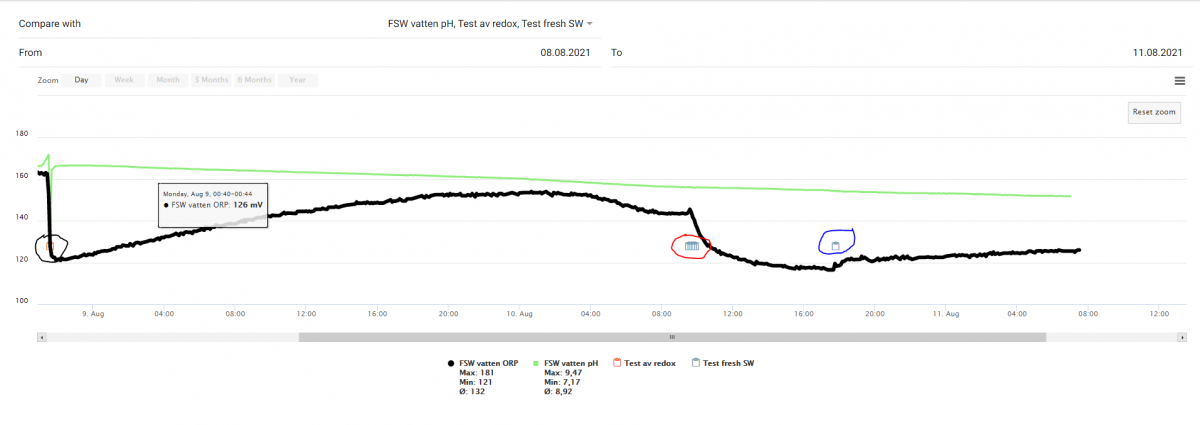








 I also add 5 ml to my 310 L aquarium (where the water was collected from yesterday) and the result was the expected - a prominent dip, I´ll come back with the diagrams later on. I will let the test continue for a while.

















