Sixty, I dont believe bacterial rip cleaning accomplishes sandbed export though. It’s a topical fix, it doesn’t reduce particulate waste per Tarichas findings and per any cloud testing. It saves work though
only raw export exports sandbed waste. We would need to get to fifty pages of fixes and completely cleaned tanks to equivocate the two in regards to old tank syndrome fixes, but it’s gotta begin somewhere / that test and we have some readers ready to try so that’s a good start.
I have very, very low faith in waste away I’ve already watched it for about a decade in work threads but I rate it as totally safe to try
if we can put a dowel rod or stick in a sandbed and swoosh up a cloud of waste, that eventually has consequences in a reef tank but maybe they’re staved off a while longer.
a full rip clean tank has no dangerous pocketing in the sand, a huge handful can be lifted and dropped with no clouding and no consequence in a surgically ripped clean tank, it’s raw total physical export vs at best case reduction by a doser and then a small portion is liberated into the water column for catchment in filters or pads etc. I cannot fathom any doser producing a cloud free sandbed, it has no way to lift out particulate waste mass. Taricha shows in ineffective for that ability
Any product that is sold to clean the system will have organic carbon that will reduce organic matter, there are a lot of folks that use mb7 fairly successfully and post results with less algae and less build up detritus.
Reef actif won’t be the only product available I just find that knowing the ingredients and that the amount is less diluted more cost effective in comparison.
The basis of a “rip clean” is to reduce organic as per @brandon429 threads, in here myself and Brandon propose a clean made by bacteria allowing them to do the work for you instead of breaking a full system down.
the difference is also that sometimes a normal rip clean may not be effective as the person performing it would just clean the rock and leave the sand bed untouched, only solving half the problem. With a bacterial rip clean all parts of the system will be clean from organics the difference is that it will take longer to do.
I suggest reef actif as I find it safe enough for all stages of experience im the hobby it’s a fail proof kind of product as long as instructions are followed, one could even use nopox although the carbohydrates content in fairly small and reduce more inorganic nutrients vs organic nutrients.
Other than Reef Actif what other products would you recommend to do a rip clean like this? You mentioned MB7…what else do you like almost as much as Reef Actif?
Sixty, I dont believe bacterial rip cleaning accomplishes sandbed export though. It’s a topical fix, it doesn’t reduce particulate waste per Tarichas findings and per any cloud testing. It saves work though
only raw export exports sandbed waste. We would need to get to fifty pages of fixes and completely cleaned tanks to equivocate the two in regards to old tank syndrome fixes, but it’s gotta begin somewhere / that test and we have some readers ready to try so that’s a good start.
I have very, very low faith in waste away I’ve already watched it for about a decade in work threads but I rate it as totally safe to try
if we can put a dowel rod or stick in a sandbed and swoosh up a cloud of waste, that eventually has consequences in a reef tank but maybe they’re staved off a while longer.
a full rip clean tank has no dangerous pocketing in the sand, a huge handful can be lifted and dropped with no clouding and no consequence in a surgically ripped clean tank, it’s raw total physical export vs at best case reduction by a doser and then a small portion is liberated into the water column for catchment in filters or pads etc. I cannot fathom any doser producing a cloud free sandbed, it has no way to lift out particulate waste mass. Taricha shows in ineffective for that ability
I haven read the full link from taricha although he mentioned what I believe to be the problem, in a small test tube is fairly easy to deplete oxygen and limit the bacteria that way, this one is also from taricha
The purpose of this thread is to try to measure and understand how bottled bacteria might work in our tanks. Not the cyclers / nitrifiers - that's well covered here (bacteria in a bottle, Myth or Fact). I'm talking about the bacteria that are meant to help with digestion and breakdown of food...
Sixty, I dont believe bacterial rip cleaning accomplishes sandbed export though. It’s a topical fix, it doesn’t reduce particulate waste per Tarichas findings and per any cloud testing. It saves work though
only raw export exports sandbed waste. We would need to get to fifty pages of fixes and completely cleaned tanks to equivocate the two in regards to old tank syndrome fixes, but it’s gotta begin somewhere / that test and we have some readers ready to try so that’s a good start.
I have very, very low faith in waste away I’ve already watched it for about a decade in work threads but I rate it as totally safe to try
if we can put a dowel rod or stick in a sandbed and swoosh up a cloud of waste, that eventually has consequences in a reef tank but maybe they’re staved off a while longer.
a full rip clean tank has no dangerous pocketing in the sand, a huge handful can be lifted and dropped with no clouding and no consequence in a surgically ripped clean tank, it’s raw total physical export vs at best case reduction by a doser and then a small portion is liberated into the water column for catchment in filters or pads etc. I cannot fathom any doser producing a cloud free sandbed, it has no way to lift out particulate waste mass. Taricha shows in ineffective for that ability
In my system, I use a turkey baster periodically to stir up the sand bed. It's only an inch thick at most. If you haven't touched your sand in more than 6 months, I wouldn't recommend you do the whole bed at once.
But to the point, I think stirring the sand right after dosing the product will help with getting to the deep layers and getting rid of the waste in the bed. There's always a cloud coming up from stirring it.
I guess I need to see more data, based on those threads from @taricha not sure how you can state that it's responsible for doing what you think it's doing. Don't get me wrong, I really think the trick with our tanks is at the bacteria level and I think if we can ever really figure that out then we may be able to have a path that anyone can follow and have a successful tank. Today its very hit or miss and I think a lot of that has to do with the bacteria in our tanks or the bacteria not in our tanks.
I was willing to give it a try but I do not like the fact that it's hard to source, has anyone gotten any confirmation that it's not been discontinued? Again what would be the alternatives to reef actif?
The reasoning for using carbohydrates that will stimulate heterotrophic decomposers (organic matter reducing bacteria) vs etanol or acetic acid that stimulates the pelagic bacteria (No3 and po4 reducing bacteria)
The main difference is that one is stimulating bacteria to “assimilate” left over “foods” and “fish waste” before they start rotting and releasing ammonia into the water column. As some may know the nitrogen cycle needs ammonia to oxidise and become nitrate. With less organic matter in the system to become nitrates one will have to add those in the form of potassium or calcium nitrate as your system will be producing much less of it naturally.
The trick here is to reduce ammonia that is much more desirable by nuisance algae in comparison to nitrates that they will have to use more energy to re convert them into ammonia again. The same is for coral. Once you are algae free then allowing for ammonia to rise would be beneficial for rapid coral growth.
In the above sketch one can see the nutrients pathway from the moment organic matter is introduced in the system (fish food) until the nutrients get assimilate by a organism, ammonia is a very desirable nutrient, proteins amino acids and organic matter are all sources of nutrients and the current thoughts that only NO3 and Po4 are nutrients is at the minimum misleading wend nitrogen has so many different forms during its cycle in our systems.
understanding how to raise and lower them in our systems is beneficial due to everything that is photosynthetic will compete for them.
Biochemistry is quite complex. As a marine engineer whose first job was superintendent of municipal waste water treatment plant, I am all about the bugs & the “little people” in the microbial loop”. A micro biologist on nano reef called bacteria the “microbial overlords”.
When you brought up the two bacteria groups:
“The reasoning for using carbohydrates that will stimulate heterotrophic decomposers (organic matter reducing bacteria) vs etanol or acetic acid that stimulates the pelagic bacteria (No3 and po4 reducing bacteria)”
@Timfish & I see another contributor in the big picture. As you pointed out, not all carbon is the same. His point of reference comes from Dutch researches on the sponge loop“ in Caribbean reefs. To briefly summarize
(Timfish will get more detailed if you ask him.) briefly:
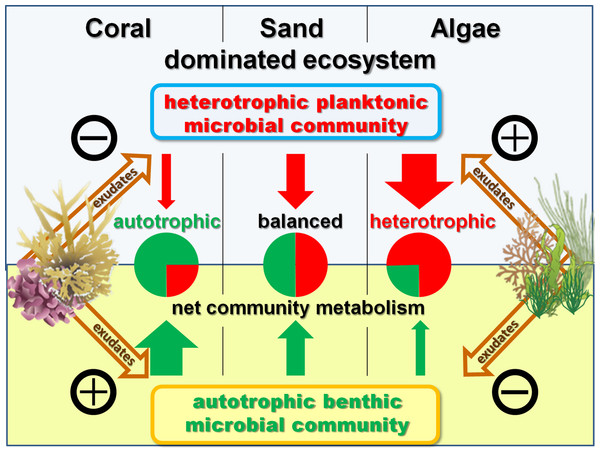
As primary producers, all photosynthetic organisms have exudates of DOC (dissolved organic carbon). Coral exudates are lipids & proteins while algae exudates are carbohydrates. In effect, the sugar in carbohydrates suffocate coral with algae. This happened in the Caribbean some decades ago due to a virus killing 95% of urchins on many reefs.
As a reefer for 51 years, I have collected and thrown away a garage of STUFF to run a reef tank. For the last 30 years before retiring from deep water drilling, I worked a schedule 28 days on with 28 days off as a subsea engineer. During those early years there was limited economical automation. With that focus, I found that recycling nutrients (sequestration) was the way to go. During the next 30 years I experimented with different marine ecosystems and have come to appreciate numerous inverts including flame scallops & sea apples. I attribute this to diversity of micro flora & fauna that is brought in with diver collected uncured live sand & live rock.
The three platforms of biochemistry for recycling nutrients are bacteria, algae including coral zooanthelia and “cryptic sponges”.
To complicate nutrient pathways, gas exchange is a major contributor of nutrient exchange between water and air: bringing in oxygen to complete chemistry required to grow, bringing in nitrogen gas to be converted into ammonia by “nitrogen fixation” bacteria and because Earth is a carbon based planet, carbon dioxide dissolves readily into water to form alkalinity which when combined with photosynthesis forms glucose which is carbon for the reef.
@sixty_reefer
Outstanding thread. My long post was intended to be a new thread. Not knowing your background, I assume you are a micro biologist and I desire to know WHY things happen, so I am following your thread.
Other than Reef Actif what other products would you recommend to do a rip clean like this? You mentioned MB7…what else do you like almost as much as Reef Actif?
Live phytoplankton and any “bacteria” products that has a limited dosage specified on the label
This are products that are good for folks that are new to the hobby and not comfortable with carbon dosing. (Still carbon dosing just safer for beginners)
for more advanced aquarists any carbon dosing source Many brands offer them.
they all work to a certain extent due to most being dissolved organic carbon they will affect the nitrates and phosphates more in relation to the organic nutrients, I find reef actif unique due to being organic carbon it doesn’t dissolve as fast and this allows for other bacteria responsible for eating detritus to use it in that stage. It’s made from carbohydrates from seaweed and other plants it’s just a natural source of carbon similar to phytoplankton.
Live phytoplankton and any “bacteria” products that has a limited dosage specified on the label
This are products that are good for folks that are new to the hobby and not comfortable with carbon dosing. (Still carbon dosing just safer for beginners)
for more advanced aquarists any carbon dosing source Many brands offer them.
they all work to a certain extent due to most being dissolved organic carbon they will affect the nitrates and phosphates more in relation to the organic nutrients, I find reef actif unique due to being organic carbon it doesn’t dissolve as fast and this allows for other bacteria responsible for eating detritus to use it in that stage. It’s made from carbohydrates from seaweed and other plants it’s just a natural source of carbon similar to phytoplankton.
From my experience live phytoplankton starts being effective at the nutrient level only at 2-3ml/gallon that is a lot of phytoplankton for a 225 gallon system hence looking for more effective options, not knowing the ingredients of mb7 I wouldn’t be able to chip in on that.
I strongly recommend we focus the thread on completed tank jobs, with hardly any theory/that's not being mean it's that replacing the fundamental work of selling invaded tanks on applying a method, then seeing that method through, all in one place is what makes work threads so unique
not everybody can fix the tanks, that's key, even if their own home reefs are spectacular
there's simply nothing more humbling in reefing than working on someone elses tank across the way, if you kill it or fail to produce results, they let you know with no filter on the description. we should not aim this thread as a reflection of our own tanks, or anything we wrote
any contributors here should be showing up with before pics on a system not their own that they sold on trying this method, with results posted here. that's what we need: five of those, every page, this is about to become an expounding thread solely if we don't control for that tendency
the easy thing is to make predictions
the hard thing is to solicit via trust + bring over here actual work jobs/focus there pls team/it's the only thing that evolves our hobby. nobody can disagree on results is why
I guess I need to see more data, based on those threads from @taricha not sure how you can state that it's responsible for doing what you think it's doing. Don't get me wrong, I really think the trick with our tanks is at the bacteria level and I think if we can ever really figure that out then we may be able to have a path that anyone can follow and have a successful tank. Today its very hit or miss and I think a lot of that has to do with the bacteria in our tanks or the bacteria not in our tanks.
I was willing to give it a try but I do not like the fact that it's hard to source, has anyone gotten any confirmation that it's not been discontinued? Again what would be the alternatives to reef actif?
I believe oxygen have affected taricha results, I could show you (need 3 to 4 days) a full cooked cocktail shrimps disappear in my system Vs the same shrimp in a small vessel illustrating the difference that oxygen and temperature will have on the impact of organic matter decomposition.
with logic most ingredients we get from the grocery store are sealed for similar reasons.
I strongly recommend we focus the thread on completed tank jobs, with hardly any theory/that's not being mean it's that replacing the fundamental work of selling invaded tanks on applying a method, then seeing that method through, all in one place is what makes work threads so unique not everybody can fix the tanks, that's key, even if their own home reefs are spectacular
there's simply nothing more humbling in reefing than working on someone elses tank across the way, if you kill it or fail to produce results, they let you know with no filter on the description. we should not aim this thread as a reflection of our own tanks, or anything we wrote
any contributors here should be showing up with before pics on a system not their own that they sold on trying this method, with results posted here. that's what we need: five of those, every page, this is about to become an expounding thread solely if we don't control for that tendency
the easy thing is to make predictions
the hard thing is to solicit via trust + bring over here actual work jobs/focus there pls team/it's the only thing that evolves our hobby. nobody can disagree on results is why
Ive already done this whole process at least 7 times already. Brought 3 tanks back to life just using carbon dosing after complete wipeouts. It’s just science. It works if you do it correctly and follow the process. There’s 1000 ways to mess up along the way and people will mess up so i really don’t see the point of relying on work threads. Instead learn the science and trust the science.
but Taricha is controlled in all experiments, in a lab setting, and rarely in an aquarium full of variables. he lists complex charts and measures and test kit calibration proofing for most experiments, it's beyond legit setups he's posting.
working in tanks does not allow for that proofing and it rarely allows for replication of outcomes among a set of reefs unless we're dealing in something very very effective.
I am hoping we don't get theory bulking up the thread in place of in-process work jobs
when the requested writers show up soon they're not bringing work jobs needing fixed live time they're bringing past experience on their systems in reflection.
this adds pages of read that are not examples of completed jobs
all readers should be rounding up work jobs from help invasion posts on multiple forums, linking them here, they post a before pic and await the custom plan.
we need several invasion-challenged tanks to post up willing to dose the required items here, and give it 3 fair months for tracking. since the payoff might take as long we need to start the jobs now/page 5
I believe that everything has its place, there is many systems thriving in zero or near zero phosphates and nitrates, although no one explains in detail why that happens.
In a system that is mature, nuisance free and full of coral this is really good method to increase nitrogen in the form of ammonia, corals just like algae love ammonia due to being so easily assimilate. In this situation ammonia is increased due the limitations in heterotrophic bacteria by depleted phosphates.
in a young system that has nuisance and coral this is not a good idea due to algae being just as effective at assimilating ammonia. You see why is a bad idea to fight algae by depleting nitrates or phosphates, instead of reducing nutrients for the algae folks are actually increasing nitrogen in the form of ammonia and the algae will actually take over much faster.
folks are being mislead by folks with bigger audiences that still believe nitrates and phosphates are the root cause.
in a way they not wrong although they not right either, in the situation you mention above the nutrients are being consumed by the algae although they not consuming nitrate they using all the ammonia and by effect reducing nitrates.
If ammonia is being used by the algae there won’t be much ammonia left for nitrifying bacteria to oxidise into nitrates and if nitrates are depleted there is no source of energy for coral or source of energy for beneficial heterotrophic bacteria
Nine days in with flux and cyano patches are already appearing. Is there a particular product or process you would recommend, reef actif? At this point I have gha, cyano, and what I'm pretty sure is bryopsis. Its not what I call overrun but a nuisance just the same. I just did a little reading on Dr Tim's program using Re Fresh and Waste Away but am hesitant as I always am about adding anything. I used to think just waiting things out and letting a tank mature on its own is best but I'm not so sure any longer. I fixed cars for 38 years so my science and chemistry skills are non existent beyond what I gather here and online.
this is due to the ammonia that algae was using being redirected to another nuisance in your situation is Cyanobacteria although it could be other depending on what’s present in the system.
your best chance here is to reduce ammonia by promoting a good nitrifying population or reduce ammonia by adding reef actif.
waste away works similar to reef actif imo it’s bacteria and organic carbon that will reduce organic nutrients. Both are good although everyone will already have the bacteria present they just need that bit extra carbon to work more efficiently at reducing organic waste
Kudos to this post. Why things happen is more important to me than what happened. I can learn and prevent, if I know why. In Oceeneering 101, Dynamic Equilibrium explained the stability relationship with carbon dioxide gas in athmosphere and limestone sediments to maintain alkalinity & pH
DETRITUS IS NOT INERT until after a long, long, long time.
I operated a mud algae filter for 20 years with an accumulation of detritus .5” that felt spongy to the touch. Mud was crawling with worms and things. Five years ago, I turned out the lights and composted tomatoes with Chaeto and added live rock to create a cryptic refugium.
I often feed ammonia to this system as well as live mussels.
From what I've read it's not the ammonia form of nitrogen that's the issue it nitrates. Shantz and Burkpile have looked at nitrogen (one paper reviewed the data from 44 different published studies) and it was nitrates that caused the most issues wiht corals, not ammonia. A quote from one of their papers I think points out the complexity we are dealing with:
"the response of corals to increasing nutrient availability was context dependent, varying with coral taxa and morphology, enrichment source, and nutrient identity"
Nitrogen pollution increases the susceptibility of corals to heat-induced bleaching. However, different forms of nitrogen (nitrate vs. ammonium/urea) may have different impacts on thermal tolerance of corals. We used an 18-month field experiment on the oligotrophic fore reef of Moorea, French...
Adding labile DOC, aka carbon dosing, does promote heterotrophic bacterial growth. There's lots of research demonstrating that. Unfortunately, ta major difference between coral DOC and algal DOC is coral DOC is largely refractory and promotes autotrophic microbial processes (read oxygen conserving) while algal DOC is largely labile and promotes heterotrophic microbial processes (read oxygen consuming. Adding labile DOC to promote heterotrophic microbial prcesses can have an immidiate or acute effect on corals. It can promote heterotrophic microbial growth in corals microbiomes and can literally suffocate corals as heterotrophic bacteria suck up oxygen using labile DOC to consume the refractory DOC available. Excess labile DOC can also have chronic effects on corals taking years to have obvious negative effects on corals (Old Tank Syndrome)
As Subsea pointed out, sponges are a variable. A huge variable as it turns out depending on how a species feeds. Some feed exclusively off DOC and remove it 1000X faster than the bacterioplankton in a system. While they may mitigate the negative effects on labile DOC in a system they do process DOC differentially depending on it's source. DOC from corals results in different compounds than DOC from algae. We don't know yet how artificial sources of labile DOC effect microbial prcesses but considering the mountain of peer reviewed research showing labile DOC causes coral death I'd wouldn't use it.
Here's a data bomb
Nitrogen stuff
Nitrogen cycling in hte coral holobiont
Ammonium Uptake by Symbiotic and Aposymbiotic Reef Corals
SUMMARY. This study was designed to assess the importance of dissolved free amino acids (DFAA) as a nitrogen source for the scleractinian coral Stylophora pistillata. For this purpose, experiments were performed using 15N-enriched DFAAs, and %15N enrichment was measured both in animal tissue and...
Urea can be one of the major sources of nitrogen for phytoplankton, but little is known about its importance for corals. Experiments were therefore de…
Corals are mixotrophs: they are able to fix inorganic carbon through the activity of their symbiotic dinoflagellates and to gain nitrogen from predation on plankton and uptake of dissolved organic and inorganic nutrients. They also live in close association with diverse diazotrophic communities...
Many symbioses involve multiple partners in complex, multi-level associations, yet little is known concerning patterns of nutrient transfer in multi-level marine mutualisms. We used the anemonefish symbiosis as a model system to create a balance sheet for nitrogen production and transfer within...
link.springer.com
Elevated ammonium delays the impairment of the coral-diniflagellate symbiosis during labile carbon pollution
Labile dissolved organic carbon (DOC) is a major pollutant in coastal marine environments affected by anthropogenic impacts, and may significantly con…
www.sciencedirect.com
DOC Stuff
"Coral Reefs in the Microbial Seas" This video compliments Rohwer's book of the same title (Paper back is ~$20, Kindle is ~$10), both deal with the conflicting roles of the different types of DOC in reef ecosystems. While there is overlap bewteen his book and the video both have information not covered by the other and together give a broader view of the complex relationships found in reef ecosystems
Maintenance of Coral Reef Health (refferences at the end)
Global microbialization of coral reefs (Increased microbial loads negatively impact coral reefs)
Analysis of 60 sites in three ocean basins suggests that overgrowth of fleshy algae on coral reefs supports higher microbial abundances dominated by copiotrophic, potentially pathogenic bacteria via the provision of dissolved inorganic carbon.
www.nature.com
Indirect effects of algae on coral: algae‐mediated, microbe‐induced coral mortality
Benthic primary producers in tropical reef ecosystems can alter biogeochemical cycling and microbial processes in the surrounding seawater. In order to quantify these influences, we measured rates of photosynthesis, respiration, and dissolved organic carbon (DOC) exudate release by the dominant...
peerj.com
Role of elevated organic carbon levels and microbial activity in coral mortality
Effects of Coral Reef Benthic Primary Producers on Dissolved Organic Carbon and Microbial Activity
Algae releases significantly more DOC into the water than coral.
Benthic primary producers in marine ecosystems may significantly alter biogeochemical cycling and microbial processes in their surrounding environment. To examine these interactions, we studied dissolved organic matter release by dominant benthic taxa and subsequent microbial remineralization in...
journals.plos.org
Pathologies and mortality rates caused by organic carbon and nutrient stressors in three Caribbean coral species.
DOC caused coral death but not high nitrates, phosphates or ammonium.
Planar optodes were used to visualize oxygen distribution patterns associated with a coral reef associated green algae (Chaetomorpha sp.) and a hermatypic coral (Favia sp.) separately, as standalone organisms, and placed in close proximity mimicking coral-algal interactions. Oxygen patterns were...
peerj.com
Biological oxygen demand optode analysis of coral reef-associated microbial communities exposed to algal exudates
Exposure to exudates derived from turf algae stimulated higher oxygen drawdown by the coral-associated bacteria.
Algae-derived dissolved organic matter has been hypothesized to induce mortality of reef building corals. One proposed killing mechanism is a zone of hypoxia created by rapidly growing microbes. To investigate this hypothesis, biological oxygen ...
www.ncbi.nlm.nih.gov
Microbial ecology: Algae feed a shift on coral reefs
Human pressures on coral reefs are giving macroalgae a competitive advantage over reef-building corals. These algae support larger, and potentially pathogenic, microbial populations that are metabolically primed for less-efficient, yet faster, carbohydrate remineralization, perpetuating a...
www.nature.com
Coral and macroalgal exudates vary in neutral sugar composition and differentially enrich reef bacterioplankton lineages.
Increasing algal cover on tropical reefs worldwide may be maintained through feedbacks whereby algae outcompete coral by altering microbial activity. We hypothesized that algae and coral release compositionally distinct exudates that differentially alter bacterioplankton growth and community...
www.ncbi.nlm.nih.gov
Sugar enrichment provides evidence for a role of nitrogen fixation in coral bleaching
Elevated ammonium delays the impairment of the coral-dinoflagellate symbiosis during labile carbon pollution
(here's an argument for maintaining heavy fish loads if you're carbon dosing)
Labile dissolved organic carbon (DOC) is a major pollutant in coastal marine environments affected by anthropogenic impacts, and may significantly con…
www.sciencedirect.com
Excess labile carbon promotes the expression of virulence factors in coral reef bacterioplankton
Coastal pollution and algal cover are increasing on many coral reefs, resulting in higher dissolved organic carbon (DOC) concentrations. High DOC concentrations strongly affect microbial activity in reef waters and select for copiotrophic, often potentially virulent microbial populations. High...
www.nature.com
Unseen players shape benthic competition on coral reefs.
Recent work has shown that hydrophilic and hydrophobic organic matter (OM) from algae disrupts the function of the coral holobiont and promotes the invasion of opportunistic pathogens, leading to coral morbidity and mortality. Here we refer to these dynamics as the (3)DAM [dissolved organic...
www.ncbi.nlm.nih.gov
Allelochemicals (DOC) Produced by Brown Macroalgae of the Lobophora Genus Are Active against Coral Larvae and Associated Bacteria, Supporting Pathogenic Shifts to Vibrio Dominance.
Diverse microbial communities associate with coral tissues and mucus, providing important protective and nutritional services, but once disturbed, the microbial equilibrium may shift from a beneficial state to one that is detrimental or pathogenic. Macroalgae (e.g., seaweeds) can physically and...
www.ncbi.nlm.nih.gov
Macroalgae decrease growth and alter microbial community structure of the reef-building coral, Porites astreoides.
With the continued and unprecedented decline of coral reefs worldwide, evaluating the factors that contribute to coral demise is of critical importance. As coral cover declines, macroalgae are becoming more common on tropical reefs. Interactions between these macroalgae and corals may alter the...
www.ncbi.nlm.nih.gov
Macroalgal extracts induce bacterial assemblage shifts and sublethal tissue stress in Caribbean corals.
Benthic macroalgae can be abundant on present-day coral reefs, especially where rates of herbivory are low and/or dissolved nutrients are high. This study investigated the impact of macroalgal extracts on both coral-associated bacterial assemblages and sublethal stress response of corals. Crude...
www.ncbi.nlm.nih.gov
Biophysical and physiological processes causing oxygen loss from coral reefs.
Element cycling on tropical coral reefs.
This is Jasper de Geoij's ground breaking research on reef sponge finding some species process labile DOC 1000X faster than bacterioplankton. (The introduction is in Dutch but the content is in English.)
Marine sponges are ubiquitous colonizers of shallow, clear-water environments in the oceans (1, 2). Sponges have emerged as significant mediators of biogeochemical fluxes in coastal zones by virtue of respiring organic matter and facilitating both the consumption and release of nutrients (3, 4)...
www.pnas.org
Phosphorus sequestration in the form of polyphosphate by microbial symbionts in marine sponges
Coral reefs are highly productive ecosystems that raise a conundrum called “Darwin’s paradox”: How can high production flourish in low-nutrient conditions? We show here that in three abundant Caribbean sponges, the granules that have been commonly observed in sponge tissue for decades are...
www.pnas.org
Differential recycling of coral and algal dissolved organic matter via the sponge loop.
Sponges treat DOC from algae differently than DOC from corals
Coral reefs are economically important ecosystems that have suffered unprecedented losses of corals in the recent past. Why have Caribbean reefs in particu
academic.oup.com
Surviving in a Marine Desert The Sponge Loop Retains Resources Within Coral Reefs
Dissolved organic carbon and nitrogen are quickly processed by sponges and released back into the reef food web in hours as carbon and nitrogen rich detritus.
PDF | On Jun 23, 2015, Jasper M de Goeij and others published 2013 deGoeij Science Sponge loop | Find, read and cite all the research you need on ResearchGate
www.researchgate.net
Natural Diet of Coral-Excavating Sponges Consists Mainly of Dissolved Organic Carbon (DOC)
Coral-excavating sponges are the most important bioeroders on Caribbean reefs and increase in abundance throughout the region. This increase is commonly attributed to a concomitant increase in food availability due to eutrophication and pollution. ...
www.ncbi.nlm.nih.gov
The Role of Marine Sponges in Carbon and Nitrogen Cycles of COral Reefs and Nearshore Environments.
Explore millions of resources from scholarly journals, books, newspapers, videos and more, on the ProQuest Platform.
search.proquest.com
And since we're discussing favorable and not so favorable bacteria here's a paper looking at how different corals and polyps are influencing the bacteria in the water column.
Aura-biomes are present in the water layer above coral reef benthic macro-organisms
As coral reef habitats decline worldwide, some reefs are transitioning from coral- to algal-dominated benthos with the exact cause for this shift remaining elusive. Increases in the abundance of microbes in the water column has been correlated with an increase in coral disease and reduction in...