The DSR Method (Dutch Synthetic Reefing)

  • Thread starter Thread starter glennf
  • Start date Start date
  • Tagged users None
How to annihilate Valonia ventricosa with 10% Caustic soda solution.


- start with turning of all streaming pumps


The object
11760609736_1686072a2c_z.jpg


The caustic soda solution (10% NaOH)
11760103143_bafd8365ce_z.jpg


cover with a blanket of NaOH (time 19:05)
11760613176_ec8596174d_z.jpg


after turning on the pump (time 19:12)
(the key is to spread it as quickly as possible with all streamer turned to full power to prevent flocks dropping on corals, this can burn/damage the corals)
11760106113_d9e859a7ff_z.jpg


one day later (time 13:18)
11760617506_4848611925_z.jpg


two days later (time 11:24)
11760618846_daae36cd4f_z.jpg


use a turkey baster to remove spills on corals by blasting then off and spreading the flocks.

 
Effect on PH level in the tank

tank applied to ~150 liters


Ph before start procedure
11760608106_c9be379dc9_z.jpg


used 1 ml for Valonia , no measurable difference in pH


after dosing 7ml into the tank
11760107283_72725d0e90_z.jpg
 
Nice!

I might try this on some mushroom corals someday....they've had it coming!

Would it make sense just to be prepared to siphon out the "aftermath" rather than spreading it around the tank?

-Matt
 
Nice!

I might try this on some mushroom corals someday....they've had it coming!

Would it make sense just to be prepared to siphon out the "aftermath" rather than spreading it around the tank?

-Matt

Good idea....
 
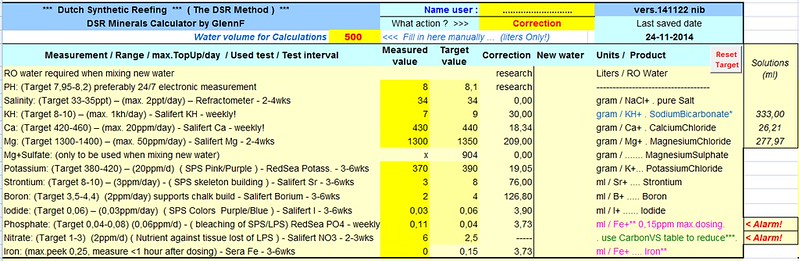
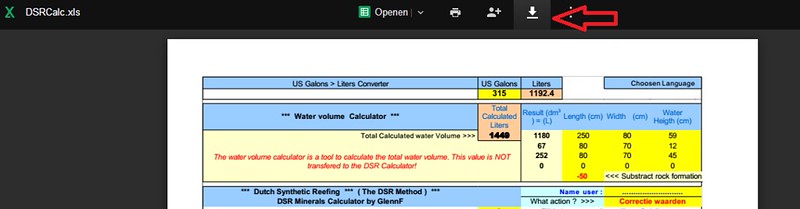
i finished a new version the DSR Calculator

version v.141122nib


https://drive.google.com/folderview?id=0B7Bl4pLrZYSdNjRpbDVZQVViMWs&usp=sharing


15678031270_dc094f90b6_c.jpg


i build in some intelligence to deal with:
NO3 vs CarbonVS Dosing, with alarm when healthy boundaries are being crossed
PO4 vs Fe Dosing, with alarm when healthy boundaries are being crossed
Fe dosing volume is automatic adjusted when not dealing with PO4 reducing


greetings, GlennF
 
Glenn, very interested in your use of iron to remove phosphate. I was recently thinking of using ferric chloride to control phosphate myself. If you are able to answer the few questions it would be much appreciated.

Do you use iron(2) or iron(3) and in what salt form?
Not chelated iron I assume?
What test kit do you use to ensure your iron levels don't go too high?
Lastly, most importantly, you mention that iron levels drop within a few hours, to very low levels. Do you think this is because you are adding exactly the right amount to bind with the quantity of phosphate in your tank, or is the excess binding with something else and precipitating? If you think its binding with something else, what form do you think the excess iron is precipitating in?

The use of iron dosing would seem to have application not only to DSR users but possibily all reef owners I am wondering.

Thanks, Pete
 
Glenn, very interested in your use of iron to remove phosphate. I was recently thinking of using ferric chloride to control phosphate myself. If you are able to answer the few questions it would be much appreciated.
i have no own experience with FeCl2 not FeCl3

Do you use iron(2) or iron(3) and in what salt form? FeSO4 chelated with a citrate to make it dosable, otherwise it will precipitate in the bottle due to oxidation i believe.
Not chelated iron I assume? chelated
What test kit do you use to ensure your iron levels don't go too high? Sera Fe test, i found out that the RS Fe test was not accurate.
Lastly, most importantly, you mention that iron levels drop within a few hours, to very low levels. Do you think this is because you are adding exactly the right amount to bind with the quantity of phosphate in your tank, or is the excess binding with something else and precipitating? If you think its binding with something else, what form do you think the excess iron is precipitating in? the excess binding with something else and precipitating, i believe the same as a GFO would do exchanging PO4- ions with OH- ions.
randy wrote something about it here Iron Oxide Hydroxide (GFO) Phosphate Binders by Randy Holmes-Farley - Reefkeeping.com

The use of iron dosing would seem to have application not only to DSR users but possibily all reef owners I am wondering.
in holland many reefers with PO4 problems they could not overcome started with my iron mix (Fe+) and slowly switched to the full method, so i suppose they were happy with the first results.

Thanks, Pete

...
 
Last edited:
And why is the target value for iron (0.15 ppm) so incredibly high?

i have experimented with several dosing and read into several documentation before i decide i don't want to cross above 0,25ppm.

i use the iron dosing to reduce PO4 in my tank and found it cheap, far more effective and steadier than using GFO.
i have also limited the maximum single dosing to 0,15ppm, after extensive testing myself and field experience of DSR user i found out that this was a save upper limit.

The target level don't mean i want the Fe measurement to become 0,15ppm. (it's purpose is to limit the maximum dosing)
in reality iron will be unmeasurabe low after 6 hour already (depending on the PO4 present).
 
Last edited:
The target level don't mean i want the Fe measurement to become 0,15ppm. (it's purpose is to limit the maximum dosing)
in reality iron will be unmeasurabe low after 6 hour already (depending on the PO4 present).

OK, thanks. That clarifies it.

A few folks seem to want to maintain iron at a kit testable level. :)
 
OK, thanks. That clarifies it.

A few folks seem to want to maintain iron at a kit testable level. :)

It is possible, but is not desirable at all and because it won't last long.

Beside that if i stays bounded it won't react with PO4, which make it useless as PO4 remover.

I haven't found a suitable chelator yet than will last long time in a salty/alkaline environment.

The one i found is coloring the water reddish which is unacceptable for this purpose.
 
Very Nice tank GlennF,
I was wondering if you did a ICP test with Triton to see your tank parameters? Would be interesting to see.
 
Very Nice tank GlennF,
I was wondering if you did a ICP test with Triton to see your tank parameters? Would be interesting to see.

I did one juli2013 just because i was curious. I haven't done any recently.
Als long as is see my lifestock is healthy and growing, i don't think i need it.
But like you said, it would be interesting to see how this would turn out.

The possibillity for ICP testing is awesome.
I will do one in the future when i feel it's time to get some usefull info.
I believe in controlling things what need to be controlled.
I don't believe in plain mimicking all parameter in NSW.
I believe it's more usefull to find the boundaries where we can keep our corals healthy and thriving, instead of chasing NSW values.
I believe some elevated values could even benefit many species.
This is what I found out for po4 and no3. Now I keep both higher than NSW and i keep 180 species growing in here.
Few people who couldn't keep discusoma, zoa's, soft corals and lps like acan's alive, contacted,
me and tried this out and were succesfull.
 
Last edited:
No edit possible, so this is a addendum
I did one juli2013 just because i was curious. I haven't done any recently.
Als long as is see my lifestock is healthy and growing, i don't think i need it.
But like you said, it would be interesting to see how this would turn out.

The possibillity for ICP testing is awesome.
I will do one in the future when i feel it's time to get some usefull info.
I believe in controlling things what need to be controlled.
I don't believe in plain mimicking all parameter in NSW.
I believe it's more usefull to find the boundaries where we can keep our corals healthy and thriving, instead of chasing NSW values.
I believe some elevated values could even benefit many species.
This is what I found out for po4 and no3. Now I keep both higher than NSW and i keep 180 species growing in here.
Few people who couldn't keep discusoma, zoa's, soft corals and lps like acan's alive, contacted,
me and tried this out and were succesfull.

The key is you need to decide what you want with your tank.

You like ULNS, Softcorals, Mixed reef, or any other combination tban you choose your strategy.

DSR and the calculator is only a tool to reach your goal. But you decide what way you're going.

I have steered my tank into all directions and seen what happened with the corals living in it.

You may say i used my tank to experiment how the 180 species would react if i change one parameter. That's a lot of sensors if you look at it from a technical point of vieuw.
 
Last edited:
Hi Glenn,

Thanks for the info regarding you use of iron. I guess I might be one of those who would start with using iron and gravitate towards your whole method, as the idea of not doing water changes appeales to me too (obviously). I already have quite a few of the lab grade trace chemicals required for fertigation nutrient mixes for my fruit garden.

Going back to iron, my impression is that if you overdose iron relative to the amount of phosphate, the iron levels will still drop to low levels within hours, but could you confirm this? IE if you have say <0.01 ppm PO4, and you dose 0.15 ppm iron, the iron will still precipitate in one form or another despite the lack or phosphate, because it will precipitate in another form - hydroxide I think you are suggesting. Can I just confirm this is your opinion? Its quite important to me because if I add iron to my dosing pump, but am away for a few days (or couple of weeks) and feeding is much less, then less PO4 will be produced. So phosphate might become too little for the amount of iron being dosed. If this is still safe, thats good news (I appreciate that you feel that phosphate which is too low is harmful, but I am just wondering if its possible for iron levels to build up to >0.25 ppm if you are dosing 0.15 ppm per day).

Lastly if you have ever tried overdosing iron consistently for several days, what kind of level did the phosphate settle at? Did the iron completely strip phosphate from the water to unmeasurable levels?

Thanks, Pete
 

IF YOU HAD TO TAKE A REEFING EXAM, WOULD YOU PASS?

  • Yes!

    Votes: 32 45.7%
  • Not yet, but I have one that I want to buy in mind!

    Votes: 9 12.9%
  • No.

    Votes: 26 37.1%
  • Other (please explain).

    Votes: 3 4.3%
Back
Top