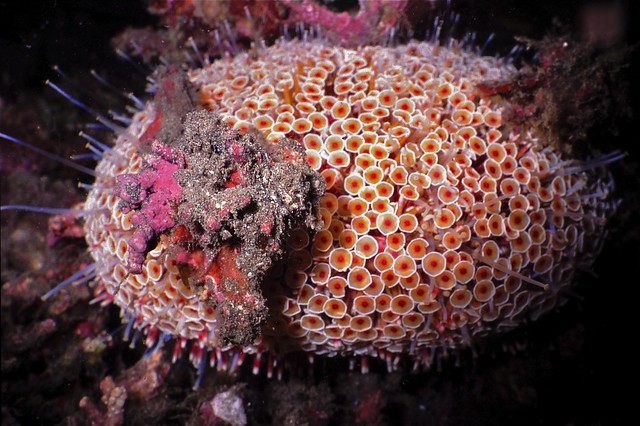
Effects on humans
In 1930, the
Japanese marine biologist Tsutomu Fujiwara accidentally envenomated himself with seven or eight flower urchin pedicellariae while working in a fishing boat. He described his experience in a paper published in 1935:
[32][51][50]
On June 26, 1930, while I was working on a fishing boat on the coast of Tsutajima in
Saganoseki, I scooped up with my bare hand an individual of the sea-urchin which had been carried up by a diver with a fishing implement on the water surface from the sea-bottom about 20 fathoms in depth, and I transferred the sea-urchin into a small tank in the boat. At that time, 7 or 8 pedicellariae stubbornly attached themselves to a side of the middle finger of my right hand, detached from the stalk and remained on the skin of my finger.
Instantly, I felt a severe pain resembling that caused by the
cnidoblast of
Coelenterata, and I felt as if the toxin were beginning to move rapidly to the blood vessel from the stung area towards my heart. After a while, I experienced a faint giddiness, difficulty of respiration, paralysis of the lips, tongue and eyelids, relaxation of muscles in the limbs, was hardly able to speak or control my facial expression, and felt almost as if I were going to die. About 15 minutes afterwards, I felt that pains gradually diminish and after about an hour they disappeared completely. But the facial paralysis like that caused by cocainization continued for about six hours.
Tsutomu Fujiwara (1935). "On the poisonous pedicellaria of
Toxopneustes pileolus (Lamarck)".
Annotationes Zoologicae Japonenses 15 (1): 62–68.
There have been reports of fatalities resulting from flower urchin envenomation.
[52] One such report was the purported drowning of a
pearl diver after being rendered unconscious from accidental contact with a flower urchin.
[53][54][55] But it remains difficult to confirm if these incidents actually occurred since no documentation or details of the deaths have been uncovered so far.
[56][53]
Nevertheless, flower urchins are still considered highly dangerous. The severe debilitating pain of the flower urchin sting compounded by muscular paralysis, breathing problems, numbness, and disorientation can result in accidental drowning among divers and swimmers.
[4][18][57] The flower urchin was named the "most dangerous sea urchin" in the 2014
Guinness World Records.
[58]