ULNS or a bit of NO3?

  • Thread starter Thread starter Yas
  • Start date Start date
  • Tagged users None
You mean because people may overshoot to the low side, or because you are concerned about the methods themselves?

If it is the former, why are "artificial" methods (whatever those are in your definition) worse than "natural" methods?

If I may take a crack at a question not really directed at me. I’m going to fudge the artificial thing and give it my own definition.

I’m correct in understanding almost anything taking nutrients out of solution is going to shift the equilibrium point of nutrients in solution down a bit or a lot of its good at it?

If there is one thing doing this and there’s a lot of that thing the equilibrium would settle at a level where that thing is having a hard time taking up more. That may be zero, but it could also be a bit higher, correct?

If you have two things doing it, one of them could still be quite active even when the other has hit its limit and the equilibrium would then settle at a level where the more efficient of the two is hitting its limit.

Now I get in our systems there are lots of things, but there are biological and inorganic methods speaking generally. If the inorganic methods set an equilibrium more than a days feeding below the level at which corals can get to the stuff then the corals are generally out of luck and either get a lot of particulate food or starve. If on the other hand you’re using chaeto, it’s possible the chaeto has similar limits to the coral. Even if you wring it’s neck, as soon as you feed the level gets back up to a coral friendly level and stays there for a while.

It’s speculation on my part, but there is certainly a mechanism which would make biological removal less stressful than inorganic removal. Bacteria and carbon complicated things, but perhaps the amount of carbon is driving it sufficiently that it just overperforms. On the other hand, a Zeo tank is a bacteria driven tank and my corals are growing. Perhaps depletion by carbon dosing isn’t as risky as GFO depletion?

Does it work that way? You’d have to ask someone that knows a lot more than I do. That’s probably half the forum, but that’s why it’s fun to speculate.

 
You 100% do not need no3 and po4 in those ranges. My nutrients are barely detectable and my sps are deeply colored and are no where near death.

I know some people do the same, but I wonder how! I did the same and they died. I raised the nutrient levels, and it suddenly became so much easier to me. I'm not saying either one is good or bad. I'm just curious how such a ULNS tank is possible, and why it didn't happen to me. Could you give me a clue?
 
If I may take a crack at a question not really directed at me. I’m going to fudge the artificial thing and give it my own definition.

I’m correct in understanding almost anything taking nutrients out of solution is going to shift the equilibrium point of nutrients in solution down a bit or a lot of its good at it?

If there is one thing doing this and there’s a lot of that thing the equilibrium would settle at a level where that thing is having a hard time taking up more. That may be zero, but it could also be a bit higher, correct?

If you have two things doing it, one of them could still be quite active even when the other has hit its limit and the equilibrium would then settle at a level where the more efficient of the two is hitting its limit.

Now I get in our systems there are lots of things, but there are biological and inorganic methods speaking generally. If the inorganic methods set an equilibrium more than a days feeding below the level at which corals can get to the stuff then the corals are generally out of luck and either get a lot of particulate food or starve. If on the other hand you’re using chaeto, it’s possible the chaeto has similar limits to the coral. Even if you wring it’s neck, as soon as you feed the level gets back up to a coral friendly level and stays there for a while.

It’s speculation on my part, but there is certainly a mechanism which would make biological removal less stressful than inorganic removal. Bacteria and carbon complicated things, but perhaps the amount of carbon is driving it sufficiently that it just overperforms. On the other hand, a Zeo tank is a bacteria driven tank and my corals are growing. Perhaps depletion by carbon dosing isn’t as risky as GFO depletion?

Does it work that way? You’d have to ask someone that knows a lot more than I do. That’s probably half the forum, but that’s why it’s fun to speculate.

Well, I'm not a specialist either, but I've heard bacteria can be a good food for SPS, and mucus of SPS can be a good food for bacteria. So while bacteria process mucus and other nutrients, making water harmless, they provide good food source at the same time. And that could be the same reason why SPS in a natural environment is so healthy even if they are in a low-nutrient environment. This is not my notion. It's just something I've heard. But if that's true, and if one can have the similar environment as in ocean, that could be a safer ULNS tank, I guess.

Generally, most mechanical filtration may not be able to work like that. Compared to natural equilibrium, they just deplete things without providing anything. And I think it happened to my previous ULNS system. That's why my SPS are healthier in the current tank with a bit more nutrients. Sorry, I can't compare mechanical equilibrium and natural equilibrium as I couldn't have a successfully established ULNS tank.
 
Because people go too far and we lack good quality tests to see how low Nitrate really is - .

OK, I can accept that as a reasonable concern. I'm not inclined to agree that it relates to artificial vs natural methods, but I have a hard time even understanding what that means in the context of a reef and due to the fact that most methods we use are just ramped up versions of things that take place naturally.
 
I know some people do the same, but I wonder how! I did the same and they died. I raised the nutrient levels, and it suddenly became so much easier to me. I'm not saying either one is good or bad. I'm just curious how such a ULNS tank is possible, and why it didn't happen to me. Could you give me a clue?

Corals have many sources of N, and nitrate is only one of them. Since many people are not actually measuring any of the others (ammonia and all sorts of organic compounds), what happens in one tank might not reflect what is happening in another with respect to these other sources.
 
I know some people do the same, but I wonder how! I did the same and they died. I raised the nutrient levels, and it suddenly became so much easier to me. I'm not saying either one is good or bad. I'm just curious how such a ULNS tank is possible, and why it didn't happen to me. Could you give me a clue?

Every system is different. It seems that the heavier the import, the lower the nutrients can appear to be and still be available to the corals. Reefs are oligotrophic but there is a constant supply of nutrients moved through by the currents. I don’t think there’s a number for all tanks, find your own sweet spot.
 
Corals have many sources of N, and nitrate is only one of them. Since many people are not actually measuring any of the others (ammonia and all sorts of organic compounds), what happens in one tank might not reflect what is happening in another with respect to these other sources.
Every system is different. It seems that the heavier the import, the lower the nutrients can appear to be and still be available to the corals. Reefs are oligotrophic but there is a constant supply of nutrients moved through by the currents. I don’t think there’s a number for all tanks, find your own sweet spot.

Right. Likewise, while I keep cleaning glass everyday, others don't have much algae in their tanks. So I completely understand. I just wished I could learn so-called secret, but it's someone's secret, and may not be mine. So I'm lost again! This is so puzzling! :D
 
To keep healthy SPS you'll want 2-5 PPM NO3 and 0.03 or a bit higher PO4. Anything less you'll get pale colors and they are basically starving.

If you honestly believe this you have learning to do
 
I think what happens in this hobby is a lot of generalization of information, myself included. The biggest idea I argue against is that natural reefs are very low nutrient systems. I believe they are very low "residual" nutrient systems. The natural world has a great talent for exploiting food sources so the second some "nutrient excess" happens something comes along to exploit it and grow. There are literally tons of food washing over a reef but it does not get locked in like in our glass boxes. So in the end they are "low" nutrient zones. The best tanks I've seen successful for long periods are tanks with heavy import and heavy export leaving little behind unused. How you get there is a puzzle with more than one answer. The key is to have enough food available, for any living thing, when it needs it. Having excess around doesn't guarantee success, it's just excess. But not having enough there when needed is worse. I think we still have a lot to learn, for instance, how lighting levels can influence "nutrient" uptake by corals. Some say the higher the par the higher the nutrient levels need to be. Are they right? I don't know if we know for sure just yet. I personally kept nutrients low and had lousy success until I talked with a coral grower and found out what his levels were and his filtration methods were much simpler than mine. Now I've raised them and simplified and it's working for me, maybe not for anyone else, but it's working for me. The only thing I know for certain is there is no single "right" way to succeed, there are many paths.
 
People are less and less inclined to mimic the main food source in nature, and the folks that do moreso have flexibility in how they keep a tank. I am fully convinced that lighting is still by-far the main contributor to a healthy acropora tank (we are in the SPS section). I do not find it shocking at all that tanks with cut-spectrum and lower power lights struggle with lower in-tank nutrients since the collection of available energy is significantly lower, in aggregate... although all that I have to base this on is a lot of anecdotes from posts in internet message boards as well as a few dozen local friends.

Dr. Holmes-Farley - how is Protein Skimming mimic'd in nature? Aluminum or Iron phosphate binders? LC? Granular Activated Carbon or remove organics? I kinda get growing bacteria with organic carbon is kinda natural, but excesses of organic carbon don't happen in nature either. I saw foam on a beach once and I though "hey, there is protein skimming" and then it rained and washed it all right back in there. We do change water, which is mostly equivalent to washing water off of the reefs. I call "natural" the process of letting the appropriate bacteria grow on their own to take care of the tank and then police themselves to the right levels based on need - people doing this with materials in canisters can get this right, but they also can over/under shoot since they are not capable of doing what the bacteria does over long periods of time.
 
I know some people do the same, but I wonder how! I did the same and they died. I raised the nutrient levels, and it suddenly became so much easier to me. I'm not saying either one is good or bad. I'm just curious how such a ULNS tank is possible, and why it didn't happen to me. Could you give me a clue?

I am not sure why you were having issues but in my 180 tank I feed a ton (6ish cubes of frozen and pellets two other times) and have 25 fish with 4 being big tangs. I feel people who run into issues with nutrients being so low is when they are doing it by carbon dosing. I grow chaeto when my main lights are not on so any available nitrate can possibly get used by my corals as they grow and it seems my chaeto uses what's left at night.

It gets so confusing when you go by the actual numbers you get by nitrate and phosphate from a test kit. Some people will have algae everywhere and have no detectable nitrates and some will just say "you have plenty of nutrients as you have algae growing everywhere". To me it's the same as growing chaeto, I have this giant ball of chaeto growing but have barely any detectable nutrients. The chaeto won't grow if there isn't enough nutrients.

Keep plenty of fish to feed the corals and feed them well and you shouldn't have an issue.
 
I'm just so amazed and can't thank enough to all of you guys. I was expecting to have simpler answers when I started this thread.
The only thing I know for certain is there is no single "right" way to succeed, there are many paths.
I agree. I was hoping to add a missing part, but it probably is not one simple thing. I try to think like this way. My tank wasn't imbalanced. It's in the process of balancing itself.
I saw foam on a beach once and I though "hey, there is protein skimming" and then it rained and washed it all right back in there.
Very interesting perspective, indeed! I live in Japan, and there are lots of so-called magical-formula-kind-of-stuff in the store. Every time I tried such things when I was a very beginner, they made my tank worse! I still sometimes think there could be such a formula, and I would probably buy one if I found one. But such a thing can only weaken the natural immune system of the tank, I guess.
To me it's the same as growing chaeto, I have this giant ball of chaeto growing but have barely any detectable nutrients. The chaeto won't grow if there isn't enough nutrients. Keep plenty of fish to feed the corals and feed them well and you shouldn't have an issue.
Thank you for the great input! At least there is a difference between simple nothing and balanced low-nutrient water, I guess.
 
Dr. Holmes-Farley - how is Protein Skimming mimic'd in nature? Aluminum or Iron phosphate binders? LC? Granular Activated Carbon or remove organics? I kinda get growing bacteria with organic carbon is kinda natural, but excesses of organic carbon don't happen in nature either. I saw foam on a beach once and I though "hey, there is protein skimming" and then it rained and washed it all right back in there. We do change water, which is mostly equivalent to washing water off of the reefs. I call "natural" the process of letting the appropriate bacteria grow on their own to take care of the tank and then police themselves to the right levels based on need - people doing this with materials in canisters can get this right, but they also can over/under shoot since they are not capable of doing what the bacteria does over long periods of time.


Every process we use happens in the ocean. Some are of lesser or greater importance, but all happen. Some, involving purely man made materials (e.g., Purigen) mimic processes that happen with related natural materials (e.g., proteins).

Acetate (the organic in vinegar) is common and is fairly rapidly processed in marine sediments:

Turnover of 14C-labelled acetate in marine sediments
https://link.springer.com/article/10.1007/BF00394618?LI=true

" In the upper 10 cm of the sediments 2–70 nmol acetate cm-3 sediment was found."
Note that 70 nmol/cm3 = 70 micromole/L = 4,200 ug/L = 4.2 ppm!

"The rate constants ranged from 1.5–13 h-1 in the investigated sediments. "

Binding of phosphate to iron oxides is a primary part of the phosphorus cycle in some parts of the ocean:
The phosphorus cycle in coastal marine sediments
http://onlinelibrary.wiley.com/doi/10.4319/lo.1992.37.6.1129/full

"In the oxidizing surface sediment, a major portion of the sedimentation flux of organic phosphorus is mineralized, and the released phosphate is partitioned between the pore water and surface adsorption sites. Surface-adsorbed phosphate is released to the pore water as needed to replace dissolved phosphate that escapes to the overlying water. Most of the phosphate is released deeper in the sediment column from iron oxides undergoing reduction. "

Binding of phosphate to iron and aluminum in sediments:
Phosphorus Forms Related to Sediment Grain Size and Geochemical Characteristics in French Coastal Areas
http://www.sciencedirect.com/science/article/pii/S0272771401907668

". It has been shown that the exchangeable and Fe/Al phosphate were preferentially associated with the fine particles (<63 um) in the three studied areas, but that, in the more sandy sediments of the Bay of Seine, these forms were also found in significant concentrations in the larger size classes."

Skimming:

Bubble Scavenging and the Water-to-Air Transfer of Organic Material in the Sea
http://pubs.acs.org/doi/abs/10.1021/ba-1975-0145.ch018

"Surface-active organic material (SAOM) in the sea tends to concentrate at the surface. It is brought there by diffusion, by Langmuir circulations, and by the surfaces of air bubbles rising through the water. These bubbles, produced primarily by breaking waves, not only carry SAOM to the surface but upon breaking eject it into the air. This process may account for the airborne droplets of sea water in the marine atmosphere which have SAOM concentrations several thousand times that found in the sea. The SAOM on the droplets has given marine meteorologists a tracer which enables them to understand better the role of these droplets in rain formation."


Lanthanum

It appears that lanthanum phosphate precipitation in the deep ocean may be what limits the lanthanum concentration of seawater, and why it doesn't rise higher from river inputs:
Rare earth precipitation and coprecipitation behavior: The limiting role of PO43− on dissolved rare earth concentrations in seawater
http://www.sciencedirect.com/science/article/pii/0016703793903643

"Model calculations of lanthanum speciation (BYRNE et al., 1988, 199 1) and phosphate speciation ( MILLERO and SCHREIRER, 1982), in conjunction with the above solubility data, indicate that saturation equilibrium with respect to LaP04 * nHl0 (s) can be attained under normal seawater conditions (i.e., pH = 7.8; ZCOz = 2.3 X 10F3 mol kg-‘) if the product of total dissolved lanthanum and total dissolved phosphorous is on the order of 1 X lo-” mol* kg-‘. Examination of previously reported lanthanum and phosphate water column profiles then indicates that the deep waters of the world oceans are approximately at saturation with respect to the insoluble phosphate salt, LaP04. nH*O(s)."

"We regard these results as indicating that the rare earths in seawater below 300 m are approximately at saturation with respect to a relatively fresh REE phosphate coprecipitate."
 
That is pretty cool. Thanks.

Does any of this happen in any practical capacity where a reef will benefit from it, or is all of this just academic basic chemistry reaction stuff and any impact on reefs just by coincidence, if any at all? Seems pretty certain that bubble scavenging impacts anywhere with waves and warm enough weather. I am hardly educated on any of this or else I would not have asked the question, but I could have guessed that there was iron oxide and lanthanum in the ocean... but more wondering if it actually does anything that a reef would benefit/detriment from.

Again, nature handles all of these, instead of humans. As I have noted a few times, humans being in charge of this is where the breakdowns happen, not with the methods themselves. This is an application issue, not an academic one.
 
Every process we use happens in the ocean. Some are of lesser or greater importance, but all happen. Some, involving purely man made materials (e.g., Purigen) mimic processes that happen with related natural materials (e.g., proteins).

Acetate (the organic in vinegar) is common and is fairly rapidly processed in marine sediments:

Turnover of 14C-labelled acetate in marine sediments
https://link.springer.com/article/10.1007/BF00394618?LI=true

" In the upper 10 cm of the sediments 2–70 nmol acetate cm-3 sediment was found."
Note that 70 nmol/cm3 = 70 micromole/L = 4,200 ug/L = 4.2 ppm!

"The rate constants ranged from 1.5–13 h-1 in the investigated sediments. "

Binding of phosphate to iron oxides is a primary part of the phosphorus cycle in some parts of the ocean:
The phosphorus cycle in coastal marine sediments
http://onlinelibrary.wiley.com/doi/10.4319/lo.1992.37.6.1129/full

"In the oxidizing surface sediment, a major portion of the sedimentation flux of organic phosphorus is mineralized, and the released phosphate is partitioned between the pore water and surface adsorption sites. Surface-adsorbed phosphate is released to the pore water as needed to replace dissolved phosphate that escapes to the overlying water. Most of the phosphate is released deeper in the sediment column from iron oxides undergoing reduction. "

Binding of phosphate to iron and aluminum in sediments:
Phosphorus Forms Related to Sediment Grain Size and Geochemical Characteristics in French Coastal Areas
http://www.sciencedirect.com/science/article/pii/S0272771401907668

". It has been shown that the exchangeable and Fe/Al phosphate were preferentially associated with the fine particles (<63 um) in the three studied areas, but that, in the more sandy sediments of the Bay of Seine, these forms were also found in significant concentrations in the larger size classes."

Skimming:

Bubble Scavenging and the Water-to-Air Transfer of Organic Material in the Sea
http://pubs.acs.org/doi/abs/10.1021/ba-1975-0145.ch018

"Surface-active organic material (SAOM) in the sea tends to concentrate at the surface. It is brought there by diffusion, by Langmuir circulations, and by the surfaces of air bubbles rising through the water. These bubbles, produced primarily by breaking waves, not only carry SAOM to the surface but upon breaking eject it into the air. This process may account for the airborne droplets of sea water in the marine atmosphere which have SAOM concentrations several thousand times that found in the sea. The SAOM on the droplets has given marine meteorologists a tracer which enables them to understand better the role of these droplets in rain formation."


Lanthanum

It appears that lanthanum phosphate precipitation in the deep ocean may be what limits the lanthanum concentration of seawater, and why it doesn't rise higher from river inputs:
Rare earth precipitation and coprecipitation behavior: The limiting role of PO43− on dissolved rare earth concentrations in seawater
http://www.sciencedirect.com/science/article/pii/0016703793903643

"Model calculations of lanthanum speciation (BYRNE et al., 1988, 199 1) and phosphate speciation ( MILLERO and SCHREIRER, 1982), in conjunction with the above solubility data, indicate that saturation equilibrium with respect to LaP04 * nHl0 (s) can be attained under normal seawater conditions (i.e., pH = 7.8; ZCOz = 2.3 X 10F3 mol kg-‘) if the product of total dissolved lanthanum and total dissolved phosphorous is on the order of 1 X lo-” mol* kg-‘. Examination of previously reported lanthanum and phosphate water column profiles then indicates that the deep waters of the world oceans are approximately at saturation with respect to the insoluble phosphate salt, LaP04. nH*O(s)."

"We regard these results as indicating that the rare earths in seawater below 300 m are approximately at saturation with respect to a relatively fresh REE phosphate coprecipitate."

So I just looked over the one on phosphate and it looks like the iron is acting as a buffer for the phosphate level thereby maintaining an equilibrium. Would that be different from what happens in our tanks in that we’re adding “clean” media and deliberately shifting the equilibrium? Would saturated or mostly saturated media create a different equilibrium from fresh stuff?
 
GFO bonds to equilibrium with the tank water. The higher the tank water, the more that it will bond, the lower then the less that will bond.

When we add clean media, the tank water drops significantly until it reaches equilibrium at a lower level, then it slowly goes back up until the GFO gets changed for fresh and then the lowering cycle starts all over again.

If I read the article correctly, and I probably did not because I am stupid... that would be like always leaving the same GFO in your tank, which would always be at equilibrium with your water column, but also never lower anything since nothing is exported, it is just another source for binding like aragonite that does not get exported that much either. The ocean is lacking the export that our tanks have... again, if I read it correctly, which is not likely.
 
With a little bit of NO3 and PO4, you shouldn’t have algae growing to the point you need to clean glass every day and it’s growing all over your rocks. My nano is a pretty high nutrient system and I clean the glass twice a week, all my SPS are fine and there’s not a blanket of algae on the rock lol. My vote is for a little NO3 and PO4, much easier to maintain and cheaper long term IMO.

dilly dilly! (yes, I agree)
 
Every process we use happens in the ocean. Some are of lesser or greater importance, but all happen. Some, involving purely man made materials (e.g., Purigen) mimic processes that happen with related natural materials (e.g., proteins).
If I know fundamental things happening in the ocean, it would be just easy as adding a missing process, but since I'm not a marine expert, I just implemented so-called ULNS, and failed, probably because of the lack of sufficient parameter monitoring as well as some other things which I'm still not fully aware of.

I was a dumb clean water believer not paying attention to the balance and many factors involved. This is the most complicated hobby that I've even tried. Or I'm too simple, maybe. Maybe I should try things in a moderate manner to slowly figure out the right balance without risking SPSs.
 
This is the most complicated hobby that I've even tried. Or I'm too simple, maybe.
I addressed just this sentiment in another thread! This hobby IS hard! Name another one where your trying to re-create an entire ecosystem. Your trying to do what it takes an entire ocean to do in nature. I think if we just cut ourselves some slack, allow for how hard this can be that fewer of us would get so discouraged and our overall enjoyment would be better. You did not fail, you learned one way it would not work, then tried another. Isn't that just life? Your fine, your just learning, that's all.
 
If I know fundamental things happening in the ocean, it would be just easy as adding a missing process, but since I'm not a marine expert, I just implemented so-called ULNS, and failed, probably because of the lack of sufficient parameter monitoring as well as some other things which I'm still not fully aware of.

I was a dumb clean water believer not paying attention to the balance and many factors involved. This is the most complicated hobby that I've even tried. Or I'm too simple, maybe. Maybe I should try things in a moderate manner to slowly figure out the right balance without risking SPSs.

That!
Re a previous post #4.
No water changes, manual dosing and manual evaporation top up.
I have 2 refugiums ( display refugium and one in the sump) and a skimmer.
I don't test so I have no idea where my phosphates and nitrates are, I watch my macro algae.
The current tank is only 28 months old, it was designed to run as low maintenance as possible (note, I didn't use the word "natural"!).
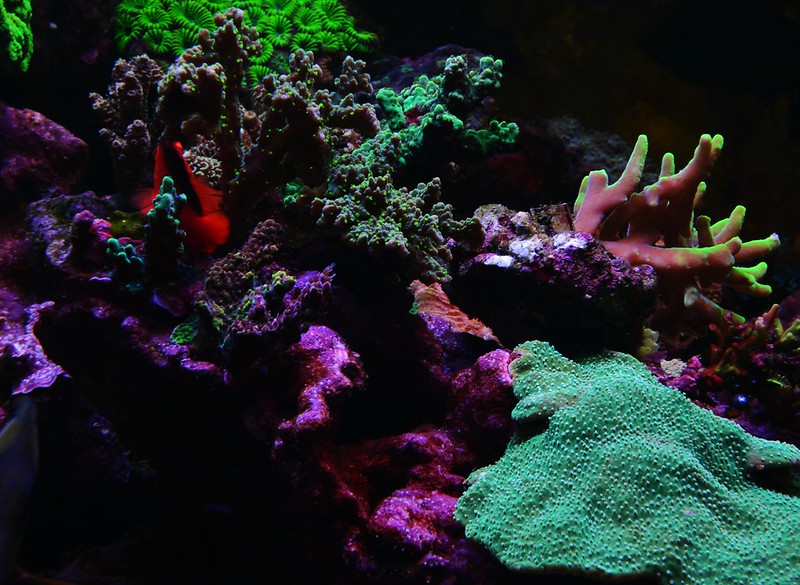
My sps do probably grow slower than in a lot of tanks, as long as they are happy and healthy I don't mind, I can wait!
Took this earlier for another reason! :)

DSC_0006 by sshipuk, on Flickr
 

IF YOU HAD TO TAKE A REEFING EXAM, WOULD YOU PASS?

  • Yes!

    Votes: 32 45.7%
  • Not yet, but I have one that I want to buy in mind!

    Votes: 9 12.9%
  • No.

    Votes: 26 37.1%
  • Other (please explain).

    Votes: 3 4.3%
Back
Top