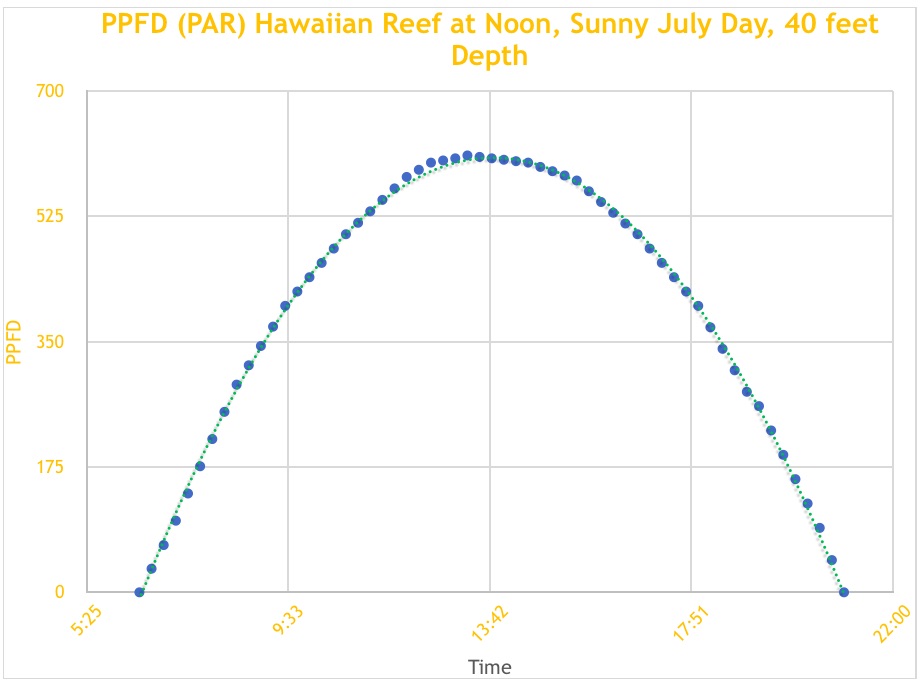
What is PAR and how much do we need?

Its not full spectrum, it’s the older model from a few years back.
You‘d be just as well getting a Seneye, or renting an MQ510.

I have an MQ510, used it four times and the last time was just because I was bored.
Thank you for the suggestion, I am torn between buying one and or renting one. I think you made a good point. Renting a 510 from BRS is 70$, if I do it right and not change my tank or the lights or the mounting option that is the only dollar amount I will be sending. Just my thoughts ..
 
My question is: over what peak intensity period would you expect this?
I had a conversation with Dana on this a few weeks back, and despite his best efforts, I’m thick, so I understood about 27.3% of what he said.

For example, you say for acros that 400 - 500+ is something to aim for, over 6 hours, 8, 10? Does it matter if there is ramp up time?

I am not the expert and I am sure someone can comment on this better than I. I set up my highest peak for a short time, trying to mirror how the earth rotates around the sun or some say it the other way. I do not have any Acros so my experience with them is none.
 
Thank you for the suggestion, I am torn between buying one and or renting one. I think you made a good point. Renting a 510 from BRS is 70$, if I do it right and not change my tank or the lights or the mounting option that is the only dollar amount I will be sending. Just my thoughts ..

I like the fact that you can rent them from BRS, much cheaper than purchase. I purchased one because this will not be the only time I will need it. I am learning as much as I can for the future build, we are looking into a room addition and installing an 800-1000 gallon tank with a fish room behind it. I have been planning it for years.
 
I like the fact that you can rent them from BRS, much cheaper than purchase. I purchased one because this will not be the only time I will need it. I am learning as much as I can for the future build, we are looking into a room addition and installing an 800-1000 gallon tank with a fish room behind it. I have been planning it for years.
Good luck with the new build, that is a major undertaking - money, time and a mix of blood and sweat :)
 
Great article on an important subject. I rented the meter from BRS and did a thorough access for my tank which I posted on the sticky thread.

I do have a question for which I've not been able to find an answer. How does duration of exposure fit into the equation? For example, how does 8 hours of 200 par compare to 4 hours of 400 par? I would think a relationship must exist but I've not been able to find information that explains this. I imagine its not linear, but perhaps should be factored in when scheduling exposure time.
 
Great article on an important subject. I rented the meter from BRS and did a thorough access for my tank which I posted on the sticky thread.

I do have a question for which I've not been able to find an answer. How does duration of exposure fit into the equation? For example, how does 8 hours of 200 par compare to 4 hours of 400 par? I would think a relationship must exist but I've not been able to find information that explains this. I imagine its not linear, but perhaps should be factored in when scheduling exposure time.
Your referring to dli or daily light integral.
Here is the formula for calculating DLI with a quantum meter.

μmol m-2s-1 x (,3600 x photoperiod) / 1,000,000 = DLI

- μmol m-2s-1 is a reading, or averaged readings, from the quantum meter

- 3,600 is the number of seconds in an hour

- Photoperiod is the period (in hours) of light exposure per 24 hours

- 1,000,000 is the number of μmols per mole

For example, 38.1 μmol m-2s-1 x 3600 seconds/hour x 12 hour photoperiod / 1000000 μmoles/mol = 1.6 mol. m-2d-1 (or 1.6 moles/day).

The more scheduled readings a user takes with their quantum meter throughout the day, the more representative the data becomes. You can substitute an averaged reading (per day) for the single reading in the above equation.

The photoperiod in the equation serves to estimate values for missed measurements, and can be removed from the equation in a scenario where readings are consistently taken throughout the day (such as item 3501 Greenhouse Growth Tracker).
 
Last edited:
So help me out a bit more, I'm being a little dense. If a species of coral has been determined to require 300 PAR but I only have 200 PAR available artificially, can I lengthen the exposure time to compensate for the lower PAR?
 
So help me out a bit more, I'm being a little dense. If a species of coral has been determined to require 300 PAR but I only have 200 PAR available artificially, can I lengthen the exposure time to compensate for the lower PAR?
Generally speaking but it's really way more complicated than that.

I and you need to defer to experts.

Bear in mind that it is acceptable to expose a coral to light intensities higher than shown in Figure One, especially if expression of intense coloration is desired.
There can be minor or major differences and things like light saturation point need to be considered or amount /type of pigment production based on intensity and/ or spectrum.

This x coral needs y par is really insufficient.
How would one conclude 300 par is err ideal?
reef-par-test-at-the-natuer.jpg

Goes for any photosynthetic organism.
 
This is my first time reading the article Lighting the Reef Aquarium Part 4, Dana Riddle explain the saturation points of various Acropora species. Some good stuff. Thanks oreo5457 for sharing.


1612099471518.png
 
@oreo5457 , @ShepherdReefer I agree with your statements and like the charts you've shared:

"This x coral needs y par is really insufficient.
How would one conclude 300 par is err ideal?"

And I like and understand the time chart you offered.

The problem I have difficulty resolving is that often many vendors will describe a coral as requiring "high" light, or light with a PAR of 300 for example. I think the Saturation Points of Acropora species is fantastic and I would like to see that for other species also. That said, what if I see a species that has a 300 par saturation point and I only have lights that reach 200 par? Does that mean I should not consider the species for my tank at all, or, if I increased the duration of light from say 8 hours to 12 hours I would be ok?

I may be over complicating the issue. I probably wouldn't even consider the species requiring the 400 par saturation in this scenario, but I might be willing to push the envelope on the 300 par species. On the other hand, if others before me have tried to "push the envelope" in this manner, I would love to be able to benefit from their experiences.

Thanks for the thoughtfulness of your posts.
 
This is my first time reading the article Lighting the Reef Aquarium Part 4, Dana Riddle explain the saturation points of various Acropora species. Some good stuff. Thanks oreo5457 for sharing.


1612099471518.png
Br aware of self-shading when viewing the Acro Saturation Point chart. The shaded part of a branching coral (those with Saturation Points less than 100) should receive the amount of light (or close to it) in the chart. Point the PAR meter sensor downwards to estimate the amount of light reflected from the sand bed or bottom of the tank.
 
So help me out a bit more, I'm being a little dense. If a species of coral has been determined to require 300 PAR but I only have 200 PAR available artificially, can I lengthen the exposure time to compensate for the lower PAR?
Yes. It can be that simple. There comes a point though when insufficient PAR intensity can't pen coral tissue and extending time doesn't help.

Also, I've met Sanjay in person, and he's pretty grounded in terms of his approach towards lighting and not a fan of a lot of what the reef lighting industry is pushing. When I mentioned the UV spectrum lunacy he acted like I insulted his ancestors for wasting oxygen bringing it up.
 
This thread has taken a twist from PAR to PUR. The need for ultraviolet radiation/violet light is raised from time to time. Let me present some facts - if you're intelligent enough to maintain a reef aquarium, you're certainly smart enough to form your own opinions. Is UV-A (315 -380nm or 400nm, depending upon your reference)/violet light (400nm - 450nm) absolutely required by zooxanthellae? Probably not. This isn't an true analogy, but if you've ever visited the Thurston Lava Tube on the Big Island of Hawaii, you've seen ferns growing where the only illumination is by sodium vapor lamps. The peak emission of sodium vapor lamps is yellow-green through red (HPS) or orange (LPS) with minor shoulders in the violet/blue portion of the spectrum in the HPS lamps. Bear in mind the accessory pigments in zooxanthellae are different from those in ferns, but the point is that these ferns are growing in mostly orange/red light. Is some portion of UV-A radiation and violet light useful in zooxanthellae photosynthesis? Certainly. In addition, fluorescence of some proteins found in coral tissues is excited by UV-A and violet radiation. There is evidence that the presence (or not) of violet radiation can cause shifts in fluorescent emissions of protein found in some corals. Some of the violet non-fluorescent proteins in corals merely reflect that portion of the spectrum.
 
Mr. Paletta Looked into some folks Par and a couple are running 750 to 800. His own tank runs over 1000 for 5 months a year.
 
This thread has taken a twist from PAR to PUR. The need for ultraviolet radiation/violet light is raised from time to time. Let me present some facts - if you're intelligent enough to maintain a reef aquarium, you're certainly smart enough to form your own opinions. Is UV-A (315 -380nm or 400nm, depending upon your reference)/violet light (400nm - 450nm) absolutely required by zooxanthellae? Probably not. This isn't an true analogy, but if you've ever visited the Thurston Lava Tube on the Big Island of Hawaii, you've seen ferns growing where the only illumination is by sodium vapor lamps. The peak emission of sodium vapor lamps is yellow-green through red (HPS) or orange (LPS) with minor shoulders in the violet/blue portion of the spectrum in the HPS lamps. Bear in mind the accessory pigments in zooxanthellae are different from those in ferns, but the point is that these ferns are growing in mostly orange/red light. Is some portion of UV-A radiation and violet light useful in zooxanthellae photosynthesis? Certainly. In addition, fluorescence of some proteins found in coral tissues is excited by UV-A and violet radiation. There is evidence that the presence (or not) of violet radiation can cause shifts in fluorescent emissions of protein found in some corals. Some of the violet non-fluorescent proteins in corals merely reflect that portion of the spectrum.

Really don't understand what you mean. :).
 
You bet Shepherd, I didnt understand that comment either. Sanjay's 1400 PAR at the surface then Mr Palettas 1000 is sure fascinating. Take care.
 

IF YOU HAD TO TAKE A REEFING EXAM, WOULD YOU PASS?

  • Yes!

    Votes: 32 45.7%
  • Not yet, but I have one that I want to buy in mind!

    Votes: 9 12.9%
  • No.

    Votes: 26 37.1%
  • Other (please explain).

    Votes: 3 4.3%

New Posts

Back
Top