Why all the different LED colors blended?

sawdonkey

Valuable Member
View Badges
Joined
Jan 8, 2014
Messages
2,183
Reaction score
3,334
Location
Chicago
What state or country do you live in
Illinois
Rating - 0%
0   0   0
I’ve been thinking about lighting a lot these days and this is going to come off as a noob question. Many of the popular light brands cluster a bunch of different colored LEDs together with the goal of having all of the spectrums blend into and a desired overall spectrum (I think this is the goal?). If all of the individual spectrums are blended, do the individual spectrums that make up the overall spectrum matter?

Why can’t we just determine what the best overall spectrum is, and make a COB led that achieves that and do away with all of the individual LED colors?

Please know this question comes from a place of complete ignorance, so by all means, tell me where I’m off base.

 
Why can’t we just determine what the best overall spectrum is, and make a COB led that achieves that and do away with all of the individual LED colors?

The problem is determining that "best overall spectrum". Part of that answer can be objective, but still not easy to answer and almost certainly would vary based off of the specific coral/macro/invert we are talking about. Even then though the "best" spectrum may vary based off whether you are talking about.... growth/color/health/etc. The other part of that answer to the "best overall spectrum" is most certainly subjective. Some people want a bluer look.... some want a whiter look.

Back when I ran metal halide I read a lot of data to be convinced a 6500k bulb could give me max growth for my acros. However this was not the light I liked best and much preferred a 14k look... even if it meant it was not the best (in this context "best" being determined by acro growth).

I would also add that making a single LED bulb emit broad spectrum wavelengths is as I understand it much more complicated than with something like incandescent and while they can and do make broader spectrum led bulbs it is not as straight forward as with something like metal halide or incandescent where you are always going to get a fairly broad spectrum.

In any case I think most people like the controllability of being able to easily change the spectrum of their light by increasing/decreasing intensity of specific channels. Certainly not saying it is needed for a successful tank (MH/T5/etc) have shown us that, but what most consumers have come to expect.
 
I’ve been thinking about lighting a lot these days and this is going to come off as a noob question. Many of the popular light brands cluster a bunch of different colored LEDs together with the goal of having all of the spectrums blend into and a desired overall spectrum (I think this is the goal?). If all of the individual spectrums are blended, do the individual spectrums that make up the overall spectrum matter?

Why can’t we just determine what the best overall spectrum is, and make a COB led that achieves that and do away with all of the individual LED colors?

Please know this question comes from a place of complete ignorance, so by all means, tell me where I’m off base.
You are not off base but depending on what parts if the spectrum you consider important determines the number of colors.

One can take a violet or royal blue " pump" and add all sorts of phosphors to create your reef centric one diode ( or cob) approach.
Same as how you got dozens of " colors" of t5's and metal halides as an example.
BUT there are 2 catches 1) Apparently industry doesn't t care to and 2) This would subtract from the " adjustability"

Technically yet crudely there are such creatures with 10000k or greater led chips.
Using just a blue pump and yellow/green phosphor is too crude and/ or unacceptable visual quality.

Lastly afaict you can't "up" nm with phosphors so your high energy is determined by the nm of the pump.

Using say 365nm leds and down converting the spectrum w/ phosphors is currently not practical for a number of mostly economic reasons.
 
Ohhh sooo close..
I would also add that making a single LED bulb emit broad spectrum wavelengths is as I understand it much more complicated than with something like incandescent and while they can and do make broader spectrum led bulbs it is not as straight forward as with something like metal halide or incandescent where you are always going to get a fairly broad spectrum.

No.. They are at least equally easy..IF one ends at the most important visual part..

This is sort of a cheat.. A Bridgelux 6500 high cri COB BUT uses 2 different blue "pumps" plus phosphors

bridgeluxeb6500k.JPG

iwablue.JPG
 
The problem is determining that "best overall spectrum". Part of that answer can be objective, but still not easy to answer and almost certainly would vary based off of the specific coral/macro/invert we are talking about. Even then though the "best" spectrum may vary based off whether you are talking about.... growth/color/health/etc. The other part of that answer to the "best overall spectrum" is most certainly subjective. Some people want a bluer look.... some want a whiter look.

Back when I ran metal halide I read a lot of data to be convinced a 6500k bulb could give me max growth for my acros. However this was not the light I liked best and much preferred a 14k look... even if it meant it was not the best (in this context "best" being determined by acro growth).

I would also add that making a single LED bulb emit broad spectrum wavelengths is as I understand it much more complicated than with something like incandescent and while they can and do make broader spectrum led bulbs it is not as straight forward as with something like metal halide or incandescent where you are always going to get a fairly broad spectrum.

In any case I think most people like the controllability of being able to easily change the spectrum of their light by increasing/decreasing intensity of specific channels. Certainly not saying it is needed for a successful tank (MH/T5/etc) have shown us that, but what most consumers have come to expect.
Yeah, I guess saying “best spectrum” was not the best way to phrase this. Maybe there could be a choice for visual or tank specific concerns, but one COB led that accomplishes this…kinda like a T5 bulb. What I think you are saying is that LED have a very narrow spectrum. With T5, you choose “blue plus” or something like that, and you get colors across the spectrum. But a single LED is incapable of creating “blue plus” and con only do 450 or 470….etc?
 
You really can't achieve all of the parts of the spectrum you need with a single LED, basically. You need red and you need blue, so practically speaking they need to come from different sources, hence the smattering of LED colors on the lights.

Now do we all need fifteen types of blue LEDs? Probably not, but in the reefing community more is always better and the most expensive is clearly the best :)
 
Yeah, I guess saying “best spectrum” was not the best way to phrase this. Maybe there could be a choice for visual or tank specific concerns, but one COB led that accomplishes this…kinda like a T5 bulb. What I think you are saying is that LED have a very narrow spectrum. With T5, you choose “blue plus” or something like that, and you get colors across the spectrum. But a single LED is incapable of creating “blue plus” and con only do 450 or 470….etc?
No, not at all.
4000k phosphor converted blue pump has plenty of red and blue and green and yellow.....
The less phosphors the higher the k....till zero phosphors and just the royal blue

1438578381_84280.png
 
Last edited:
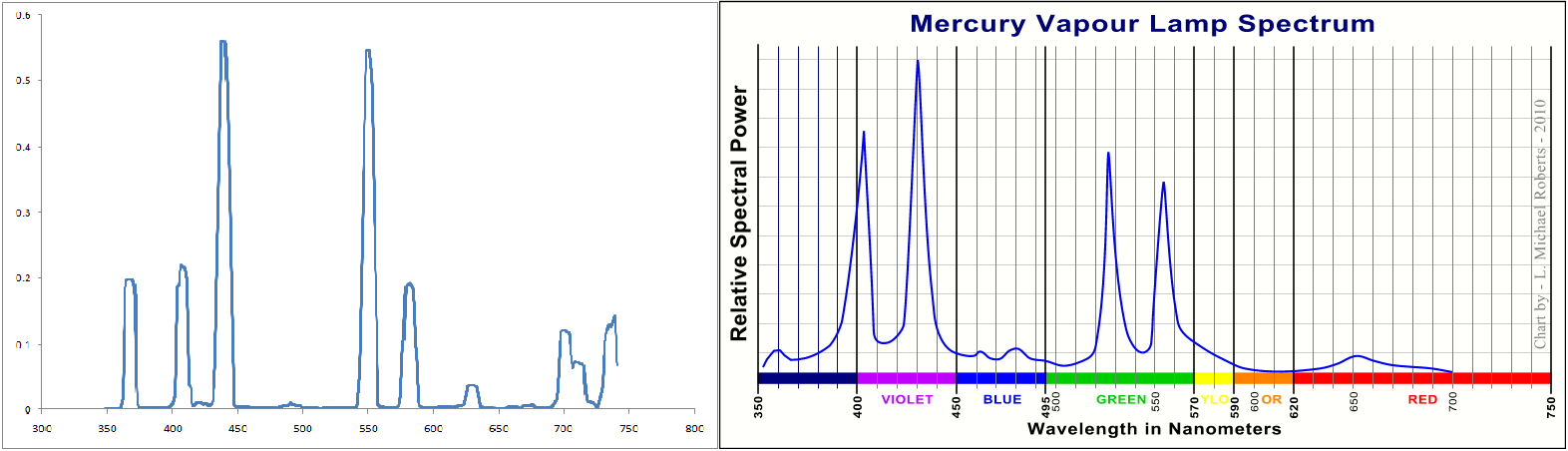
Mercury based lamp prior to salts or phosphors.. General spectrum and changes w/ pressure.
mercury1.png


roughly what a metal halide lamp looks like without "additions"
Probably why one adds multiple blue nm diodes which, again, is easily manufactured in an led using a violet pump and a broad blue phosphor.. for the blue part..they just don't do it..except to add more phosphors (green, red) to make high cri "sunlight" like leds.

The emission spectrum of OSRAM HQL 125 W mercury vapor lamp​

The-emission-spectrum-of-OSRAM-HQL-125-W-mercury-vapor-lamp-used-in-the-study-Reproduced.png
 
Last edited:

IF YOU HAD TO TAKE A REEFING EXAM, WOULD YOU PASS?

  • Yes!

    Votes: 32 45.7%
  • Not yet, but I have one that I want to buy in mind!

    Votes: 9 12.9%
  • No.

    Votes: 26 37.1%
  • Other (please explain).

    Votes: 3 4.3%
Back
Top