Navigation
Install the app
How to install the app on iOS
Follow along with the video below to see how to install our site as a web app on your home screen.
Note: This feature may not be available in some browsers.
More options
You are using an out of date browser. It may not display this or other websites correctly.
You should upgrade or use an alternative browser.
You should upgrade or use an alternative browser.
worm with white ends
- Thread starter dr_vinnie_boombatz
- Start date
- Tagged users None


- Joined
- Jan 16, 2024
- Messages
- 114
- Reaction score
- 99
- Location
- North Texas
- What state or country do you live in
- Texas
That thing is awesome looking! I have no idea tho maybe @ISpeakForTheSeas can help.


My first thought would be a Syllid worm of some variety (most of which are harmless), but is there any chance you could get clearer pics, OP?

OP
OP

Took some time but I managed to get one! It manages to hold onto things extremely well, it lives under coral, does not fully leave, and recoils back super quick when spookedMy first thought would be a Syllid worm of some variety (most of which are harmless), but is there any chance you could get clearer pics, OP?
I believe I had ripped off the tail since it was hanging on
Last edited:
Nice pic of the bristles/body! You can even see some of the characteristics of the chaetae (the bristles).Took some time but I managed to get one! It manages to hold onto things extremely well, it lives under coral, does not fully leave, and recoils back super quick when spooked
I believe I had ripped off the tail since it was hanging on
Yeah, this is definitely a different worm than the first one.
A couple ID-related questions:
Is this the head?
Or is this the head? (I know these questions seem ridiculous, but some worms have weird heads and weird tails).
If the first one is the head, does it have four tentacles or five? The translucence of the tentacles has me second guessing myself.

OP
OP
That's a great question @ISpeakForTheSeas - I was wondering the same thing as I was taking the pictures! I believe it is 4 tentacles and assumed that was the head, but now am second guessing myself. Unfortunately I only have the one photo of the other side, it was moving and unremarkable so I focused on the tentacles thinking that was the head. I do have a few more pictures, hopefully they help. In hindsight I should have taken some video and more pictures 
Thanks again for all your help!!
direction of movement denoted with arrow


Thanks again for all your help!!
direction of movement denoted with arrow

- Joined
- Dec 27, 2022
- Messages
- 407
- Reaction score
- 197
- Location
- Sweden
- What state or country do you live in
- Other International
i think i have these living in my lobophyllia skeleton and in other places under rocks, dont think they harm the coral cause the lobo hasnt died or been injured, they look like caterpillars almost they almost have no tentacles at the front of their head which makes me think they look like caterpillars.
Yeah, seeing the direction of movement there, I'm assuming the head is the tentacle-free, rounded part, and the tail is the part with the four tentacles (which would be two pairs of pygidial cirri in this case).That's a great question @ISpeakForTheSeas - I was wondering the same thing as I was taking the pictures! I believe it is 4 tentacles and assumed that was the head, but now am second guessing myself. Unfortunately I only have the one photo of the other side, it was moving and unremarkable so I focused on the tentacles thinking that was the head. I do have a few more pictures, hopefully they help. In hindsight I should have taken some video and more pictures
Thanks again for all your help!!
direction of movement denoted with arrow
I feel pretty confident this is some kind of Lumbrinerid worm (differentiated from Oenonid worms by the presence of the hooks mixed in amongst the chaetae - the bristles), but I can't quite tell for sure from the pics (again, the pics are great - this specific feature is just hard to see from a top view; pics of this feature are typically taken either directly from the side or the front).
Using your pic (below), you can see the limbate chaetae (the bristles that bend about halfway through their length and look kind of like sickles or the arms of a praying mantis) - in Lumbrinerid worms, there should be hooks beneath/mixed in with the chaetae. The first link below has four different figures (basically collages of different Lumbrinerid species' features) on it (the first figure is where the link lands) that show this fairly clearly; the second and third links show it fairly clearly as well, but they show very different-looking versions of it. Between the three links, it should give an idea of what to look for with the hooks.
A new species of Lumbrineriopsis (Annelida, Eunicida, Lumbrineridae) from southeastern Brazil
ZooKeys is a peer-reviewed, open access, online and print, rapidly published journal, launched to support free exchange of ideas, data and information in all branches of Zoology. It is one of the most dynamic, innovative and technologically advanced scholarly journals in its field. Zookeys was...
zookeys.pensoft.net
Taxonomy, phylogeny, and biodiversity of Lumbrineridae (Annelida, Polychaeta) from the Central Pacific Clarion-Clipperton Zone
ZooKeys is a peer-reviewed, open access, online and print, rapidly published journal, launched to support free exchange of ideas, data and information in all branches of Zoology. It is one of the most dynamic, innovative and technologically advanced scholarly journals in its field. Zookeys was...
zookeys.pensoft.net
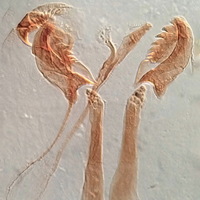
A new species of Lumbrineriopsis (Annelida, Eunicida, Lumbrineridae) from southeastern Brazil
Lumbrineriopsis dulcis sp. nov. is morphologically described from the continental shelf and slope of Espírito Santo and the Campos Basin of Rio de Janeiro state, southeastern Brazil, at depths between 14 and 400 m. Lumbrineriopsis mucronata is the only species of the genus recorded until now in...
zookeys.pensoft.net

Taxonomy, phylogeny, and biodiversity of Lumbrineridae (Annelida, Polychaeta) from the Central Pacific Clarion-Clipperton Zone
The DNA taxonomy of six species of the annelid family Lumbrineridae collected from the Clarion-Clipperton Zone (CCZ) in the Central Pacific, an area of potential mining interest for polymetallic nodules, is presented. Lumbrinerids are an ecologically important and understudied annelid family...
zookeys.pensoft.net
If it turns out to be a Oenonid worm, then it's most likely going to be predatory towards bivalves (clams, oysters, scallops, mussels, etc.) and gastropods (snails).To quote about their diet:
"most lumbrinerids are carnivores on both sessile and motile prey, with a few herbivorous and subsurface deposit-feeding exceptions"*
The carnivorous ones tend to eat things like bivalves, snails, other worms, brittle starfish, and occasionally Heart Urchins (Spatangoida). The herbivorous ones feed on diatoms, sea grass, etc.
*Source:
Diet of Worms Emended: An Update of Polychaete Feeding Guilds - Appendix A - Family-by-Family Review
(The paper)
https://www.annualreviews.org/content/journals/10.1146/annurev-marine-010814-020007 (The link you can download the Appendix from)
Diet of Worms Emended: An Update of Polychaete Feeding Guilds | Annual Reviews
Polychaetes are common in most marine habitats and dominate many infaunal communities. Functional guild classification based on taxonomic identity and morphology has linked community structure to ecological function. The functional guilds now include osmotrophic siboglinids as well as...www.annualreviews.org
Either way, probably not a keeper worm in this case.

OP
OP
Thank you @ISpeakForTheSeas - you are the best!! This is super interesting!
Similar to @kjkszpj9 this worm doesn't bother LPS or attack astera snails but will go violently for mysis shrimp
I found this article on Oenone worm and did not notice any "ooze" when observing the worm. I did find this worm was like Spiderman in that it would stick to all surfaces, and would not fall off even with shaking.
 melevsreef.com
Found two more related pictures, is this the hook in the upper right?
Thanks again!


Similar to @kjkszpj9 this worm doesn't bother LPS or attack astera snails but will go violently for mysis shrimp
I found this article on Oenone worm and did not notice any "ooze" when observing the worm. I did find this worm was like Spiderman in that it would stick to all surfaces, and would not fall off even with shaking.
Oenone Fulgida - A predatory worm | Melev's Reef
Found two more related pictures, is this the hook in the upper right?
Thanks again!
Yeah, those seem to show hooks - so, Lumbrinerid it is.Thank you @ISpeakForTheSeas - you are the best!! This is super interesting!
Similar to @kjkszpj9 this worm doesn't bother LPS or attack astera snails but will go violently for mysis shrimp
I found this article on Oenone worm and did not notice any "ooze" when observing the worm. I did find this worm was like Spiderman in that it would stick to all surfaces, and would not fall off even with shaking.
Oenone Fulgida - A predatory worm | Melev's Reef
Found two more related pictures, is this the hook in the upper right?
Thanks again!