6500k T5 Bulbs - Important Spectrums Missing in LEDs?

Don't have many photo's left. The tank was shut down over five years ago. This looks about 70% white.
IMG_9255.JPG


Purple-420nm gives the greatest variety and quality of fluorescence compared to all other colours. The problem is all other colours quickly over power it, so it takes a lot of purple.
The yellow stag center/left is from a warm white led. The green frag far right/top is the same coral. The blue stage top/center is getting approx. 800 par.
 
In the same vein of learning the facts of lighting, the history and evolution in reefing can also be very important. VHO & NO T12 and HPS were around when I got in. I was around for all of the rest of this... running a Pet Store both selling and using the stuff. There were no real doubters about T5 outside of the few outliers that doubt/hate everything (keep in mind that NO T12s were common and able to deliver really nice reefs in high numbers) - even those were quickly converted.** There were no real doubters about MH, but a few as 14 and 20k bulbs came out - again, quickly converted.*** Nobody doubted HQI when it came out. There were real doubters about PCs - they were proved right. LEP had doubters - quickly faded. Sunlight tubes - a really good idea if you can swing it... always was and still are. There were, and still are, real doubters about LED and their ability to get to the same level as other lights - this is still ongoing, but it has been a decade+... which is like a thousand years is today's innovation timeline.

LED is the first real tech that has stayed in limbo for long... all others either were universally accepted (not used by all, but accepted by all), or quickly failed with only a few relics remaining.

** The reason that VHO T5 was a thing was not because people did not believe in HO T5s. It was because a lot of people had VHO T12 retro'd into their canopies and hoods and all that they had to do it to swap out the end caps (and live with no 6' bulbs). Just about any solid reefer had a Icecap ballast running something and available to use. As Icecap went out of business and open-top, AIO tanks got more popular with people wanting fixtures like ATI, Giesemann, AquaMedic, etc., then just normal attrition and customer preference cut the usage of VHO T5s. Some people still use them with tremendous success.

*** If anything, people invested into MH too much... using dual 400w setups over 55g tanks where 175w would have been enough. I know people that got 3x 1000w halides for a standard 180g. This trend did not last long.
 
I would highly recommend viewing Tullio's MACNA 2017 presentation on the nature of light. This is purely a scientific presentation and not an advertisement for any brand or type of light. However, it does underline the basics of the physics of light as it relates to our reef aquariums. Tullio is one of the most respected people in the field of LEDs and lighting in general, consulted by major public aquariums and light manufacturers. So rather than go forward based on anecdotes and personal experience, let science lay our foundation for the understanding of how light functions and how we can best utilize various types of lights to the benefit of the needs of our corals.


Thank you, a-mused! I can't believe how seldom this presentation has been brought up. I was just about to mention Tullio Dell Aquaila's presentation at MACNA 2017. I've never been able to get his comment about points of LED light being like sun through a magnifying glass on our animals. His passing comment really enforced on me that we really need to think more about optics, dispersion, and blending of light from LEDs.
 
What a great read on a Friday morning to kill some work time. @jda , I came in back in the late 90's with NO and berlin style tanks. then in the early 2000's I tried PC and eventually settled back on tried and True t-12VHO. LOVED those. ICE cap ballasts and big fat bulbs. Had one of the best growing least maintenance tanks under those bulbs (4x48" on a 75g). when I got my 180, it had 3x 350watt MH with Lumantek reflectors and Icecap electronic ballasts. also 4x36 T-5 in the canopy. that setup was great but the heat was Killer. I ran some cheap bulbs from 1000bulbs.com and man did they grow coral. these were 14k bulbs but were much closer to a 10K in reality. I am strictly LED Now. Love the fine tune ability of them.
 
Cant tell ya. However IIRC there was alot of GROWTH successes when we used 10k or less MH bulbs. at that time those of us in that camp laughed at the windex looking blue tanks thinking that color was just for show to make corals glow with unnatural colors. In my mind, get yoru tank goals and light accordingly. if you like that blue look, go for it. I prefer a 12k look.


I did play with my Hydra26HD a bit and maxing the cool white and the green as best I can does not seem to significantly impact the yellow spectrums.
 
Last edited:
I did modify my AB+ schedule since I opted out for the non pro versions of the Radions G4 and figured I needed an extra bit more of white to compansate for the missing LEDs although it’s just a few whites and some UVs, but after reading that others run successful tanks running all channels at 100% i been slowly raising white green and red. 100% on the blues and 50-70% w/r/g I’m currently at 100% all blues and 50% w/r/g and have not noticed any ill effects on any of my corals expect a few LPS I had to remove from direct light. I been raising them 5% every 2 weeks for the past few months but have not noticed Any significant color changes in my sps except for my blue torts I feel are def more solid blue the purple hues are gone now
 
Don't have many photo's left. The tank was shut down over five years ago. This looks about 70% white.
IMG_9255.JPG


Purple-420nm gives the greatest variety and quality of fluorescence compared to all other colours. The problem is all other colours quickly over power it, so it takes a lot of purple.
The yellow stag center/left is from a warm white led. The green frag far right/top is the same coral. The blue stage top/center is getting approx. 800 par.


So, if that is the way it looks in person, that is the exact color I am looking for.

How was growth?
 
Are there any analysis on a mainstream like Radions or Kessels at 8" versus 18'-24" above water and spectrum at coral location? Say at 100%/100% would be interesting. I believe most aquaculture are running 24" above water surface. I've definitely seen more "punch" through the water column with LED's despite anemic readings on PAR meters. Alton, what is our club meter again?
 
Radion also states that their less popular Pheonix 14k program which runs more whites and red, gives increased coral growth compared to the AB+ program. Honestly, too blue of light bugs me, and too white of light bugs me as well. I think about 15-16k looks neutral enough to my eyes.

With a Radion G4, I wonder if that would be best achieved by using the spectrum slider, or just by increasing the cool/warm whites.

Additionally, Orphek is a believer in the higher infrared spectrums -- This is, I believe, lacking on almost all lighting sources except specialized LED's. Traces of IR may be present in some Halides if I remember correctly.
 
Radion also states that their less popular Pheonix 14k program which runs more whites and red, gives increased coral growth compared to the AB+ program. Honestly, too blue of light bugs me, and too white of light bugs me as well. I think about 15-16k looks neutral enough to my eyes.

With a Radion G4, I wonder if that would be best achieved by using the spectrum slider, or just by increasing the cool/warm whites.

Additionally, Orphek is a believer in the higher infrared spectrums -- This is, I believe, lacking on almost all lighting sources except specialized LED's. Traces of IR may be present in some Halides if I remember correctly.


I was wondering the same thing but the problem is when you move the warm and cool whites only it doesn’t change the spectrum slider??

But then if you move red and green the spectrum slider changes like crazy ....

I love the 15-16k spectrum best also because I don’t like too blue of a look or too red of a look....
 
I recently switch my halides from a 20k bulb (ran for 12 months) to a 10k bulb and within 10 days all my corals have colored up better.. so far growth rate is about the same.
 
Anybody wonder that the reason that 100% LED systems look go so good because corals do not really care for PWM? How can it matter... I mean, we cannot see it, right (this is a joke, BTW)?

Other than spectrum, PWM is something to put on the list that is different at 100%.
 
Traces of IR may be present in some Halides if I remember correctly.

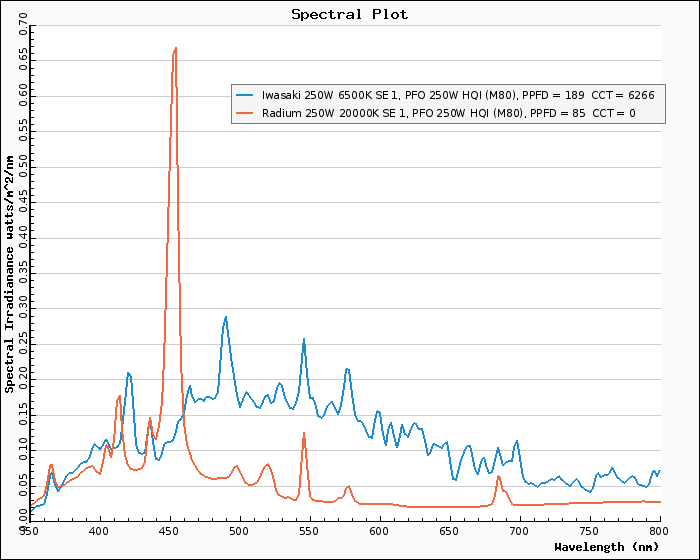
There is quite a bit of IR and also UV in Metal halides. This is why I always post graphs from 350 to 800nm since I believe that all of this spectrum is useful. If you look back at the graphs in post #14 you can see the good amount of real output from 350-400 nm (which was talked about in that presentation as being very useful), but also from 700-800nm which is the IR.

Here is the chart again:


I have posted about this before, but when I tested bulbs using an integrating sphere and a $50k spectrometer at the university, there is about 2 to 4% of output above 800 that is nothing but heat in the MH bulbs that we tested. The "bluer" bulbs like 20k Radium, 14k Phoenix and 14k Ushio all were just about 2%. Iwasaki 6500k was closer to 4% - you can see this in the chart as well. This is energy that is just wasted unless you live in a colder climate. We found that there was no efficiency in any MH bulb or LED panel when comparing radiated watts to input watts - the MACNA presentation linked above pretty much says the same thing and most people have come to realize this. We could not test T5s since the sphere was only about 24".

My hope is that someday, somebody can fine tune a MH bulb to stop production at, or around, 800nm. This would take out nearly all of the heat and then it might be even more the perfect light source. The new Hamilton 20K, Radium 20k and Phoenix 14k are all cooler than a 10k or 6500k bulb, but they still need fans at my house.
 
How was growth?
Average. Approx 1-1.5cm a month on the thick branching stags.

Without side tracking the original question to much, the most import consideration in light design IMO is: the angel of incidence of light on a circular branch. If fluorescence is greatest perpendicular to the light source (the top down look), consider the 2 scenarios in following diagram and the distribution of light over the branch.
coral.jpg

I like a par reading where when you rotate the meter from vertical to the front of the tank the reading remains reasonably constant.
 
There is quite a bit of IR and also UV in Metal halides. This is why I always post graphs from 350 to 800nm since I believe that all of this spectrum is useful. If you look back at the graphs in post #14 you can see the good amount of real output from 350-400 nm (which was talked about in that presentation as being very useful), but also from 700-800nm which is the IR.

Here is the chart efficiency in any MH bulb or LED panel when comparing radiated watts to input watts - the MACNA presentation linked above pretty much says the same thing and most people
 

IF YOU HAD TO TAKE A REEFING EXAM, WOULD YOU PASS?

  • Yes!

    Votes: 32 45.7%
  • Not yet, but I have one that I want to buy in mind!

    Votes: 9 12.9%
  • No.

    Votes: 26 37.1%
  • Other (please explain).

    Votes: 3 4.3%
Back
Top