Amphidinium Dinoflagellate Treatment Methods

It was easier to convert the videos to smaller files than I thought. Here they are. Quite a lot are not moving at all, others move very quickly.
Those are indeed amphidinium

...Here's what I found....

Prorocentrum
Prorocentrum_Dinoflagellates_large.jpg

The top pic is prorocentrum micans, a planktonic type that we don't have show up in our systems. Our prorocentrum look like prorocentrum Lima

 
Those are indeed amphidinium


The top pic is prorocentrum micans, a planktonic type that we don't have show up in our systems. Our prorocentrum look like prorocentrum Lima

Thank you for the correction. The description sounded like what he was referring to that I saw on this site...


Although it shows mostly reef aquariums, now that I re-read it, it applies to all aquaria.
 
@taricha - I spoke with the Hanna rep at MACNA last week hoping to buy the silica checker Hi705 at a MACNA discount. He said that it is only good in freshwater. I referred him to this thread but haven't heard anything back from him yet.

Are you still finding the Hanna checker good enough for what we need? Or would I be better trying to get the Hach test kit which is much more expensive?
 
@taricha - I spoke with the Hanna rep at MACNA last week hoping to buy the silica checker Hi705 at a MACNA discount. He said that it is only good in freshwater. I referred him to this thread but haven't heard anything back from him yet.

Are you still finding the Hanna checker good enough for what we need? Or would I be better trying to get the Hach test kit which is much more expensive?
I am aware that hanna says their meter is only approved for FW. However it is rock-solid consistent in SW testing around ~10% below expected values according to data from Rick Mathew.
So my assumption is that since this is above hanna's stated uncertainty - to them that makes it not approved.
To us a ~10% undermeasure error is miles better than the 100% error that other hobby grade Si kits give.
 
I'm guessing these are amphidinium? They aren't moving much at all.

0912191537c.jpg


0912191608_HDR.jpg


I also have what looks like a small amount of osteropsis and cyano.
 
I'm guessing these are amphidinium? They aren't moving much at all.


I also have what looks like a small amount of osteropsis and cyano.
I'm not 100% convinced this is dino. Do you have a short video showing the movement?
 
Yeah, I'm having hopeful doubts myself. They aren't moving quickly like the other vids I've seen and the shape is more square but the characteristics are very dino-like. 1. They started after I added new GFO before leaving for vacation. 2. They reced at night after lights out. 3. They started to become long and stringy. Here's a vid...


I'm just finishing a 72 hr. blackout and H2O2 dosing today. It looks like they are gone and the little rust left looks green so I guess I'll know in the next day or 2.
 
They aren't moving quickly like the other vids I've seen and the shape is more square but the characteristics are very dino-like. 1. They started after I added new GFO before leaving for vacation. 2. They reced at night after lights out. 3. They started to become long and stringy. Here's a vid...
Based on this, I'd presume it's a prorocentrum type dino. Amphidinium is not stringy/snotty.

I'd get a UV and later try another short blackout to push them into the water.
 
Based on this, I'd presume it's a prorocentrum type dino. Amphidinium is not stringy/snotty.

I'd get a UV and later try another short blackout to push them into the water.
I am a new member but I have been following and reading these posts. I have a 130 gal reef that I started with a transfer of live rock, corals and fish from a 30 gal in March 2019. I dropped my P to undetectable with GFO in May and have Dino infestation since. Would like help in identifying. Primarily on glass and sand with no sign of toxicity. Snails and hermits eat them off glass and seem fine. Attached a video. Only have 40x. Sorry about background music from our lab.

 
Last edited:
Based on this, I'd presume it's a prorocentrum type dino. Amphidinium is not stringy/snotty.

I'd get a UV and later try another short blackout to push them into the water.

Thanks! I hope so. I'll give it a try.
 
I am a new member but I have been following and reading these posts. I have a 130 gal reef that I started with a transfer of live rock, corals and fish from a 30 gal in March 2019. I dropped my P to undetectable with GFO in May and have Dino infestation since. Would like help in identifying. Primarily on glass and sand with no sign of toxicity. Snails and hermits eat them off glass and seem fine. Attached a video. Only have 40x. Sorry about background music from our lab.
check this video of oxyrrhis marina, a predatory dinoflagellate.
Yours looks similarly fast swimming, little pigment and spins a lot. These are all signs of heterotrophy - and those type dinos don't usually cause problems. they bloom and fade as their prey is consumed.

Got a pic of the affected area?
 
check this video of oxyrrhis marina, a predatory dinoflagellate.
Yours looks similarly fast swimming, little pigment and spins a lot. These are all signs of heterotrophy - and those type dinos don't usually cause problems. they bloom and fade as their prey is consumed.

Got a pic of the affected area?
Yes. Looks like the same motion of staying in place and doing donuts. These return to the glass shortly after scraping and sand after turning it over. They seem to be increasing in numbers and turning green as I try and raise phosphates to detectable levels. They are generally unaffected by my 25 watt AQUA UV running in DT. Snails and Coral Beauty eat them. Sorry I’m not a good photographer.

DF043545-074E-4B02-8415-03FE702CA982.jpeg D0377E8E-5CF8-4B52-B582-232C011EC14E.jpeg
 
Trying to figure out my game plan. Dosing Neonitro (5-10 ml/day) and NeoPhos (~20 ml/day). NO3 steady at 2.5ppm(salifert). PO4 0.1ppm post dose and below detection 12 hrs post (Hanna). Alk=8.6dkh, Ca2+ =460ppm, Mg2+ =1450ppm; NH3 and NO2 undetectable. Skimmer is running, GAC changed in reactor weekly, UV in DT, no water changes about 1.5 months. Lighting 12 hr cycle ATI 4xT5 and 2x Kissel A360. Refugium light off. Scrape front and side glass regularly to get Dinos through UV. UV has no real effect on Dino load. Front and side mainly Dinos(thick). Back glass has Dinos and some diatoms and coralline (leaving it alone). Sand has Dinos and are now on some rocks and SPS. After months of Dino infestation SPS is suddenly suffering rapid tissue necrosis. War coral is suffering, but most LPS seem ok. Fish, snails, hermits, and fish seem ok. Did 4 gal water change today. Started dosing spongexcel today and added diatoms from 30 gal. Very disheartened with coral loss. Ordered SurfZone Sand activator kit fro IPSF. Saw others use Garf Grunge. May get some new rocks from LSF. Anything else I should be doing?
 
Trying to figure out my game plan.


Let's take a couple of steps back.
I don't think your nuisance is amphidinium, maybe not a dino at all - as the microscope pics showed no recognizable problem dinos.
Secondly, raising N while P is still stuck at zero is an added stress to coral.

get a scraping of the glass where the bubbly film is and suck it up for microscope inspection. (or if the junk is easier to suck out from the rocks or sand do that.)
Let's find out what photosynthetic stuff is in that film. because it's not the zooming predators of the video.
 
Let's take a couple of steps back.
I don't think your nuisance is amphidinium, maybe not a dino at all - as the microscope pics showed no recognizable problem dinos.
Secondly, raising N while P is still stuck at zero is an added stress to coral.

get a scraping of the glass where the bubbly film is and suck it up for microscope inspection. (or if the junk is easier to suck out from the rocks or sand do that.)
Let's find out what photosynthetic stuff is in that film. because it's not the zooming predators of the video.
Thanks for the reply. Here is a picture of the front glass Thursday evening, followed by microscope shots of scraping from front glass Friday morning. I will also post a video of the front glass scrapin Whatever is growing on the glass will reappear within an hour or so after cleaning. Similar with cleaning the sand. I will get a scraping of the bubbly film isn’t he pic above near my WAV tomorrow morning.

33537A8B-F0A6-472F-9215-E404198BFFF2.jpeg FCE1E815-7744-4B36-97E4-BCEA1D2BCECE.jpeg 9D827593-DF72-47DC-A59C-38EE297D1820.jpeg
 
Thank you for the advice on not raising N while P is still zero. I may have done some damage to my corals. Today is my first 24 hr period where P did not drop back to zero. Here are some pics of the bubbly film area. First is 10x overview followed by two 40x. Fauna is more heterogeneous than what I see on glass surfaces that are more regularly cleaned.

1A3EEC47-9468-4DAF-83D6-2A26F5165DA4.jpeg 70385969-93CB-4D88-9741-2B91C7A3C52E.jpeg 26305312-3FD9-4C6A-907D-4C1D0B18B02E.jpeg
 
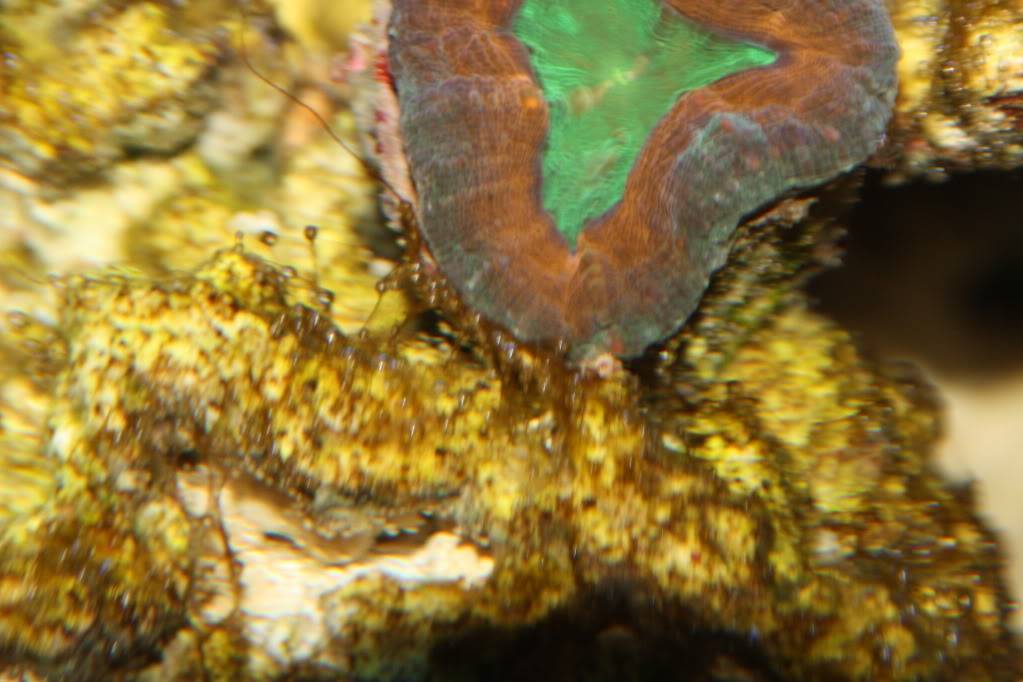
That makes more sense as the film. Lots of diatoms.
If you don't find dinos microscopically, and there was no sign of toxins - clean up crew was eating the films, then no reason to attempt to "cure dinos". Up the clean up crew and export algae growth.
 

IF YOU HAD TO TAKE A REEFING EXAM, WOULD YOU PASS?

  • Yes!

    Votes: 32 45.7%
  • Not yet, but I have one that I want to buy in mind!

    Votes: 9 12.9%
  • No.

    Votes: 26 37.1%
  • Other (please explain).

    Votes: 3 4.3%
Back
Top