

Boiling tank water releases phosphate

I'm not proposing a notion that 'hidden' phosphate increases cyanobacterial growth. I'm stating that a theoretical tank with a 'phosphate depot factor' of 3, compared to a tank with a depot factor anything less than 3, will have more P within said system.

Phosphorous increases risk for cyanobacterial growth, and is often the limiting factor for cyano growth in most ecosystems, so much so that cyanobacterium can uptake excess P relative to metabolic demand.

Taken from here:


Further excerpt from here (this is actually from a book covering cyanobacteria published in the journal Progress in Biochemistry and Biophysics, full copy available here ):

I challenge the assertion the high P, whether is your depot hypothesis or just phosphate itself leads to cyano. Just look at tanks like Richard Ross with 1 ppm phosphate. Cyano was not an issue there.

 
I challenge the assertion the high P, whether is your depot hypothesis or just phosphate itself leads to cyano. Just look at tanks like Richard Ross with 1 ppm phosphate. Cyano was not an issue there.

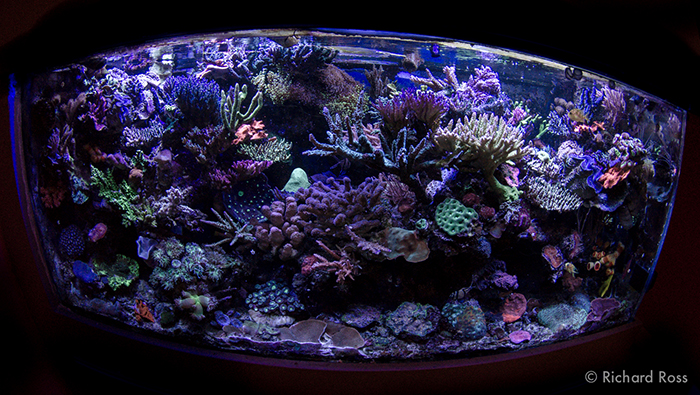
I agree with you, it's not high P that causes this, but is a risk factor.

I'd have to see his tank to comment thoroughly but if I had to guess, I imagine he has adequate N availability for his corals as well as a reasonable coral load (as opposed to just frags dotting rocks) that have adapted to his higher P regime and have been growing for some time. In a system like this even with higher risk factors for algae as long as the corals can dominate and are not limited by anything chemically they will outcompete.

It's why I place emphasis keeping N and P balanced over a long term regardless of where your spot Phosphate level finds itself in the near term, as often the elevated P will cause corals to exhibit the same symptoms as inadequate N if not kept in balance.
 
I agree with you, it's not high P that causes this, but is a risk factor.

I'd have to see his tank to comment thoroughly but if I had to guess, I imagine he has adequate N availability for his corals as well as a reasonable coral load (as opposed to just frags dotting rocks) that have adapted to his higher P regime and have been growing for some time. In a system like this even with higher risk factors for algae as long as the corals can dominate and are not limited by anything chemically they will outcompete.

It's why I place emphasis keeping N and P balanced over a long term regardless of where your spot Phosphate level finds itself in the near term, as often the elevated P will cause corals to exhibit the same symptoms as inadequate N if not kept in balance.

1721325311916.jpeg


He has high N and P.
 
I'm not proposing a notion that 'hidden' phosphate increases cyanobacterial growth. I'm stating that a theoretical tank with a 'phosphate depot factor' of 3, compared to a tank with a depot factor anything less than 3, will have more P within said system.
The depot factor of three is meaningless because that number can be derived an infinite number of ways and that would mean cyanobacteria will grow with any size of phosphate depot. This can’t be right.
 
The depot factor of three is meaningless because that number can be derived an infinite number of ways and that would mean cyanobacteria will grow with any size of phosphate depot. This can’t be right

Why can’t it be right? I’m not sure I follow
 
Why can’t it be right? I’m not sure I follow

Cyanobacteria do not grow under phosphate depletion (you mentioned this above). Let me suggest that when phosphate levels are at 0.006 and 0.002 ppm, your system is phosphate depleted, but we have a factor of 3 which indicates your system is in danger of growing cyanobacteria. But that contradicts cyanobacteria not growing under phosphate depleted conditions. Therefore, the ratio is useless. That’s all I saying.
 
Cyanobacteria do not grow under phosphate depletion (you mentioned this above). Let me suggest that when phosphate levels are at 0.006 and 0.002 ppm, your system is phosphate depleted, but we have a factor of 3 which indicates your system is in danger of growing cyanobacteria. But that contradicts cyanobacteria not growing under phosphate depleted conditions. Therefore, the ratio is useless. That’s all I saying.

in this instance, phosphate limitation would just limit the amount of cyano that can grow. So a system measuring between 0.006 and 0.002 ppm at a depot value of 1 would have a total of 0.006 or 0.002ppm available in water. A system with a depot factor of 3 would have 3 times the phosphate present within the system, and thus would be less 'depleted' (I'd suggest using the wording limited vs depleted) than the tank with a depot factor of 1.

This value says nothing more about the ability for cyano to grow other than the fact that the phosphate limitation between these two tanks for the purposes of nutrient cycling is not the same.
 
in this instance, phosphate limitation would just limit the amount of cyano that can grow. So a system measuring between 0.006 and 0.002 ppm at a depot value of 1 would have a total of 0.006 or 0.002ppm available in water. A system with a depot factor of 3 would have 3 times the phosphate present within the system, and thus would be less 'depleted' (I'd suggest using the wording limited vs depleted) than the tank with a depot factor of 1.

This value says nothing more about the ability for cyano to grow other than the fact that the phosphate limitation between these two tanks for the purposes of nutrient cycling is not the same.

It is pure speculation that the phosphate “depot” is ever available to any organism.
 
in this instance, phosphate limitation would just limit the amount of cyano that can grow. So a system measuring between 0.006 and 0.002 ppm at a depot value of 1 would have a total of 0.006 or 0.002ppm available in water. A system with a depot factor of 3 would have 3 times the phosphate present within the system, and thus would be less 'depleted' (I'd suggest using the wording limited vs depleted) than the tank with a depot factor of 1.

This value says nothing more about the ability for cyano to grow other than the fact that the phosphate limitation between these two tanks for the purposes of nutrient cycling is not the same.

So you agree that the Fauna Marin analysis of a factor above 2.2 is nonsense.
 
It is pure speculation that the phosphate “depot” is ever available to any organism.

Agreed, though you could probably draw a conclusion that a tank with more deposited phosphate probably has some kind of nutrient cycling problem, but I don't necessarily agree with FM that this would cause cyano

So you agree that the Fauna Marin analysis of a factor above 2.2 is nonsense.

Yes, I was only referencing them because they had a heat test methodology which I wanted to share for the purposes of the initial post
 

IF YOU HAD TO TAKE A REEFING EXAM, WOULD YOU PASS?

  • Yes!

    Votes: 32 45.7%
  • Not yet, but I have one that I want to buy in mind!

    Votes: 9 12.9%
  • No.

    Votes: 26 37.1%
  • Other (please explain).

    Votes: 3 4.3%
Back
Top











