- Joined
- Apr 26, 2016
- Messages
- 1,156
- Reaction score
- 1,598
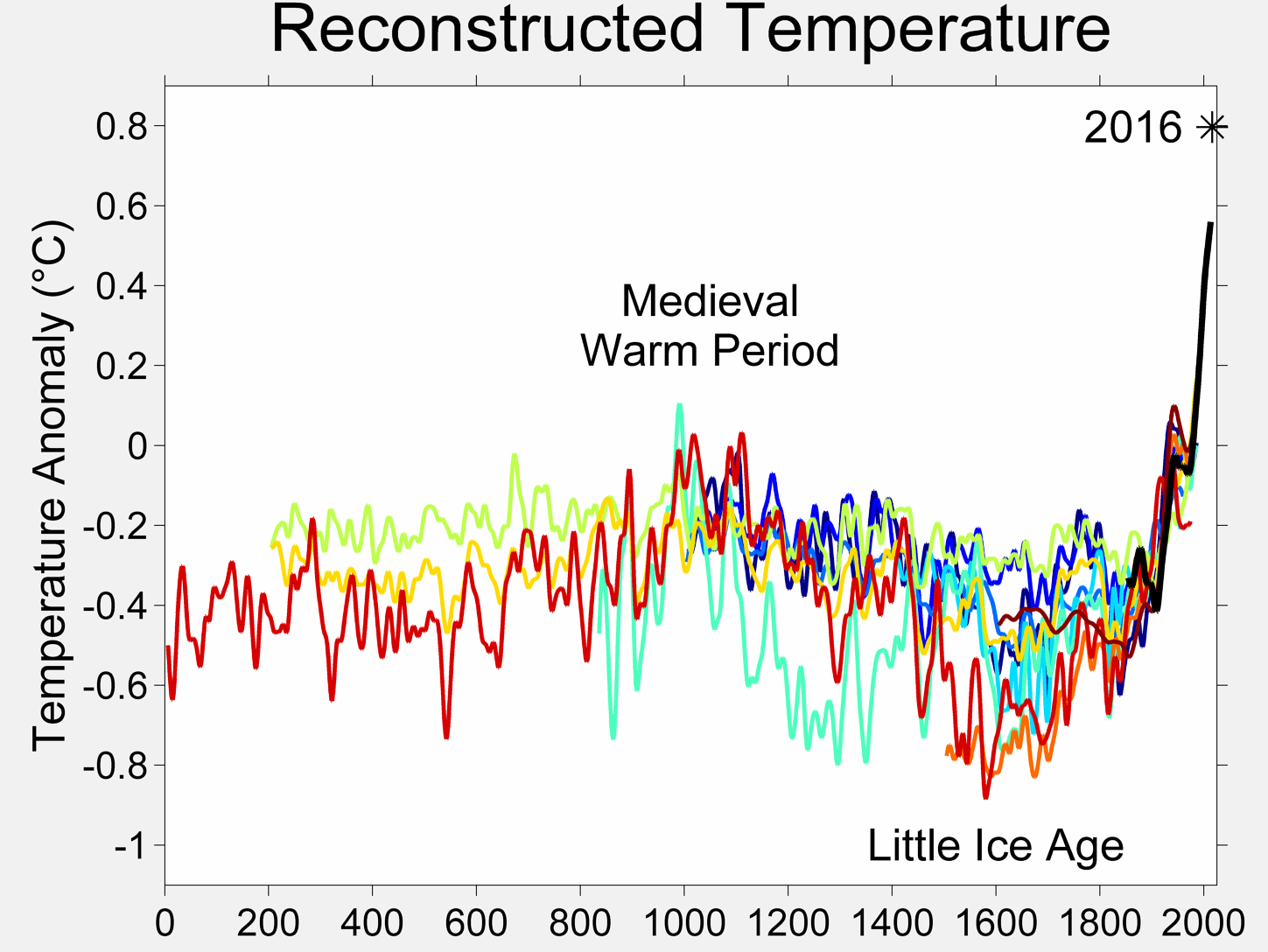
Again, as stated previously, you do not have to be a climatologist nor produce peer reviewed work, to look at read and understand observable data, nor point out that the observable data does not coincide with previous predictive models. You are ignoring the chart in the article showing the predictive models temperatures vs the temperatures actually measured. As I said previously, the fact that the models are wrong do not mean that there is no warming nor that we are not in any way responsible. It does however indicate a flaw in the consensus which needs to be examined when creating policy.The article to which you link only cites one published scientific paper. The paper's main argument appears to be that a well-respected deep ocean temperature model does not match the actual climate data from 1955 to 2011. However, the authors explicitly state that the variance they see could be explained entirely by small energy imbalances when they initialized their model. From the paper:
This suggests the possibility of energy conservation issues in the CMIP3 models (Gupta et al., 2012), although small energy imbalances at model initialization could also result in this behavior
How much data is acceptable then? How do we know that 40 years is enough data to prove that smoking causes lung cancer? How can we know that these people weren't simply predisposed to lung cancer, and that any number of other things (aside from smoking) could have caused the cancer? How do we know that genetically, these people wouldn't have just developed lung cancer anyway, even with no outside cause? You can't just look at a pile of lung cancer deaths and notice that they all smoked and say that one caused the other. You need the scientific process. You need to conduct studies, you need to collect data, and you need to prove causation. The scientific process is required to exclude all noise, to minimize all variables, and prove beyond a shadow of a doubt that the smoking actually caused the lung cancer. When the methodology used for research is sound and the results confirm the hypotheses, the scientific community tends to support such findings.
This is how consensus is formed. And this is my point. The scientific process is how we determine how our complex world works. The amount of time you have been observing data is not the only determining factor to how accurate your research is. Data alone are not enough. As I said to Maacc, if you have published peer-reviewed papers, I'd love to read your work. Please be sure to include your academic and scientific experience, as well as that of your co-authors, when you post your work.
One can mix ad hominem with argumentum ad verecundiam, but it doesn't change my point.
I think we might just need to agree to disagree.