
Chasing coral

You cannot deny our effect on the climate. This warm period is far more intense than the medieval warm period and started around the industrial age. Seems to be a bit too much of a coincidence when an unprecedented warming period starts as greenhouse gasses such as carbon dioxide and methane are released into the atmosphere at an increasing rate. The fact that models have been inaccurate in other fields of science does not discredit models made in the field of climate science.
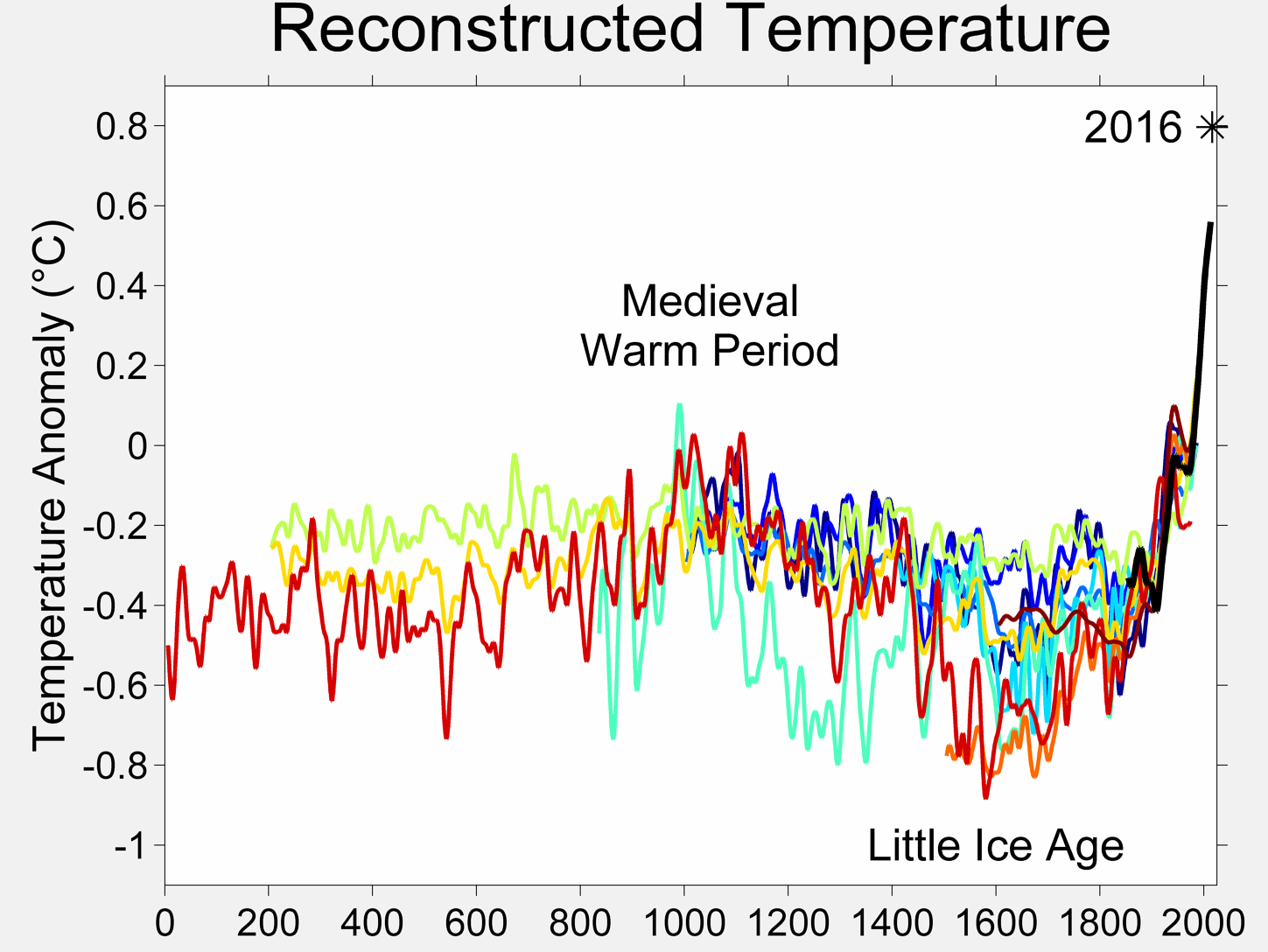
2000_Year_Temperature_Comparison.png

Once again models tell the story the model maker wants to tell.
For example, when we have large scale events like major volcanic eruptions that influences climate. What about our planet's orbit around the sun? A minor change in the path around the sun can increase or decrease our distance around it hence increasing or decreasing radiation to the planet. They are now finding out that our magnetic field is changing and reversing polarity. Could that affect that? Could the sun go through changes in output? We have no way of getting sun core samples to see that. Because of all of these variables and more I cannot accept just one hypothesis especially when there are political parties, big corporations profiting from carbon credit all behind this. Think outside the box for a minute...
If climate warming was found to be the cause of a mega sun cycle, carbon credit system would not exist... Panasonic (the worlds largest battery manufacturer) would not be benefiting from hybrid car deals. All of the "green" associated products would not be in the fore front. Yes don't forget that we need renewable resources as some day, we will run out of coal and oil, but the whole political/ economic climate would look different.

Could greenhouse gasses be a part? Maybe, but we still have so many unknowns that to just put it on one item, it does not make sense. Just like believing that corals are bleaching due to just temperature change.

 
We have no way of getting sun core samples to see tha
No, actually we look at growth patterns in both coral and trees as well as soil samples and cores as well as ice samples and cores to look at growth as well as the temperature A simple example is is the eruption of Krakatoa. It left its effect and signatures in all the above. We can track this over thoisands years. It's why all the scientists say there's a problem. They've not see this with out a possible case as mention earlier in the previous global mass extinction events. In the recent cores it's higher carbon content.
 
Once again models tell the story the model maker wants to tell.
For example, when we have large scale events like major volcanic eruptions that influences climate. What about our planet's orbit around the sun? A minor change in the path around the sun can increase or decrease our distance around it hence increasing or decreasing radiation to the planet. They are now finding out that our magnetic field is changing and reversing polarity. Could that affect that? Could the sun go through changes in output? We have no way of getting sun core samples to see that. Because of all of these variables and more I cannot accept just one hypothesis especially when there are political parties, big corporations profiting from carbon credit all behind this. Think outside the box for a minute...
If climate warming was found to be the cause of a mega sun cycle, carbon credit system would not exist... Panasonic (the worlds largest battery manufacturer) would not be benefiting from hybrid car deals. All of the "green" associated products would not be in the fore front. Yes don't forget that we need renewable resources as some day, we will run out of coal and oil, but the whole political/ economic climate would look different.

Could greenhouse gasses be a part? Maybe, but we still have so many unknowns that to just put it on one item, it does not make sense. Just like believing that corals are bleaching due to just temperature change.
There are planty of variables that alter out climate and no one denies this. However this warming period is far greater than any before, if this was purely a natural oscillation it would be similar to the ones before (medieval warm period). I do believe in man made climate however your assertion that people will profit off this hyesteria is true. I just hope that it does not get in the way of good scientific practices
 
I love the reefs, I love fish and all of the living creatures that exist within them, but to suggest "All because of the decisions that humanity is making on a day to day basis"...I just don't understand that mentality. What is the Earth, 4 billion years old...and we've been keeping records for what? A couple hundred years?

Is it sad, of course, but to suggest that people are responsible for ANY change (warming or cooling...they've been blamed for both), when change has been occuring for billions of years, just seems like a giant leep to me.
Every scientist says it's mainly because of humans. We throw carbon dioxide into the atmosphere which traps heat. The ocean absorbs the heat. Thus causing the warming of the ocean which in turn ,corals can only handle so much in increased temperature which causes them to bleach and die.
 
It's likely a fool's errand, but I'm going to briefly weigh in. I know I have zero leg to stand on, considering I hold no bachelor's degree of any kind, I'm just a lowly vet tech with an associates and I save animals for a living. I do have a brain and I do have the ability to think for myself. What saddened me the most about this documentary is how some of my fellow reefers are treating each other. Healthy debate is awesome, but when you start calling each other idiots then the debate is no longer healthy.

I believe humans have an impact on our environment just as much as I believe that dinosaur farts had an impact. I'm not trying to be gross, I'm just saying that we don't live in a vacuum, good or bad, we have an impact. Can the earth recover from our impact? Of course it can! Will it? Dunno. But my money is on the planet. When greed enters the picture, then things get dicey. It seems that greed often does rear it's ugly head and our history has proven so. In America we rode on trains and shot buffalo, then skinned them only to let their carcasses rot in the sun. B'bye wild buffalo. Now we have bleaching coral. I'm not sure if it's global warming, but I'm not sure it isn't! What I am sure of is that taking positive steps towards the preservation of *life* cannot be a bad thing! I don't think any one person can "do all the things". But if you or I do even just one thing, to make life on this planet livable, then we are doing our part. We can't make China do anything, but that doesn't mean we shouldn't do anything, right?

I enjoyed the documentary. I thought it was interesting and educational. It's made me a little more aware of my own impact and the ocean has always held an extremely large part of my heart and soul. All I can do is the best that I can. I hope you will, too. :)
 
I'm not going to get into a climate change argument, but what are the actual temps reefs are hitting?
We've shown in tanks that corals can adapt to a range of temperatures. I don't know why a small change would cause such massive bleaching. (Then again, I'm not a climate scientist)
 
Last edited:
I'm not going to get into a climate change argument, but what are the actual temps reefs are hitting?
We've shown in tanks that corals can adapt to a range of temperatures. I don't know why a small change would cause such massive bleaching. (Then again, I'm not a climate scientist)

I tried to find the article I read before but now can't find it. From memory it was about 2 degrees above average, suppose the original temperature is irrelevant if you take the 2 degree increase. What it also said is that the coral closer to the surface got affected more and that some species adapts better and less bleaching happens to them. As for the increase, it is also not the two degree increase but rather the extended period this increase lasts that causes the bleaching. The latest bleaching is so big because the temperature rise was repeated this year. In respect to the GBR it should also be added that the Queensland Coast was hit by one of the biggest tropical storms in a very long time earlier this year which also affected the reef.

And just a final point, this topic was discussed on another forum a few weeks back and at the time I found an article on the Great Barrier Reef Marine Park website (Sort of the official website for the Reef) where the CEO discussed the bleaching and the exaggeration of the event. This article also referred to recovery of the reef in certain parts that was severely affected by bleaching a few years back and referred to 80%+ recovery of that part of the reef. That article has been removed from their website and can no longer be viewed. I can only assume it severely affected their funding and was pulled for strategic reasons...
 
I'm not going to get into a climate change argument, but what are the actual temps reefs are hitting?
We've shown in tanks that corals can adapt to a range of temperatures. I don't know why a small change would cause such massive bleaching. (Then again, I'm not a climate scientist)

I tried to find the article I read before but now can't find it. From memory it was about 2 degrees above average, suppose the original temperature is irrelevant if you take the 2 degree increase. What it also said is that the coral closer to the surface got affected more and that some species adapts better and less bleaching happens to them. As for the increase, it is also not the two degree increase but rather the extended period this increase lasts that causes the bleaching. The latest bleaching is so big because the temperature rise was repeated this year. In respect to the GBR it should also be added that the Queensland Coast was hit by one of the biggest tropical storms in a very long time earlier this year which also affected the reef.

And just a final point, this topic was discussed on another forum a few weeks back and at the time I found an article on the Great Barrier Reef Marine Park website (Sort of the official website for the Reef) where the CEO discussed the bleaching and the exaggeration of the event. This article also referred to recovery of the reef in certain parts that was severely affected by bleaching a few years back and referred to 80%+ recovery of that part of the reef. That article has been removed from their website and can no longer be viewed. I can only assume it severely affected their funding and was pulled for strategic reasons...
See previous posts. It was 90+ In the film.
 
OK This from the site...

What causes coral bleaching
The main cause of coral bleaching is heat stress resulting from high sea temperatures.Temperature increases of only one degree celsius for only four weeks can trigger bleaching events.

If these temperatures persist for longer periods (eight weeks or more) corals begin to die. High water temperatures can affect reefs at regional and global scale.


Anyway, I just scanned the 2016 report from GRMPA to see what the rise was according to them and in a 44 page document there is lots of references to increase in temperature but very light on detail. I did find this:

The rising temperatures reflect the underlying trend of global ocean warming caused by climate change. In 2016 Great Barrier Reef waters had warmed by approximately 0.80 degree Celsius since 1871, and the rate of warming has accelerated since the 1950s.

And a reference to this website re increases:

https://www.ncdc.noaa.gov/data-acce...econstructed-sea-surface-temperature-ersst-v4
 
First I want to make clear I am convinced that anthropogenic global warming is a fact. But I think maybe global warming is not the only cause of coral reef decline, especially not in the GBR. New scientific experiments show that phosphorus is a key nutrient for corals and my experience says especially so for Acropora spp.. A surplus of nitrogen is detrimental to corals and high temperatures seem to increase bacterial N2-fixation in corals and in this way disturb the N-P-balance in corals. So there may be another cause for coral bleaching and coral reef decline in continental coral reefs which is runoff of nitrogen fertilizers and manure from agriculture and livestock farming. I am convinced that this may be a major factor for coral bleaching and coral reef decline in continental coral reefs next to countries with widespread agriculture and livestock farming like Australia and also the USA. So maybe there is something that can be done to better the condition or at least not to accelerate further coral reef decline which is stopping or limiting nitrogen input by rivers and continental runoff by altering agriculture and livestock farming. So you can do something for the coral reefs by minimizing your CO2 footprint and by buying organic products.
 
First I want to make clear I am convinced that anthropogenic global warming is a fact. But I think maybe global warming is not the only cause of coral reef decline, especially not in the GBR. New scientific experiments show that phosphorus is a key nutrient for corals and my experience says especially so for Acropora spp.. A surplus of nitrogen is detrimental to corals and high temperatures seem to increase bacterial N2-fixation in corals and in this way disturb the N-P-balance in corals. So there may be another cause for coral bleaching and coral reef decline in continental coral reefs which is runoff of nitrogen fertilizers and manure from agriculture and livestock farming. I am convinced that this may be a major factor for coral bleaching and coral reef decline in continental coral reefs next to countries with widespread agriculture and livestock farming like Australia and also the USA. So maybe there is something that can be done to better the condition or at least not to accelerate further coral reef decline which is stopping or limiting nitrogen input by rivers and continental runoff by altering agriculture and livestock farming. So you can do something for the coral reefs by minimizing your CO2 footprint and by buying organic products.
Is phosphate also part of agricultural runoff? If so it could dampen reef recovery since it can inhibit calcification. How is nitrogen detrimental to corals? Less runoff in general would be great, too many nutrients can create dead zones, and many have already been created
 
Phosphates combine with the minerals in the ground to form insoluble calcium and iron phosphates. This makes them less prone to leaching than nitrogen compounds like especially nitrate. Ammonia and ammonium from slurry also adhere to clay minerals but obviously an excess even reaches the groundwater. In Germany we have widespread elevated nitrate concentrations in groundwater and drinking water due to slurry disposal (I wouldn´t call this excess fertilization).

Regarding phosphates and corals newer tank experiments seem to be contradictory to older theories. It looks like phosphate is not inhibiting calcification but weakening the skeletal structure and making it more brittle.

Nitrogen is detrimental to corals if it is creating a phosphate deficiency. It causes phosphate starvation of the corals. The corals just die from tissue necrosis in tanks. In coral reefs a distrubed N-P-balance in corals is also meant to cause bleaching at elevated temperatures, so at least says the theory in one of the linked articles.
 
Last edited:
I personally don't buy into the reasoning presented behind coral bleaching.. if they're going to promote global warming as being the cause, at least have scientific studies as to how corals are effected solely by temperature in a controlled environment. Out in the ocean, there are thousands of factors that take part in keeping a reef healthy. Temperature is something that seems to be tolerated in fairly wide ranges in our home aquariums, which usually includes temperatures in the 74*F-84*F range. The filmmakers could have at least provided the actual temperatures rather than the temperature "abnormalities" that they did (what was their baseline temp for a given location?)

Another problem I have with the global warming issue altogether, is that it's based on extremely loose science. What I mean by this is I have found nobody that can tell me 1.) how much of the carbon in the atmosphere is attributable to human activity? 2.) how much atmospheric carbon would cause a 1 degree Celcius rise in global temperatures over a given time period? 3.) what would the climate look like today if there hadn't been any past human activity?
Another issue I have with the global warming argument is that there is no solutution to the problem that doesn't involve forcing millions of people back to living standards of the 19th century before the widespread use of oil. As a side note; greatly reducing or eliminating human carbon emissions will have no effect on current climate change due to carbon already being out in the atmosphere.
Now is this to say we shouldn't try to cut back on emissions? Of course not. Data shows that if 9 decent sized nuclear power plants are constructed in the US, we will not have to further rely on fossil fuels to fuel our homes. NINE power plants along with current green energy sources for the entire country's power (no this does not include gas used for cars which is a separate issue). Reducing gas emmisions from cars is a simple thing to do actually.. it involves having the government no longer subsidize gasoline and oil. With the rise in gas prices, people will want more fuel efficient cars which drives the market into providing said cars. (The government initially subsidized gas to allow for more people to purchase cars, but forced car manufactures to not take advantage of cheap gas prices and produce fuel efficient cars)


(I havnt read through the thread due to it being so extensive when I posted this so I apologize if something similar has already been said)
 
Last edited:
Is phosphate also part of agricultural runoff? If so it could dampen reef recovery since it can inhibit calcification. How is nitrogen detrimental to corals? Less runoff in general would be great, too many nutrients can create dead zones, and many have already been created

Yes, phosphorus is found in most fertilizers..

Has anyone mentioned cyanide fishing yet? It's not causing the widespread coral bleaching shown in the documentary but it is a huge detriment to Indo- Pacific reefs. (I might post a research essay I wrote about cyanide fishing for school onto the forum soon.. still debating)
 

IF YOU HAD TO TAKE A REEFING EXAM, WOULD YOU PASS?

  • Yes!

    Votes: 32 45.7%
  • Not yet, but I have one that I want to buy in mind!

    Votes: 9 12.9%
  • No.

    Votes: 26 37.1%
  • Other (please explain).

    Votes: 3 4.3%
Back
Top














