Hackspect Razor?

OllieNZ

Active Member
View Badges
Joined
Nov 24, 2018
Messages
176
Reaction score
379
Rating - 0%
0   0   0
Hi All,
I've inherited a 320w 16,000K Razor from a mate, it's sans PSU and power cord as it was damaged in a fire caused by a faulty power strip (a tale for another time) and was wondering if anyone else has played about much with these?
It was FOC as the insurance classified it "fire damaged" and my mate was just going to bin it, so rather waste an otherwise undamaged fixture I figured I'd try turn it into something useful. It's too long for my 3ft tank so I'm planning on adjusting it to suit. I could easily cut it in half and run it with 3 pucks like a 160W (the 320w is essentially just 2 160's joined together) and keep the rest for spares but I'm unsure how well the 160w would cover the 3ft? He was running it on a 48"x24"x24" and it looked really good so I'm thinking 4 pucks (same as 2x 120w) would offer better coverage and allow the light to be run at lower power.
The power side is easily figured out but I was wondering if anyone has any experience with hacking the control side of it? Given the factory controller is an Atmega 168P based device and the drivers use an LM3409 chip I'm assuming they're PWM controlled. So in theory the factory controller could be replaced with something like a Reef-Pi.

 
That would be awesome... i love the razors... super ****** lights... will be following this to see how you do it...
Should be a fun one [emoji6] given it's a freebie I'm not too bothered if I kill it (I shouldn't but you never know) already been having a play, definitely gonna cut it down, 4 pucks = a 30" fixture. Should be perfect for a 36" tank.
9d45e833b007a55d7accd51b9923cd12.jpg
 
Not sure if you will tun into issues with the power supply
I have to buy a PSU any way. The 120 and 160 use the same led drivers. The 120 uses a 24v 6.3a 120w PSU and the the 160 is 36v 5.9a 160w. I'll be using the existing 2 drivers and a 24v 240w ish PSU
 
There are a number of different lights that have been hacked and are run by reef pi. I could offer some suggestions but, instead, will tag a couple of heavy-weight reef pi people. Namely the inventor of reef pi @Ranjib and an influential user/developer who has hacked a BeamsWork light @Bigtrout Hopefully, they'll jump in a offer some insight for you.
Good luck!
 
Last edited:
There are a number of different lights that have been hacked and are run by reef pi. I could offer some suggestions but, instead, will tag a couple of heavy-weight reef pi people. Namely the inventor of reef pi @Ranjib and an influential user/developer who has hacked a BeamsWork light @Bigtrout Hooefully, they'll jump in a offer some insight for you.
Good luck!
Cheers bud,
The majority of the control board is there for the atmega to do it's job. The driver to controller interface is 4 pins: 2x signal, power and ground. The power wire is actually to provide the controller with power rather than the other way around. The other functions the controller performs are temp monitoring and switching the fans. I could rip the lot out as it's nothing a reef pi couldn't handle.
 
But on second thoughts It'd be good to still have the stock controller on board in case there's an issue with the reef pi. I'm thinking relays (this can probably be done with transistors or something) with the relays connected as follows: Common-Driver pwm pin, NC-controller pwm, NO-Reef Pi PWM with the Reef Pi switching the relay on. That way if the Reef Pi connection is lost the stock controller can take over. It would also leave the stock controller dealing with the temp/fan side of things.
 
@Ranjib
I've taken some measurements tonight with my Fluke 115.
Operating frequency of the 2 dimming channels is 16.2 kHz
Voltage at 100% duty is 4.1v
My other assumptions regarding the power and ground pins are correct. The PSU supplies the drivers directly and passes the power through to the control board where a buck converter steps things down for the Atmega and fans.
 
@Ranjib
I've taken some measurements tonight with my Fluke 115.
Operating frequency of the 2 dimming channels is 16.2 kHz
Voltage at 100% duty is 4.1v
My other assumptions regarding the power and ground pins are correct. The PSU supplies the drivers directly and passes the power through to the control board where a buck converter steps things down for the Atmega and fans.
Hmm.. pca9685 (the pwm ic that reef-pi now supports) can only do 1.5KHz at max. The voltage rating should be ok..
So, if I understand your post correctly, unlike kesisl maxspect razor does not have separate power and control lines/channels. In that case the driver must be converting the 4.1V DC pwm signal to something beefier for the lights, something like meanwell driver must be sitting in between doing the high current/high voltage switching and taking the atmega pwm signal as input
 
Hmm.. pca9685 (the pwm ic that reef-pi now supports) can only do 1.5KHz at max. The voltage rating should be ok..
So, if I understand your post correctly, unlike kesisl maxspect razor does not have separate power and control lines/channels. In that case the driver must be converting the 4.1V DC pwm signal to something beefier for the lights, something like meanwell driver must be sitting in between doing the high current/high voltage switching and taking the atmega pwm signal as input
That would be an LM3409 driver chip.
 
Hope it works out for you man... thats a great light... I have 2
I've already fired it up at low power with an 80w 24v power brick I've got laying about, so everything works fine. I've now received the 250w PSU for it, just need the cable to hook it up properly.
 
For those interested in what the stock electronics look like.....
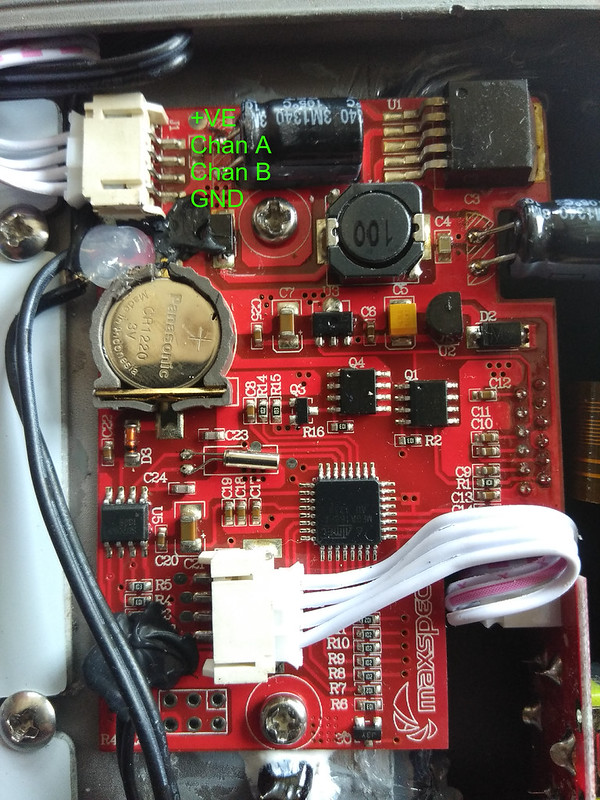
The control board:
47556701651_549d37bdb7_c.jpg

The white connector at the top of the pic is the power/pwm connector. The +ve lead voltage will depend on which model you have, the 120w runs on 24v and the 160w/320w run on 36V.

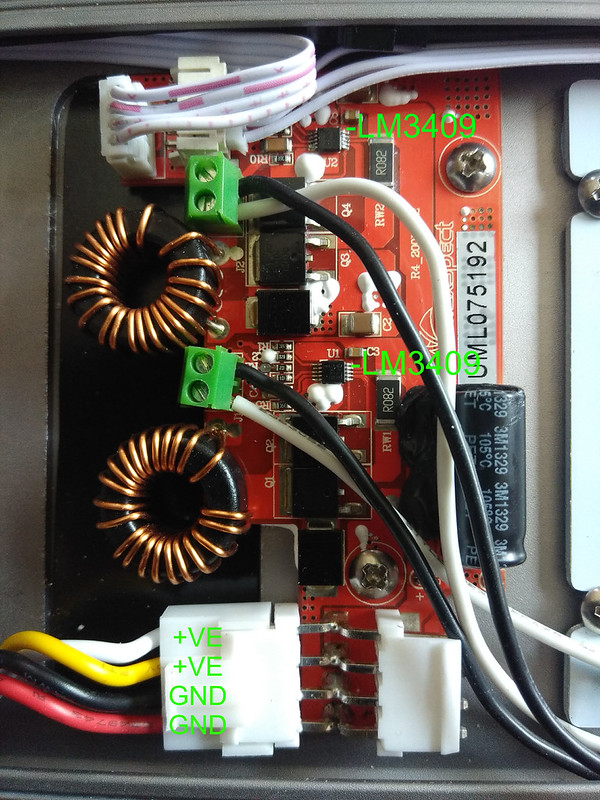
The driver board:
47503859392_c7a6c8b75d_c.jpg

The 120w/160w/320w all use the same type of driver board, with the 320w using x2 driver boards.
The pinout for the pwm connector matches the control board. The pins on the main power connector parallel onto the PCB traces. As I found out to my detriment, where the positive pins of the main power connector solder on to the PCB is incredibly fragile and if the power connectors are sticky/corroded is very easy to tear the traces off the PCB, the ground pins are through hole. Fortunately there's a second set of pads and the connector is easily removed and re-soldered on to the good pads.
 

IF YOU HAD TO TAKE A REEFING EXAM, WOULD YOU PASS?

  • Yes!

    Votes: 32 45.7%
  • Not yet, but I have one that I want to buy in mind!

    Votes: 9 12.9%
  • No.

    Votes: 26 37.1%
  • Other (please explain).

    Votes: 3 4.3%

New Posts

Back
Top