If it's in equalibrium, doen't that mean the level will permanently draw down to whatever level you physically remove from the water?
If the level of PO4 is able to "rebound" after the fact, then something else has to explain it – doesn't it? Equalibrium is continuous and real-time, at least AFAIK.
This is a good question and probably deserving of clarification going forward. The equilibrium is about the level and not the amount. The rocks can contain so much more bound phosphate that the levels then rebounds to a very-close-but-slightly lower-than-before new equilibrium level. What I cannot tell is if this extraction from the aragonite is linear or in a slight reverse-exponential pattern - it is certainly not a steep exponential curve.
GFO and water will also hold a different amount at the same level, or else it would not work any better than a water change. Saturated GFO will certainly release back into water with lower levels of phosphate.
I am making up this example, but this is what you might see:
- Tank Water P With P Filled Rocks, GFO added, Immediate Tank P After GFO, Tank P after 48 Hours, or so
- 1.0, 200ml,.12,1.0
- 1.0, 200ml,.12,1.0
- .99, 200ml,.12,.99
- .98, 200ml,.12,.98
- .98,200ml,.11,.98
- .98,200ml,.11,.98
- ...
This might be easy to experiment with some phosphate additive that can be measured, let it mingle with some weight of aragonite in a bucket for a month of two and see how much is removed from the water. Then, see how much it goes down with some weight of GFO.
I had a friend with a really badly neglected FOWLR with some fantastic Marshall Island live rock that he wanted to use for a reef. GFO was not cutting it, so he ordered a 8G bucket of aluminum media, which I have observed to be significantly more powerful than GFO. It took almost this whole bucket before his P levels would stay below .05 where he wanted them. I do not know if the aluminum media will release phosphate, or if it is bound permanently - would love to know.
Lastly, there are a few articles that you can find that show some pretty clear studies that higher phosphate will limit calcification and lower levels will promote it (leading to burnt tips as calcification outpaces tissue in low P acropora tanks with abundance of carbonate, calcium and magnesium). As anybody with higher P can tell you, coralline stops after a while. Acros slow down. There are also a few that show high levels of phosphate will inhibit dino (zoox) growth and reproduction in true (hard) coral.
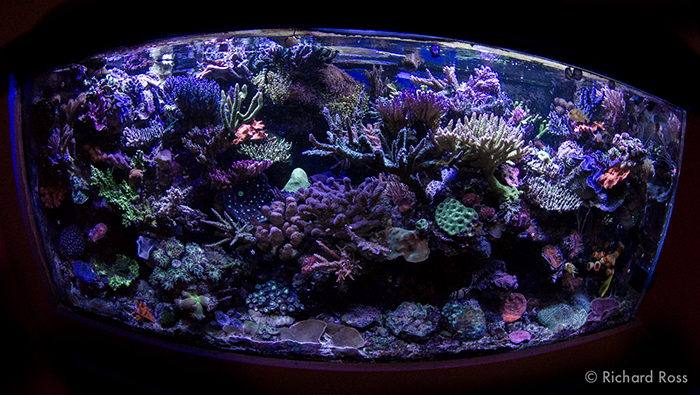
It important for everybody to know that the vast majority of the high-phosphate tanks that people like to show off did not achieve their current success with levels that high... most of them let the levels climb later on after a period of more traditional nutrient levels that led to the growth. In some cases, the folks will tell you that they have lost certain kinds of coral, but it is, by no means, a death sentence to all of the inhabitants. Don't just look at Richard Ross's tank and assume that you can get there by doing the same thing... he gave a 1 hour talk (you can find it with a Google search) about all of the nuance that goes into that one statement about the high phosphate and how he did lose some types of coral and how his tank did change.









 Admittedly I did not point the question at anyone specifically, and not in the chemistry forum....but those folks were in at least one of those discussions.



 )
)