Kessil LEDs, Intensity and PAR

Just for info..

upload_2018-11-7_4-52-13-png.883937

PR160_Spectrum.jpg
 
Actually it means didly BUT.. they implied actually 3 "blue" one UV
4 bandwidths all together..

as to the photoredox it would also apply....


thing is some are in the "blue" channel some the white..

Add cool white to complete...
Point is 5 total separate "bandwidths" assuming calling white ..err.. one..
IF it's the same in the 360 as in the old 350??
I guess it's possible that binning of LEDs used allowed use of two with similar peak outputs... this is the best that a $2,000 instrument can do.
 
In my opinion, your chart supports my "theory" , at least to me.. Blue is a bit too spread for one wavelenth. Granted there is only 10 nm between the 2.. ;)

Not to mention there is no data on the ratio beween the 2. or which "channel" has more ect..

The diodes don't need to be "exactly" matching as to wavelength. Maybe they use "off" nm diodes that don't make the cut for the analytical lamps..
 
It doesn't operate as a simple two channel array; more like two physical channels with multiple logical channels.
 
No offense.. but I'd have to hear that from Kessil or someone who reverse engineered it..
There is absolutely no reason to make it that complicated.. You gain little..if anything.

Tell me what advantage that would make to it?
Basically all you have is blue, white, and a limited power output of UV chips..
and "color" from blue to more white blue..


Yes, ind. diodes can be "addressed" and it's done all the time but at a much larger cost..
Until there is further proof we will just need to agree to disagree on this point...
 
No offense.. but I'd have to hear that from Kessil or someone who reverse engineered it..
There is absolutely no reason to make it that complicated.. You gain little..if anything.

Tell me what advantage that would make to it?
Basically all you have is blue, white, and a limited power output of UV chips..
and "color" from blue to more white blue..


Yes, ind. diodes can be "addressed" and it's done all the time but at a much larger cost..
Until there is further proof we will just need to agree to disagree on this point...

What is complicated? The UV diodes never change, they're always on. Individual banks of blues and whites are quite obviously switched, I'm not sure why you're even arguing this.
 
What is complicated? The UV diodes never change, they're always on. Individual banks of blues and whites are quite obviously switched, I'm not sure why you're even arguing this.
more like two physical channels with multiple logical channels.

How would you know the UV diodes are "always on" .. visually they are not visible, nor picked up by most cameras..
so what... 3 channels one permanent.. nobody would know.. most normal PAR meters won't see it..

not much of a difference...

It's not an argument, whether it works "my way" or your way, the bottom line is about the same..
"color" shifts from high K white to err. actinic.
Kessil "logic" current throttles the err channels (or whatever) between color shifts to "theoretically" maintain equal PAR.
Dana proved it has "errors"...
End of story really..
Personally.. complex or simple.. bottom line is the same.
All I'm saying is there are "KISS" ways to do this..


Currently: 385 nm × 1 + 420 nm × 2 + 450 nm × 6 + 460 nm × 6 + CW × 4

Kessils been using roughly the same "wavelengths" for a long time now..
https://translate.google.com/translate?hl=en&sl=ja&u=http://www.1023world.net/&prev=search

and it doesn't take any complex "ciphering" to shift the spectrum..

Just for reference:
In the last time it was only the spectrum measured with UPRtek MK 350 , but this time we also list the spectrum measured with ASEQ LR 1 . Well, it's the same (laugh)
https://translate.googleusercontent...700201&usg=ALkJrhhTBUxM6rUD0BLbK8YVyJw6aJb1ww
 
How would you know the UV diodes are "always on" .. visually they are not visible, nor picked up by most cameras..
so what... 3 channels one permanent.. nobody would know.. most normal PAR meters won't see it..

The UV shows up on spectrometers at all settings.
 
The UV shows up on spectrometers at all settings.
How are you "counting" them?..If 1 on each channel... well..............
of course they will always show up...;)


Go ask Kessil they are pretty open.. /s
 
How are you "counting" them..If 2 on each channel... well...............;)

There are only two, regardless of which channel they're on. Perhaps I'm not understanding what you're asking?
 
Sorrry.. 1 per channel.. Was thinking about the "violets".. 4 total..
 
Sorrry.. 1 per channel.. Was thinking about the "violets".. 4 total..

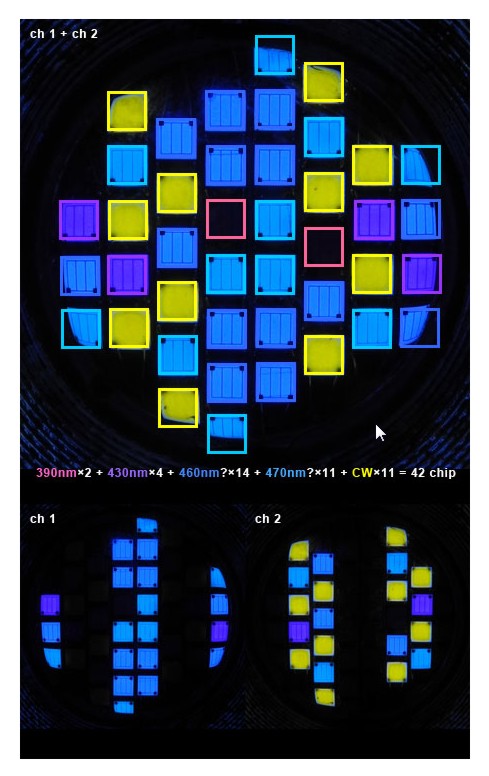
Which two emmitters are invisible in every picture in this post?

Does it matter which channel they're tied to?
 
Which two emmitters are invisible in every picture in this post?

Does it matter which channel they're tied to?
The 2 pink squares in this 350..
Went from 42 chips to 44..
k350.jpg

They moved em for the 360..see the 2 dead spots..
It doesn't matter which channel except if you want UV in both 0% and 100% color
37233605812_209b938eb0_b.jpg
 
Last edited:
This is a really good chat. I'm renting a PAR meter from BRS that is arriving today. I have a 38 gal bowfront that is about 8 months old (my Christmas present to myself). I am running two Kessil A160WE Tuna Blue lights. I have a mixed reef set up with the first SPS going in earlier this week. I started with softies, put in some LPS, now adding SPS. While the SPS has only been in the tank two days, everything looks very promising.

Obviously the rock work will be staying in place, but I plan on getting PAR numbers running the lights at 50% color and 100% intensity. I'll get readings back, middle, and front at the 1' from surface, then 6", 12" & 18" from the surface. I'll post the data on this thread "for the public good".

Super fancy graph @Dana Riddle, my data is going to look pretty dang amatuerish by comparison.
 
This is a really good chat. I'm renting a PAR meter from BRS that is arriving today. I have a 38 gal bowfront that is about 8 months old (my Christmas present to myself). I am running two Kessil A160WE Tuna Blue lights. I have a mixed reef set up with the first SPS going in earlier this week. I started with softies, put in some LPS, now adding SPS. While the SPS has only been in the tank two days, everything looks very promising.

Obviously the rock work will be staying in place, but I plan on getting PAR numbers running the lights at 50% color and 100% intensity. I'll get readings back, middle, and front at the 1' from surface, then 6", 12" & 18" from the surface. I'll post the data on this thread "for the public good".

Super fancy graph @Dana Riddle, my data is going to look pretty dang amatuerish by comparison.

Oh no! Data points are always great! Looking forward to your results!
 
Oh no! Data points are always great! Looking forward to your results!
If anyone is interested, (@Dana Riddle) I took a series of PAR readings on my 38 gallon bowfront. I'm running two Kessil A160WE Tuna Blue lights. Readings were taken at 50% color and 100% intensity. The tank is also full of rockwork, has an overflow box, and a 2" reinforcing strut along the top of the tank running front to back.

All in all, pretty good numbers - I'm pleased. I can definitely grow SPS in here.

Kessil A160 WE PAR 38 Gal Bowfront.jpg
 
If anyone is interested, (@Dana Riddle) I took a series of PAR readings on my 38 gallon bowfront. I'm running two Kessil A160WE Tuna Blue lights. Readings were taken at 50% color and 100% intensity. The tank is also full of rockwork, has an overflow box, and a 2" reinforcing strut along the top of the tank running front to back.

All in all, pretty good numbers - I'm pleased. I can definitely grow SPS in here.

Kessil A160 WE PAR 38 Gal Bowfront.jpg
I can appreciate the effort it takes to get these measurements. Good work!
 

IF YOU HAD TO TAKE A REEFING EXAM, WOULD YOU PASS?

  • Yes!

    Votes: 32 45.7%
  • Not yet, but I have one that I want to buy in mind!

    Votes: 9 12.9%
  • No.

    Votes: 26 37.1%
  • Other (please explain).

    Votes: 3 4.3%

New Posts

Back
Top