LEDS; How long can they last?

  • Thread starter Thread starter alton
  • Start date Start date
  • Tagged users None

alton

Valuable Member
View Badges
Joined
Feb 8, 2016
Messages
1,897
Reaction score
3,256
Location
Zuehl, Texas
Rating - 0%
0   0   0
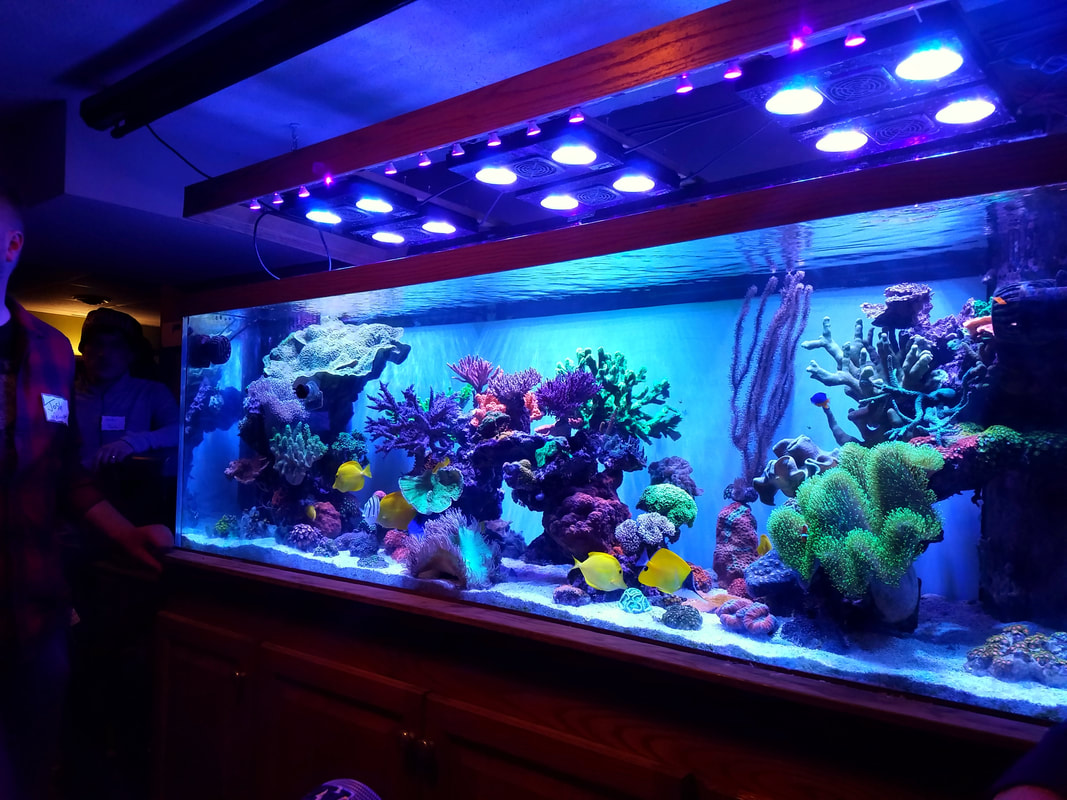
Most times we hear of someone showing their new leds, but what about the tanks that still have gen 1? Or another brand that is 5+ years old. My 180 gallon is lit by 4 Build My Leds. One is 4.5 years old, the second is almost 4. And the remaining two are 2+. My office tank has two that are 2+ and a third I bought used. They are all controlled by a manual dimmer set at 80% or less.

180 - 10-30-17.jpg
all corals REDUCED.jpg
 
LEDS generally have a lifespan of 50,000+ hours with proper maintenance and cleaning. Most of the time when they fail prematurely its due to overheating from dust collecting on the heat sink. And don't get me wrong there is always that handfull of special cases where the light just went out for no apparent reason...unfortunately it happens :)
 
Power supplies should fail first...;)

anything w/ capacitors will die first w/ proper thermal management..
 
Nobody really knows the useful life of them for sure... and there are so many different kinds. My MH bulbs have a life of 25,000 hours, but useful stops around 4000-4500 hours for some and up to 8-10k for others, or so, but people use them more and live with diminished performance. LED have phosphors as well, so illumination and effectiveness will be two different things for these as well.

The only thing that seems to be nearly certain is that some diodes with UV last a year or two before they disintegrate.
 
Nobody really knows the useful life of them for sure...
that is a pretty broad brush.. but pretty true for untested whole units..

but not for lack of trying:
http://www.ledsmagazine.com/article...-21-contributes-to-the-solution-magazine.html


TM-21 is the result of extensive analysis and it presents a realistic method of projecting lumen maintenance of LED packages, arrays and modules in actual operating conditions. However, diode lumen degradation over time is only one of many possible LED-product-degradation mechanisms. The industry is seeking to better understand component reliability metrics such as driver life, and the effect on lighting product performance.

The TM-21 document may be applied in various ways. It can be used by laboratories, manufacturers, or others as defined by the program or organization requiring its application. TM-21 data can be requested as part of LM-80 testing or applied by the manufacturer of an LED product. TM-21 is expected to achieve widespread use by organizations and program certifications (e.g. Energy Star) as part of their required documentation of performance.

TM21fig1.jpg

The useful life of standard lighting technologies is defined as the time to filament or cathode failure. For most of these lamps, the time period prior to failure exhibits acceptable levels of light output, as shown with the solid lines in Fig. 1. This makes it easy to determine when to replace the lamp.

However, LEDs do not have filament burn-out that conveniently announces the end of life (dashed line in Fig. 1). Further, the rapid development of the technology and the desire to bring products to market in a timely manner does not allow for actual testing verification of the long lives claimed (100,000 or even 35,000 hours). As a result, the industry has come to accept a definition of the end of the useful life of an LED as the point when it no longer provides a specified level of light output.

another chart from the first reference..

TM21fig3.jpg
 
Last edited:
That is an interesting chart. Do you believe that LED lose output at a similar rate to HID and tubes (until they burn out)? I am not sure. If so, then they all have very much a similar effective life over a reef tank.

It changes the equation a lot... either older units need the intensity increased (people near 100% are hosed), or they need replaced at 90% like MH and tubes.

I wish that we had more on this...
 
Last edited:
I am still using one kessil a350w that has been in use since late 2012. Mixed reef, and not measuring par but visually looks similar to a360 and a360we which are both newer. Interestingly enough the a360 does have a bit of an issue where it blinks for a few minutes when it turns on, and occasionally will blink at other times. I've completely taken it apart to clean in the past. A360we is only about 4 years old and that one like the 350 works perfectly.

If you truly get 50 000 usable hours out of the led's I'm less then halfway there, by the end of this year the a350 will have been used 24 000 hours. Meaning if it doesn't prematurely fail I will get close to 13 years out of it.

Maybe someone out there is still using those solaris pfo led's which I believe were the first reef leds. Without looking it up I think that was at least 10 years ago...
 
Asd to your question regarding lumen maintemance of LED vs "others" well best guessitimate.. not as long as they want you to believe not as short as when people "average".....
Industries do their own testing and know their own products much better than "I"

One a more positive note: Believe diodes will be a lot cheaper when most feel the need for replacement.. ;)

One thing to keep in mind.. all of this usually refers to phosphor coated "whites" not things like royal blue ect..and lumens (short subset of visible light)
Then you have heat decay of the crystal structure..

heatsink-post_light-to-heat-graph.jpg


doesn't answer your question on longevity.. Just interesting to see the differences of heat on various "colors"..
https://www.ledsupply.com/blog/why-you-need-an-led-heat-sink/

point is, like anything, poorly designed LEDs will not last as long as well designed LEDs..

Interesting paper..
https://www.sciencedirect.com/science/article/pii/S2095809916300625

One reason for the delay, given by the chairman, is that LED manufacturers are not willing to share color-maintenance data. The stated purpose of the working group is to project long-term color point stability for white LED packages only, using LM-80 data. It is not intended to apply to colored LEDs, organic light-emitting diodes (OLEDs), or remote-phosphor systems. There is currently no activity either in International Electrotechnical Commission (IEC) (Europe) or in Industry Standard Architecture (ISA) (China).

blink and things change:
2.1. The L Prize LED lamp
Two hundred L Prize lamps were tested for 25 000 h at 45°C. Testing has continued for 32 of these lamps and test hours now exceed 36 000 h (Figure 1). The L Prize lamps show that LED technology enables color shift (and lumen depreciation) to be quite small [3]. The average lumen maintenance for 200 lamps is over 100%, after 25 000 h. The average lumen maintenance at 36 000 h is 96.5% with respect to the maximum light output, which occurred after about 2000 h of operation.

1-s2.0-S2095809916300625-gr1.jpg
 
Last edited:
R2R reefers there has to be more than andrewkw and myself that still use older leds on their tanks? Not everyone has bitten the bug of upgrading every year or two?
 
R2R reefers there has to be more than andrewkw and myself that still use older leds on their tanks? Not everyone has bitten the bug of upgrading every year or two?
Not quite the main issue.. How much do they gradually fade away over time....................
I have no doubt the diodes will last a very long time (if fixtures are designed properly and no manuf defects, exceptions may apply)but at what intensity..

w/ some headroom.. say running at 75-80% they could last the 50000 hours or more..YMMV...14 yrs/10 hours per day..

http://pulsarlight.com/world-record-led-installation-longest-continuous-service/
Fast forward to today and the original ChromaPanels printed with the Pulsar name have clocked an impressive 13 years 10 months of continuous activity – actually surpassing 115,000 hours! This real-world industry first is proof of LED’s amazing longevity and also of Pulsar’s dedication to making the highest quality LED lighting fixtures on the market.
In the May of 2005 an additional 21 metres of ChromaStrip2 product were installed on Pulsar’s Facade. Would you believe it, our ChromaStrip2 product has now also surpassed 100,000 hours! Yes, we’ve done it again! The world’s second longest lasting LED installation.
Andrew Hilbert states: “Whilst the ‘headline’ is the longevity of the LED’s, it is the driver components that keep those LED’s operating. Each CS2 has 30 LED’s and more than 40 driver components which have also operated for 100,000 hours. A luminaire is only as reliable as it’s least reliable component,
 
There are probably a bunch. Keep in mind that the normal reefer does not go online very much... and more linger than post. I see about 10-15 tanks a month for work in real estate and the vast majority are lit with PetCo or LFS PC/T5 fixtures and maybe some VHO retros if they were once high end tanks. What exists and what is on the message boards are quite divergent.

If somebody made me use LED, I would seek out some of the older ones that had more whites in proportion to the blues.
 
R2R reefers there has to be more than andrewkw and myself that still use older leds on their tanks? Not everyone has bitten the bug of upgrading every year or two?

I'd wager you are not alone. I have a pair of multi-chips that are over 3 years old over my 40 breeder. I'll be moving them over my 210 that has just finished its cycle. Just need to finish the canopy then I'll move them in with the new LED's I built. Another 4 multi-channels. Proper cooling helps along with running them efficiently. I built my daughter a LED kit over her planted tank. Those are also over 3 years old.

Planted LEDs: mix of white, cool white, royal blue, blue, red, and one more (I forget)
40 breeder LED: 2 x Rapid LED Borealis muli-channel (love the lime greens)
210 gallon 30" tall: 4 x 20k acrostars pro (plus 2 above once canopy is complete)
 
yep i do still use gen1 radions in my system. I have been saving up money to replace with gen4 pros. Here is a pictures of the system over 4 years old now using gen1 lights
stag.jpg
 
6X Gen 1 Radions since November 2011. I've only had 2 issues, One had to be sent back in for fan issue ( under warranty ) and another I had to replace a ballast ( $75 refurb ) from salt creep that was my fault.

No signs yet that they need replacing, corals do just as well now as they did years ago, I believe I have compensated for age a little bit but increasing the intensity over the years but still have plenty of punch left. Back then $750 each so close to $5K invested, I'm hoping for another couple of years.

I do run two UV Leds strips ( DIY using rapidled parts ) to add a little more color pop since the Gen 1 were lacking that spectrum.


180g-03-13-2018_orig.jpeg
 
Last edited:
yep i do still use gen1 radions in my system. I have been saving up money to replace with gen4 pros. Here is a pictures of the system over 4 years old now using gen1 lights
stag.jpg
This tank never gets old. Looks amazing with gen 1 radions. Off topic but are you still collecting clams?
 
I have a Sunbrite Gen 3 tube (6 foot tube, 36 x 3 watt cree, Blue and RB) has been in my system for 6 years. Still plenty of PAR and looking great! One of the other two failed (power supply capacitor) and the other, while still working, was developing cracks in the guard area which was letting in salt; pulled it out about 60 days ago.
 

IF YOU HAD TO TAKE A REEFING EXAM, WOULD YOU PASS?

  • Yes!

    Votes: 32 45.7%
  • Not yet, but I have one that I want to buy in mind!

    Votes: 9 12.9%
  • No.

    Votes: 26 37.1%
  • Other (please explain).

    Votes: 3 4.3%
Back
Top