- Joined
- May 19, 2018
- Messages
- 692
- Reaction score
- 682
- What state or country do you live in
- Texas
*nudi’s salivate* lolHave to drop this here ;Woot:


Follow along with the video below to see how to install our site as a web app on your home screen.
Note: This feature may not be available in some browsers.

*nudi’s salivate* lolHave to drop this here ;Woot:

You know, it's actually kind of nice looking at first [emoji23]Have to drop this here ;Woot:

I was an aquarium tech and I actually have used lemon juice against aiptasia. My first go to is super buffer but if there are a lot of aiptasia using super buffer alone will cause the ph and alk to spike. To offset that I would use lemon juice.Definitely a cliff notes version would be super helpful to people. The main issue in the dino thread especially is that there seem to be two main camps.
The "dirty" method, used when nothing else has worked so that you can culture more easily manageable nuisance algae that will out compete the dinos
And the "clean" method, dropping nutrients so the dinos have nothing to feed on. Once they're in there in large numbers they usually have to be manually removed while the problem that originally created it is dealt with.
And then there's folks that just say toss on a UV sterilizer, blackout for 72 hours and hope for the best. It's really hard to gauge exactly what you need to do.
By the way - I've got a buddy that has had a recurring aptasia problem that Aptasia-X and the likes weren't working on. He found some off the wall treatment that involved (and I'm not making this up) injecting lemon juice concentrate into them. He read some article that suggested the remnant acidity from the lemon prevented the aptasia from re-colonizing that spot.
I definitely wouldn't suggest it, because if even aptasia refuses that spot I would imagine that a lot of good things would refuse that spot as well. Oddly enough, it worked for him and he hasn't had an issue with it in years.
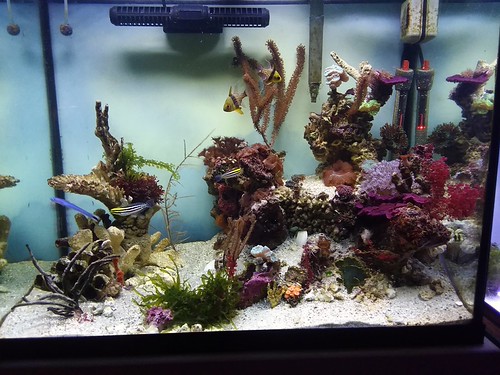 2019-02-01_06-06-56 by Dawn Gilson, on Flickr

For stubborn algae like bryopsis, and now dinos, I stick an ammonia badge in the sump for this very reason. I've noticed with manual removal there can be slight ammonia spikes. At first I figured it was due to dead parts of the sand bed being disturbed while cleaning.Also note that for algea, they have to convert nitrogen into ammonia for consumption, and that ammonia is easier for them to consume. Its possible that the nitrates may not be high, but there is detritus thats supplying ammonia for the algea.
Are algea better at using the ammonia than the bacteria? Wouldnt that cause more bacteria to die off and your algea to continue getting worse as it replaces bacteria?
I have no idea... There are a lot of cases where people have no nitrates and phosphates but still have algea growth. If algea prefers ammonia, then it may not be using nitrates if you have enough detritus...

Agreed. I certainly did not intend to be snarky, so I apologise if it came off that way. I did a LOT of research, microscopes were employed, marine biologists were consulted. The field I work in makes it easy to have these resources available.
Nuisance algae may always be present, but an infestation is not always present. Of course it cannot be completely eradicated, but the initial infestation can and should be eradicated as fast as possible when possible. I mean this stuff went from one spot to covering the entire tank within 24 hours. It was not a wait and see situation.