In addition to the ‘glamour photos’ of this little reef aquarium on it’s 14th year anniversary of continuous operation, thought it might be of interest to take a visual look at the micro and macro life that currently exists in this old system as well as my own experience with the various corals and other animals that call this place 'home'.
The Fish
Eyebrow Barnacle Blenny (Ekemblemaria myersi?) – August 2017

Even though the online recommendations suggest a 30g or greater, this blenny has done quite well in this 12g aquarium. Being of a ‘Barnacle Blenny’ type, it is pretty much a stay-at-home and so doesn’t require a lot of room. This one’s length has stayed about 2-1/2” which is ~1” shorter than the maximum length mentioned online, so that, and it’s rather darker color and different markings, leads me to believe it may not actually be E. mysersi (there are something like sixteen different related species that are currently known). This fish has lived a lot longer than the two or three smaller Pandemic Barnacle Blennies I had tried a few years back. Feeding is quite easy as long as the food is dropped close by or is carried by the current within the fish’s territory so it can dart out and get it. Great personality, hardy, seems to be relatively long-lived and only aggressive if it’s small personal space is invaded. While not one of the most colorful fish, overall I’d say it’s one of the better nano fish choices.
Azure Damselfish (Chrysiptera hemicyanea) – July 2021

When looking for an additional nano fish to increase nutrient load, I was considering between one of the Chrysiptera family damsels (Azure, Springers, Starcki, etc.) and one of the smaller wrasses (Pink-streaked, Possum). I chose the Azure and it turned out to be great choice. It has been peaceful to the extent of even being shy at times (after having two Clownfish in this aquarium for a few years, another nipping fish is the last thing I wanted!). It has grown from about 1” to 1-1/2” in length in a year. I was anticipating a larger size, but so far its growth seems to have slowed to a crawl, which is just fine. One thing I’ve noticed is that this fish is very enthusiastic and adept at picking out tiny animals (such as baby brine shrimp) from the water column, but has some real difficulties handling larger food pieces. This fits with its description of being a planktivore in nature. Since this fish and the blenny have such different lifestyles and body shapes, there’s really no competition/aggression between them (as long as the Damsel respects the Blenny’s modest few inches of personal space).
The Crustaceans
‘
Halloween Hermit Crab’ (Ciliopagurus strigatus) – October 2020

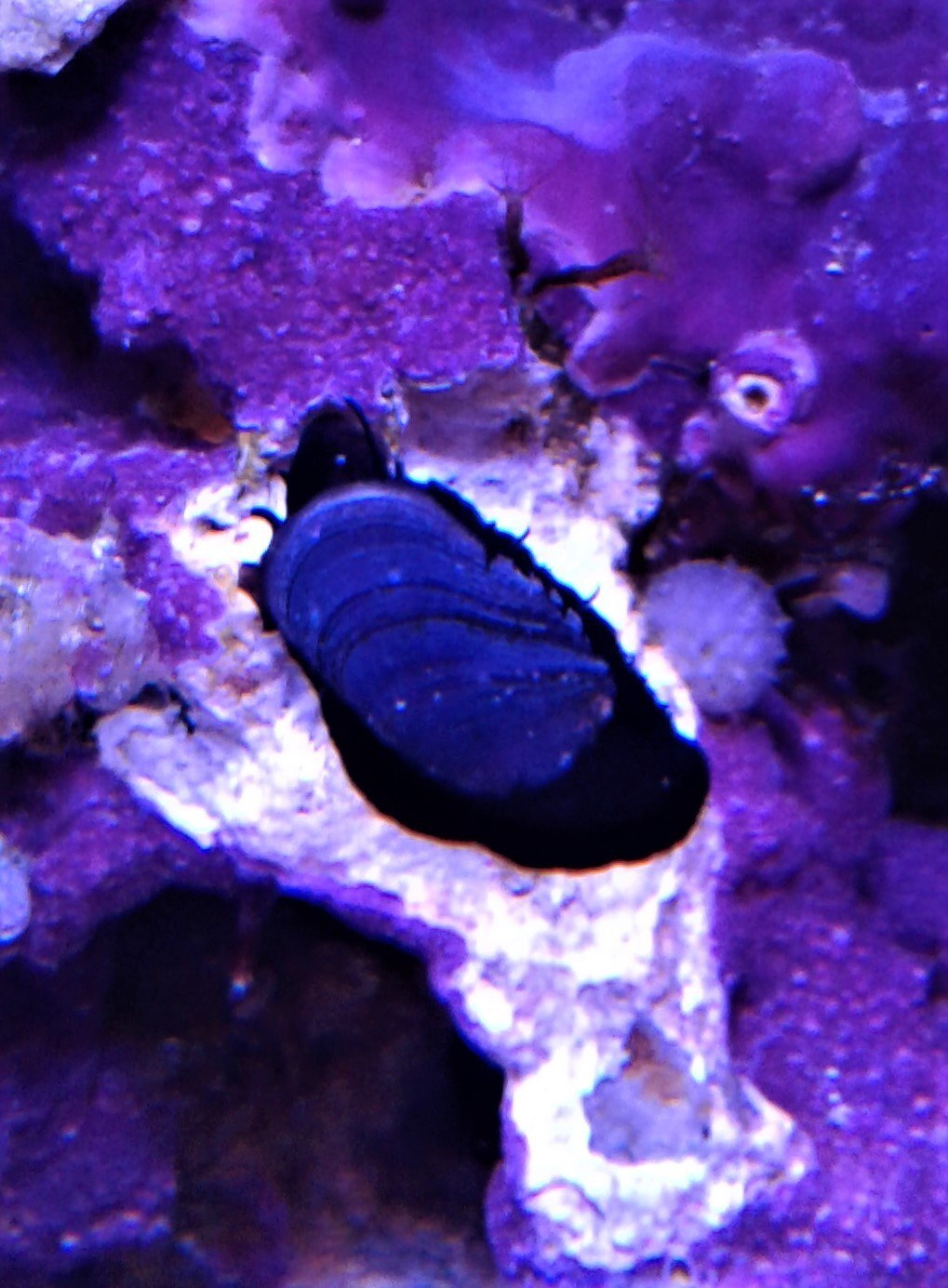
Spur of the moment purchase on the day of Halloween (seemed appropriate). Kind of the tortoise of the hermit crab world, but on the plus side it’s almost always busy (in a 12g tank, it doesn’t need to be very fast). Interestingly, the cone shell it came with has a permanent limpet-like snail hitchhiker that often pops it’s forked tongue out to rasp the rocks and gravel as the hermit lumbers along.
 Munching on a patch of mature colonial hydroids
Since the aquarium’s start, I’ve had a relatively steady population of colonial hydroids. Interestingly, since I added this hermit I’ve noticed a slow, but steady, decline in their numbers to the point that I now have to look hard to find one. It also may be responsible for the reduction and control of my digitate hydroid population.
It will eat tough fibrous algae, but doesn’t seem to stay interested in it for too long. The only caveat with this species is that it needs to have a cone shell to move into, so best to have a few spares laying around.
‘
Blue-Legged Hermit Crabs’ (Clibanarius tricolor)
I consider these the most versatile of the smaller hermit crabs as they seem to eat more types of pest algae than any other hermit species I’ve tried. I have two small Blue-Legs to get at the more inaccessible algae that the Halloween Hermit can’t get to. The only downside is that they are feisty little guys that tend to kill others of their kind over time and has been known to occasionally harvest live snails in order to obtain a more desirable home (especially so if empties are not laying around).
‘
Stomatella Snails’ (Stomatella varians and other species):

I purposely look for these little snails on my rare visits to a local LFS. Fast and efficient, never fall over and then can’t right themselves (like Asterina snails are prone to do), a shell that is not of interest to hermits...all while being able to potentially reproduce in an aquarium. What’s not to like!
Collonista Snails: Had these great little homegrown ‘Micro Trochus’ since day one
. Only issue I had with them is that they would occasionally get themselves wedged into my Hydor Rotating Water Flow device (before I put a close fitting plastic shield on the back side of it).
 White Limpet Snail:
Still have a few of these 1/4" snails that show up in the display from time to time, but more often I find them inside my return pump likely feeding on the bacteria films.
The Worms:
Eunicid sp.(?):

Although very rarely seen, I know that ‘Bob’ is still in the aquarium not by me seeing it, but rather by the way the Azure Damsel reacts when it sees it (adopts an ‘Eww, get this thing out of my space!’ posture until it moves on). There are over 150 species of these types of worms that have varied lifestyles and feeding strategies. I have not seen any direct harm from this one, altough it might possibly be responsible for silky/sticky white tube structures that I find occasionally.
Small Burrowing Worm (possibly a Eunicid sp.):

I see these tiny burrowing worms in the sand bed occasionally (look like a mini-me Eunicid worm). Don’t seen to cause any harm.
Black & White Stripped Burrowing Worm:

I have no idea what genus this worm belongs to, but it has a white-helmeted head and black and white striped pattern. It looks and moves like a mini-me version of a slithering sea snake. I also have a similar worm type with the white-helmeted head and a solid white body that lives in the live rock.
‘
Spaghetti Worms’ (Terebellidae family

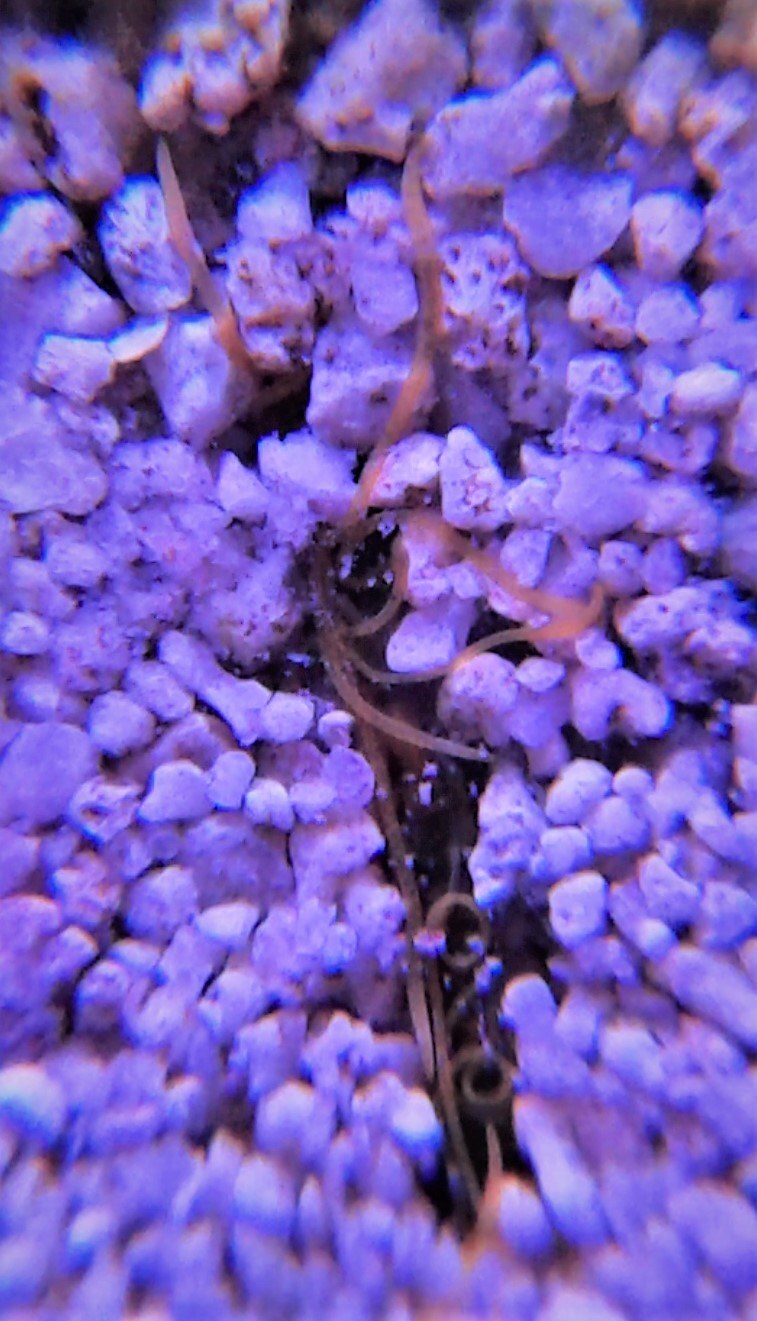
This particular species came in on a frag plug and has ‘warning, I’m poisonous’ coloration (orange with black striping). Unfortunately, a Geometric Pygmy Hawkfish that I had just purchased found out the hard way after eating one of these for dinner and then was found dead the next morning. It has done a really good job of multiplying all throughout the sand bed and as a result has reduced my bristle worm population substantially through direct competition.
Bristle Worms:

Ubiquitous CUC mainstay of most reef aquariums. I’ve had these get up to over 12” long when I first started the aquarium, but rarely see them more than 4” now (likely due to food being quickly assimilated by a wider variety and number of creatures). I used to have to use tweezers to occasionally remove excess worms, but haven’t had to do so since acquiring the spaghetti worms.
The ‘Pods’:
Only two types:
1. Isopod (~1/4”)
2. Cyclops (~1/8”)
The Echinoderms:
A single 2” reddish-stripped Brittle Star (unknown species). Acquired from a LFS and luckily it has stayed small at this manageable size. Very secretive and I often see the tips of its arms, but never the disk.
The Sponges:
Interestingly, no visible sponges in the lighted portions of the main display, but there are some in the dark and inaccessible live rock areas. Multiple sheets of opaque sponge plus a few Pineapple sponges live in the rear chambers.
The Alga:
Green Algae: Only one species of green, short and branching, tough fibrous algae left. Hermits will much on it if really hungry. Also the typical light dusting of brownish algae on the glass every 3 days or so and small splotches of some type of very difficult to remove green smear algae at the gravel line level, typically.
Coralline Algae: A bright pink species is typically the pioneer species on any new live rock space. Within a few months, deep thick encrusting purple species slowly displace the pink.
Other: Also have a maroon algae with the common name 'Burgundy Crust Algae' (
Peyssonnelia sp.). Often called a 'coralline algae', but it's not. Slimy to the touch and grows fairly fast.
Various Extinct/Exterpated Species (and cause, if known):
1. Micro Brittle Stars (unknown cause)
2. Gammarus Amphipods (Black-Barred Circus Goby -
Priolepis nocturna)
3. Mysid Shrimps (digitate hydroids)
The Stony Corals (Scleractinia):
‘
Mint Green Pavona’ (likely Pavona frondlifera)
This is one of the first stony corals in this aquarium and was one of two bags of coral left over at a frag swap back in 2009. Top down shot of the 1-1/4” frag under T5 lighting:

All that I really knew about Pavona at the time was that it was aggressive, hardy, and didn’t require high lighting, so I did have some reservations about adding it to a small nano. What I’ve noticed over the many years is that this coral is a very effective sideways encruster/spreader. It’s usually rather mellow when under medium lighting (100-150 PAR), but when given high light (150+ PAR) it becomes much more aggressive sending dozens of up to 3” sweeper tentacles towards its neighbors (`1-1/2” being more typical). It also has a little trick for getting at neighbors elevated above it; it sends up vertical ‘fronds’ that then launch sweepers from the tips. The nice thing is it’s relatively easy to simply snap these thin fronds off by hand. It’s also one of those corals that has shallow corallites and can be relatively easily scraped off the live rock with a screwdriver or similar tool.
As can be seen from the side view photo below, it has managed to encrust right around the mid base of the main rock island (it did this before the zoanthids established themselves), effectively creating two separate colonies:
 Long term small nano tank suitability:
 On a scale of 1-10, I’d give this coral a 5 mainly due to it’s encroaching encrusting nature, and especially its potential aggressiveness which is exacerbated when placed in higher flow/higher light. It can be kept manageable with moderate lighting and flow, removal via scraping of encroaching tissue and occasional snapping off of the vertical fronds.
Pavona maldivensis:
I picked up a wee little frag (about the size of a pinky nail) of this coral at a local LFS around 12 years ago. It was one of those insanely bright specs in a sea of blah and the store owner sensed I’d pay a pretty penny for it ($30 back in 2009):

It was a bit of a slow grower under lower level T5s and grew outward to look like a sombrero, but once under higher light LEDs it quickly developed the more typical mound-with-protusions form common to the species:

This color variant has an amazingly bright metallic reflectance that confuses my cell phone camera, but that’s pretty close to what it actually looks like. In this coral there is an additional photosynthetic pigment called phycoerythrIn (absorbtion @ ~498nm & 565nm, emission @ ~575nm) giving it the bright orange fluorescence.
It tends to flatten out around it’s base in around 150 PAR which helps keep the Mint Green Pavona and a Leptoseris somewhat contained via shading. Like the Mint Green Pavona it can be aggressive, but it’s less apt to target farther away neighbors than the Mint Green Pavona and the sweepers are shorter (~1”). With it’s relatively large coralites for a Pavona, this one is a fairly strong feeder and it can even handle newly born earthworms if given enough time (however, I don’t go out of my way to feed it).
Long term small nano tank suitability: On a scale of 1-10, I’d give this coral a 6 mainly due to it’s thick encrusting nature (difficult to prune) and its potential for sweepers. It can take a good amount of lighting (I had it at ~220 PAR at one point without issues) and can be kept more manageable with moderate lighting (~160 PAR) and medium flow.
Leptoseris – aka ‘Wrinkle Coral’ (likely Leptoseris mycetoseroides
‘Fallen Horizons’ (top) and ‘Jack’o’lantern’ in 2015:

The Leptoseris are very similar to Pavona, but typically will do well with a bit less light. They are moderately aggressive with short 1” sweepers on occasion that can inflict some damage. They are slow, or even unresponsive to direct feeding. I’ve had some issue with these especially during periods of very low PO4 and even lost the original JoL in this photo. I’ve found them somewhat slow to recover from damage (mature Fallen Horizons colony slowly recovering from a rare high Alk event):

Small ‘Jack’o’lantern’ coming along nicely:
 Long term small nano tank suitability:
 On a scale of 1-10, I’d give these encrusting Leptoseris corals an 8. Their sweepers are short and not super-potent, plus they do fine in moderate light and flow.
'
Ponape Birdsnest' (possibly Seriatopora aculeata or S. dendritica)
Easily my #1 pick for the best SPS branching coral for a small nano tank:

I obtained this one as a single small branchlet that had fallen to the bottom of a LFS frag rack tank.
The smaller, thinner branches are proportionately well suited to a small nano. It grows well in ‘lower light’ (130 – 150 PAR) where it keeps a fluorescent green body with purple tips. In higher light (170+ PAR) it turns a solid pink. It grows well in low/medium flow, so is a good SPS addition to an LPS dominated tank (when placed higher up).
The difficulty with most branching corals in a small nano aquarium is their natural tendency to branch out in various directions. While this may look great, whenever you need to get your hands in there for cleaning, pruning, etc. inevitably there is a real risk of either breaking the branch (thin Acropora) or dislodging the whole colony (Seriatopora). Acropora typically lay down a thick encrusting base, which is great at keeping the colony attached, but they also tend to grow very rapidly and crowd out other species or aggressively kill their neighbors. With Seriatopora, they are notorious for not growing a solid base and so one inadvertent swipe can topple the whole colony.
The Ponape Birdsnest has rather short and compact branches that are brittle enough to prune by simply snapping off between the fingers. When the colony gets too large and dense, it’s super easy to create as many frags as needed to start a new one again. In order to keep the colony base secure to the live rock, I create a 1” diameter x 3/8” thick reef epoxy flat disk, stick a few frags into it (in a splayed flower-pedal like arrangement) and then glue the epoxy base to a bare patch of live rock. The branches soon grow and intertwine (providing interlocking rigidity) and within a few short months the base is no longer visible (this coral grows really fast under the right conditions). This method helps ensures a secure base that won’t come loose when pruning.
Long term small nano tank suitability: On a scale of 1-10, I’d give this coral a 9 (would be a 10 if it would grow a bit slower).
‘
Pink Stylcoeniella’ (likely S. armata)

I bought this encruster many years ago for a reduced price from an LFS that had severely bleached it under high lighting. This is one SPS that doesn’t thrive in higher light being mainly found protected in rock cracks in shallow water or more in the open on deeper reef slopes.
There are now many color varieties, but this pink one was one of the first available and I think it’s very attractive due to the color and swaying polyp movement (it likes occasional medium strength blasts of flow). I have found that this coral needs at least occasional feedings of small foods like ReefRoids, BBS (baby brine shrimp), etc. to grow well. It does have a dark side, though, as it has a mighty powerful sting that is delivered by the extended polyps and especially the 3/4" sweepers (I’m using it right now to control an overly large Leptoseris colony). On the plus side, the tissue is like a thin mat, so it’s a very easy coral to control by simply scraping away with a mini screwdriver (or similar tool)..
Long term small nano tank suitability: On a scale of 1-10, I’d give this coral an 8
. The powerful sting and a place that’s easy to feed it are things to consider when placing it in the aquarium
'Outer Space Psammacora':

This coral is a survivor as it's positioned between a A. pachysepta, a Pink Stylocoenella and a Sunset Montipora. At one point I thought it was a goner after the Pachysepta strafed the area, but within a week or two it came back in full force.
Long term small nano tank suitability: On a scale of 1-10, I’d give this coral a 9 for hardiness and only mild aggression.
Sunset Montipora (Montipora danae)
One of the first corals in the tank:

...under former high lighting (180 PAR) 'full spectrum':

...and under the Ponape Birdsnest (~100 PAR):

One of those 'Old school' corals that really benefits from higher PAR lighting/full spectrum, but still grows fine under lower lighting and medium flow. One of the more aggressive Montis so it has been able to hold it's own for the most part.
Long term small nano tank suitability: On a scale of 1-10, I’d give this coral a 7 as it is an aggressive spreader, is semi-plating causing some shading on corals below and it lays down a thick skeleton that's hard to remove.
Leptastrea (likely L. pruinosa)
A small starter mini colony in 2012:

This Leptastrea in now 25 years old as it came from my old 55g. This is one of the so called ‘zombie corals’ as it is extremely resilient and often will make a comeback when you think it's done for. The corallites are deeply set, so tissue can survive even if the coral looks dead on the surface, awaiting for proper conditions to grow out. The best way I’ve found to stop it from expanding is by using an epoxy patch covering the area.
The colony as it is today:

Literature states that it doesn’t like high light, but when slowly acclimated it does fine in 170 PAR (I have personally seen this coral in it’s natural setting at around 15-20 ft. depth, so it can take a good amount of light). It also feeds well, devouring surprising large prey by using multiple polyps to slowly digest the meal. It’s sting is local (no sweepers), but it’s fairly potent and the coral is very persistent. This is a coral that I have to regularly prune to keep it from over growing parts of the system.
Long term small nano tank suitability: On a scale of 1-10, I’d give this coral a 4. The fact that it grows moderately quickly, regrows from areas where it was supposedly dead and is so darn persistent in it’s expansion makes it a bit of a handful to control. Would be perhaps better on it’s own separate rock island.
Really Large Polyped Corals:
I’ve taken quite a fond liking to the large polyped corals and all but the largest species are suitable for a small nano aquarium, IMO.
Blastomussa vivida:

B. vivida hugs the rock work and polyps then spread on it’s surface. I managed to separate a few tiny polyp buds from the parent and they are now slowly growing out in a different location.
Blastomussa wellsi:

B. wellsi is arguably the most common species kept and can typically be identified by the colony’s phaceloid (individual polyps on short stalks) morphology and larger corallites/polyps (polyps up to ~3 - 4”) ccompared to B. merletti (polps ~1” to 1-1/2”).
B. merletti:

I’ve found this one to grow the fastest of the Blastos and it is also the most aggressive by far.
In this photo, this B.merletti colony has severely damaged the neighboring Mint Green Pavona (left):

It also has the interesting habit of occasionally dropping it’s polyps as a form of asexual propagation:
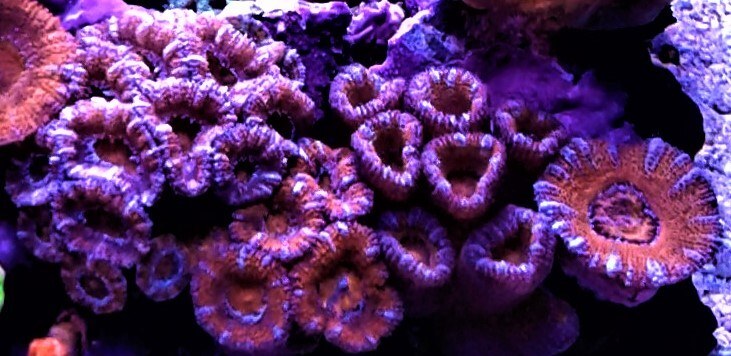
 Acanthastrea pachysepta:

When is a Lobophyllia not a Lobophyllia?...when its an Acanthastrea! While the two look superficially similar, they are actually quite different animals. Perhaps the best way to tell them apart for the hobbyist is in how they behave: Pachysepta is one mean hombre and is prone to destroying it’s neighbors with mesenterial filament attacks (typically at night) from a distance, while true Lobos are much more passive (aggression when tissue touches a neighbor). The 'tres amigos' pictured here will attack any coral within ~1” and then completely clear the area for 2” around.
I’ve also found that they are rather sensitive to higher lighting intensity and spectral changes (especially hyperviolet/violet). I’ve seen partial bleaching and distress at ~140 PAR, even when lighting adjustments were made very slowly and they will also readily evert their internal messenterial filaments when displeased.
And while we are on this subject, now I know what this uber-aggressive ‘Lobo’ from back-in-the-day really was!
 Micromssa lordhowensis (formerly ‘Acanthastrea lordhowensis'):

I’ve found these to be quite easy going corals that have changed color patterns over time in this ~100 PAR location. When illuminated with higher light (130+ PAR) they tend to turn orange with white stripping. Even higher light and they’ll start looking like they’ve been iced due to the bleaching. Interestingly, even though these multiple colonies and individual polyps received similar lighting and flow intensities, there is variability in the polyp shapes (some are relatively flat, some are typical for acans, others are more ‘fluted’.
Homophyllia bowerbanki (formerly 'Acanthastrea bowerbanki')
I picked up this pair of nickel and dime sided H. bowerbankii polps a while back for next to nothing:

...and they quickly grew into a good sized colony with the central polyp over 3” in diameter:

I've found that this coral also has strong regenerative properties and some tiny fragments went from this:

...to this in less than two months (with no die-off):

The end goal here is to have a rock covered with Bowerbankii colonies as a central focal point.
Oddly, this orange Bowerbankii showed aggression towards a solitary polyp of a supposedly M. lordhowensis, but not to a different Lord colony. That strongly suggests to me that there are superficially similar looking 'Lord' specimens that may not actually be the same species (such as we’ve seen with Lobophyllia sp. and Acanthastrea pachsepta).
‘
Button Scolly’ or ‘Croc Island Scolly’ (Micromussa pacifica)
These two ‘Button Scollys’ are two of my more recent acquisitions from this year:

Didn’t know quite what to expect from these as I’ve never kept them, but so far I’m pleasantly surprised at their easy going nature (they even tolerate the Blastomussa wellsi down below them). I’ve got them under ~120 Par and moderate flow and they seem quite content. One thing I do notice is that while they sometimes slowly open up a bit for food during the day, they really blossom open at night. So I now feed them pellets 2x/wk at night and they are really getting puffy and putting on some growth (barely 1” when added to over 1-1/2” now).
'Duncan' (Duncanopsammia axifuga

Picked up a single head of this 'fat tentacled' Duncan and with 3x/wk feeding it took off right away. In fact, after 5-6 heads I had to seriously curtail feeding to small amounts once a week just so it wouldn't outgrow the system. Lower lighting (~60 PAR) and a flow that moderately sways the tentacles works well for this one.
I had a solid grey one of these maybe 20 years ago when they first became known and quite honestly I wasn't much impressed. However, with these more colorful varieties we have today I've come to appreciate it much more.
Long term small nano tank suitability: On a scale of 1-10, I’d give this coral a 8 as I've found it rather easy to keep (although it can get moody if water parameters change) and is quite attractive as it sways in the current. With a branching growth form and being a bit 'big boned', it needs some space. If a light feeding is restricted to maybe once a week, it won't outgrow it's space as fast as when it's fed often and heavily. This is a concern as it's a difficult coral to prune due to it's thick/dense branches.
The False Corals:
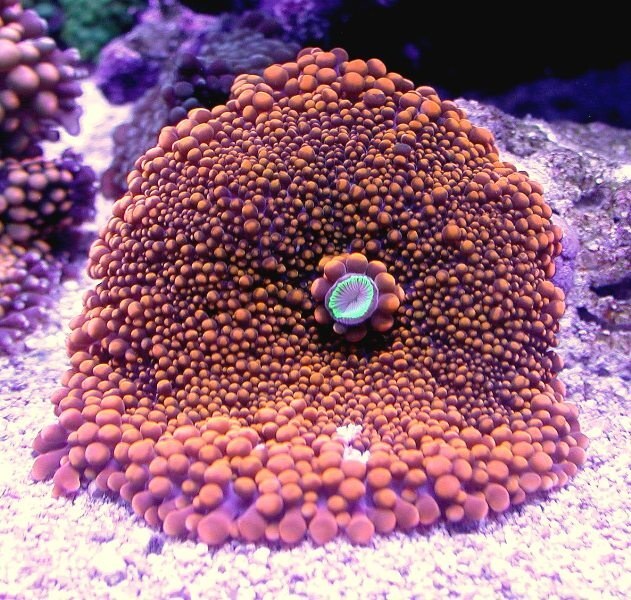
Ricordia Mushrooms (R. florida & R. yuma

Nearly all my R. florida are from a Coral Morphologic ‘10 pack’ way back in the day ($100 total, if I remember correctly). Nothing unusual, just some nice two-toned Rics. Typical of all Rics, they will annihilate stony corals if allowed to touch, but will not harm each other or R. yumas. Medium/low lighting and lower flow is optimal for these (skirts should just barely lift in the current) and can expand to nearly 6” under these conditions.
My R. yuma are a mixed bag of aquacultured and wild. These corals will go out of their way and literally ‘stretch’ to one side to try and get at neighboring stony corals. As a result, I have to make sure there is plenty of room between them all to avoid conflict. I’ve not had much luck with the large Yuma that have the row of typically white vesicles (‘bubbles’) that go from the mouth to the outer rim in a straight line, but have had little trouble with those that have uniform color and size. (except when I have inadvertantly overlit them).
This is a good example of a beautiful Yuma with the white line of bubbles that survived for only a few short months (still hurts that I couldn’t save this one):

Based on other reef keeper’s who have reported long-term success with these, I believe my tank is too brightly lit and flow is too strong (some have reported success keeping these in their sumps/refugiums with very little lighting and only 3-5x/hr flow).
...and the type that typically do well in this aquarium:

I’m waiting for a science team to do a DNA comparison study on these two types as I strongly suspect that they are not the same species.
The Zoanthids:
If there is one group of false corals that remains a challenge and an enigma, it’s the zoanthids. What I’ve noticed is that when zoanthids are aquacultured in shallow vats/aquaria with the same lighting and flow, they seem to do quite well overall (joshporksandwich and Legendary Coral videos come to mind). But finding niches in a small mixed nano reef system that various types can do well in has truly been a hit-or-miss proposition.
Take for example a wonderful little very healthy and robust colony of Red People Eaters I got from a local LFS which I placed in a lower light (~40 PAR) and medium flow area:

It wasn’t long before the skirts started to curl, which is not a good sign and slowly got worse. So I split the colony up into three groups and tried different locations (low light ~40 PAR, medium light ~130 PAR and strong (for my system) light ~200 PAR). The only colony that survived is the one in 200 PAR and strong intermittent flow and has done so well (large plump 1-1/2” polyps) that it is multiplying and taking over the area excluding other zoanthids. I’ve also never seen zoanthid polyps grab food as aggressively as these do now (they behave more like hungry LPS) and they are almost as sticky to the touch as an anemone!
And then some other nice smaller zoanthids like Rastas would do okay for a period of time and then inexplicably recede and perish within a week (sigh).
Of the 12 or so varieties I’ve tried over the years, the survivors are:
1. Red People Eaters
2. Shadow Prince
3. Fire & Ice
4. Utter Chaos
5. A few 'No Name' Zoas
Unidentified/UnexpectedCorals
After isolating two polyps in an area of lower lighting and better viewing, I believe I have identified these odd little polyps that sprang up from under the coralline on my live rock as ‘Molten Lava Leptoseris’:

I had this invasive coral take over nearly 1/3 of my rockwork a few years ago and I battled it for months until I had eliminated it (or so I thought). This is what the original frag looked like back in 2014 and it’s a pretty clear match:

While I admire it’s tenacity and spunk, needless to say, it’s not a coral that I would keep in the system…
Next up is this odd little greenish 3/8” stony coral polyp:

It originally came in years ago on a frag as a colony of 8 or so, but this is the only survivor after the Leptastrea got to it. Strange little thing that will grab onto food, but conditions are not quite right for it to multiply. I may try feeding it more often and see what it does.
'The Softie' (NPS):
Scleronephthya:

Had this one for nearly a year, and currently it's going through a 'tunic phase' where it closes up for a few weeks. I noticed this occurs whenever it is stung by digitate hydroids. I've had to remove the coral twice now to get at the hydroid's foot to remove it and each time the coral shrinks (takes 2-3 weeks to feed again after the tunic is shed).
Photo 7/23/22, smaller, but looks okay and is feeding:

At this point, it's just a matter of daily feedings and getting it to grow a bit...before the next hydroid takes up residence.
Invasive corals that were ‘Moved On’:
Montipora Setosa - grew too large shading corals underneath, branches became very solid/impossible to trim without removing the entire colony:
 Molten Lava Leptoseris (Leptoseris sp.)
 - Became an invasive unstoppable encrusting force of nature when exposed to higher intensity lighting (turned an attractive blue) and eventually occupied nearly 1/3 of the live rock surface before extirpation via reef epoxy patches.
 Ultra Blue Montipora Digitata
 – Very fast growth (overshadowing other corals), narrow base, too easy to knock off the live rock:
 Red Planet Acropora (variant)
 – Large encrusting base with super fast growth, highly aggressive nature with very potent sweepers:
 Rhodactis sp.
 - Grew to nearly 8” diameter, aggressive:

Hope this was an informative read. The main takeaways here is that a good amount of biodiversity can be maintained for the long term even in a small aquarium.
For the 15th year I'll do something similar, but I'll focus on the setup, procedures and maintenance that have kept this little system running for all these years.
Happy Reefing!
Ralph.















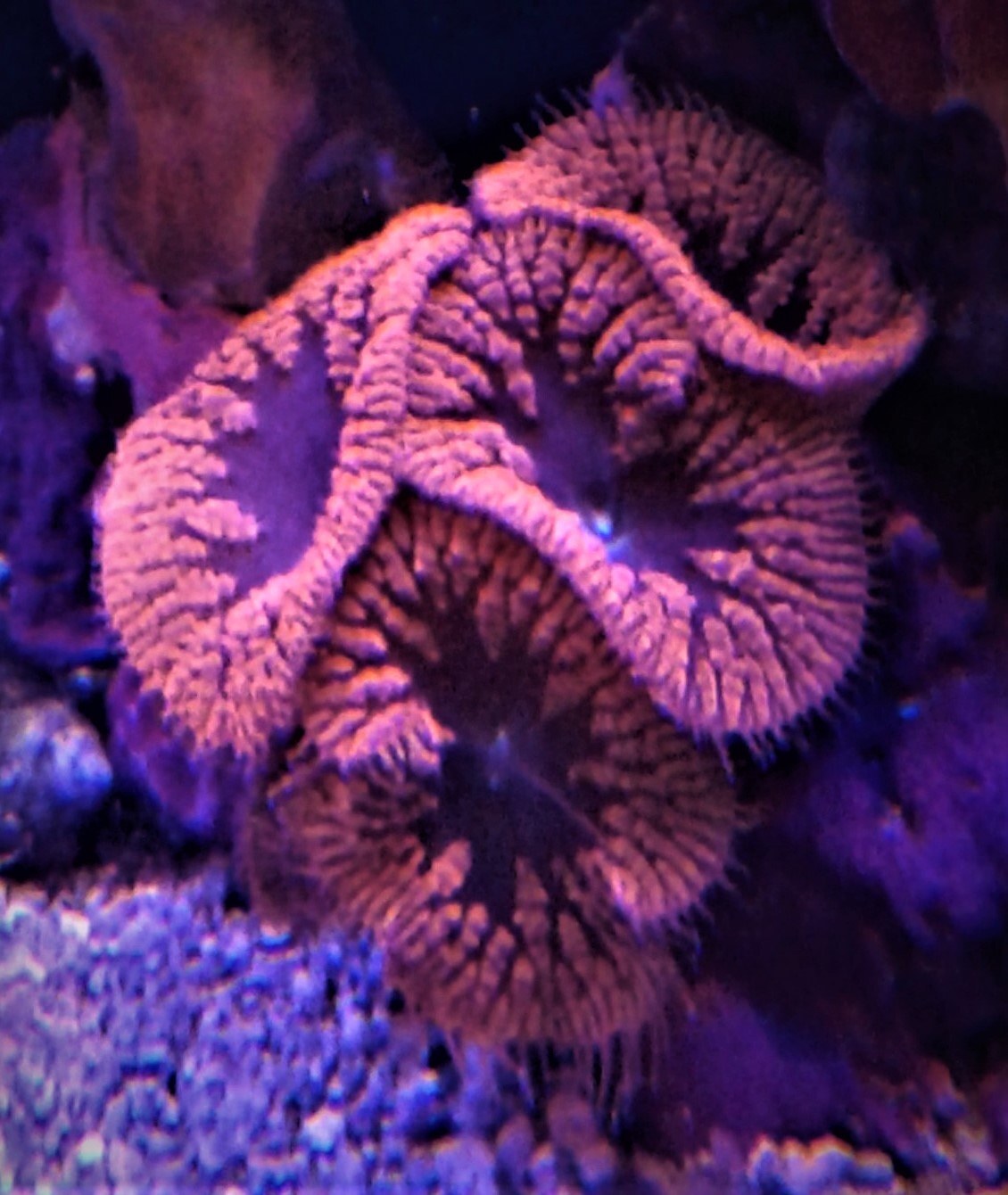
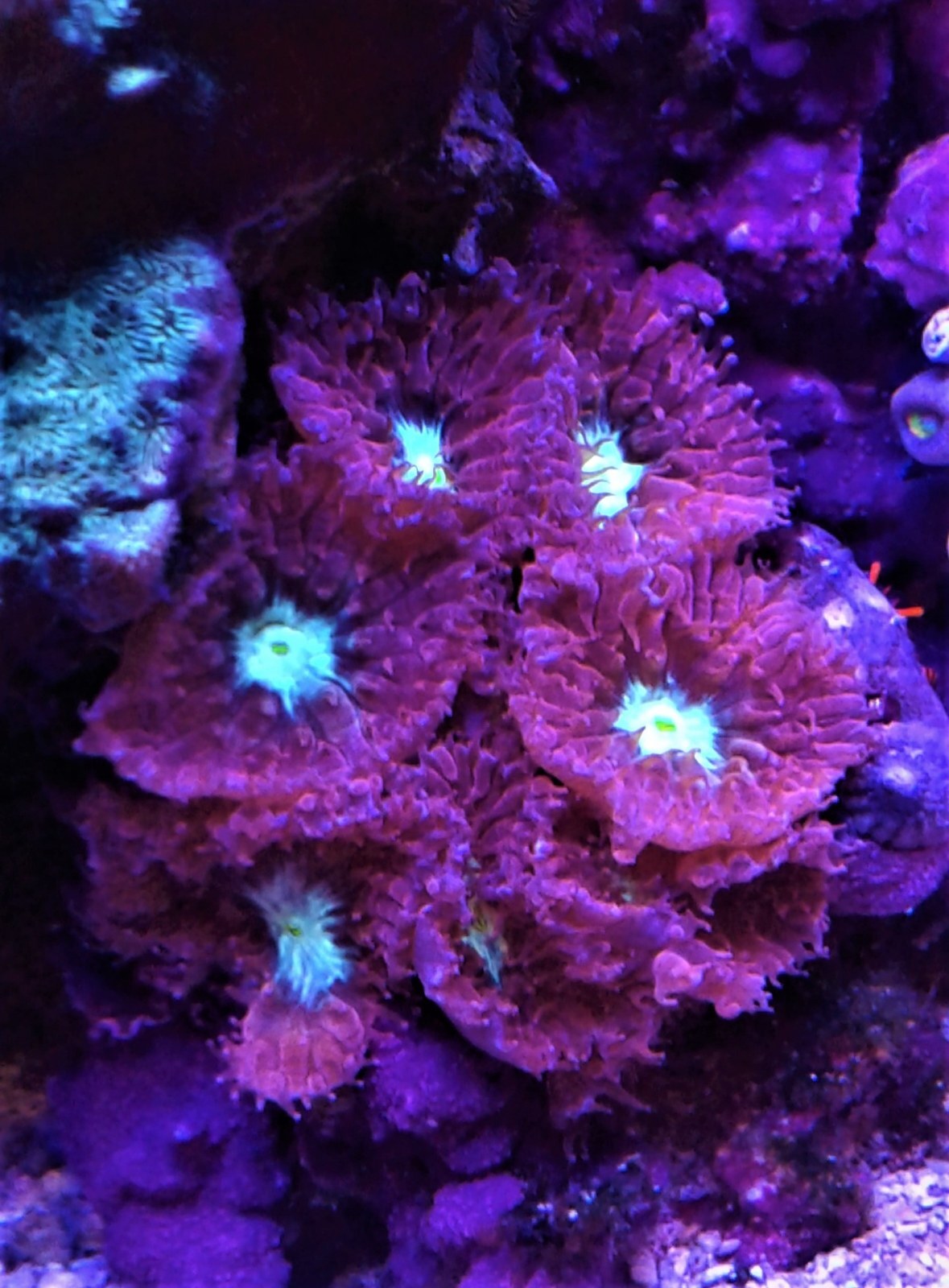









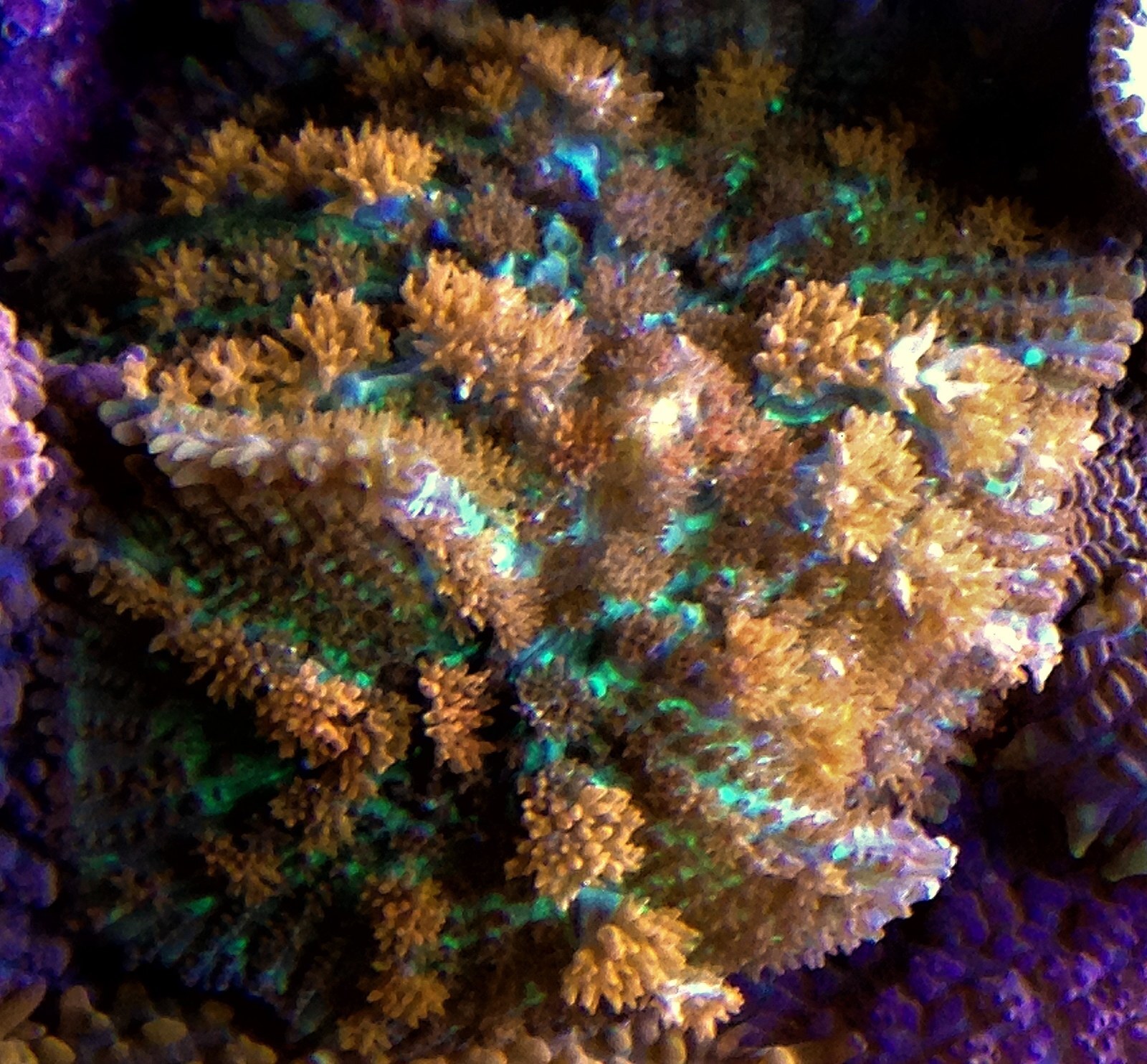





 I see these things either on the glass or floating in the water column weekly. Last week I followed one on it's journey round-and-round the tank and then right into the tentacles of a Banki (non-non).















