Neptune Apex FMK: A couple interesting observations

morpheas

Well-Known Member
View Badges
Joined
Apr 3, 2016
Messages
532
Reaction score
451
Rating - 0%
0   0   0
I just recently purchased, and just this weekend, installed the Neptune Apex FMK. As a background, I have a 30 gallon system with a sump and use a Jebao DC-6000 return pump with a 1" vinyl tubing line for the return. I run it at it's lowest setting which the pump says will do ~1100 gph at 0 head. I installed the 1" flow sensor on the return.

The first interesting observation is that it's showing ~275 gph flow. That is at ~4 ft of head. It is a very suspicious number but it might as well be true since I have no other way of measuring and verifying.

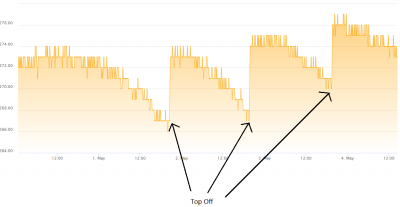
Now for the one that had me thinking for a little. I do not utilize an ATO system (I do not see a major gain in salinity stabilization - I run the numbers - and topping off daily has not become a nuisance to me yet). Every evening, I top off as needed, which at worst case could be half a gallon or so. The first day I installed the meter, it read 275 gph. Slowly, over the course of a day it gradually decreased to 268 gph. At the time I thought maybe the pump is stabilizing (I had just swapped the backup in place so I can clean the other one). As soon as I topped off the flow rate returned to ~275 gph. I scratched my head a little but since the bump coincided with my top off the prevailing theory was that the salinity made a difference. I started running the math and to my surprise it did actually make sense.

For the mathematically inclined, I will briefly explain the logic (I have a spreadsheet in google docs that I could share if you need). Initially the salinity is 1.024. Then, over the course of the day half a gallon of water is lost which brings the salinity to 1.0244 (as I mentioned before minute change). But, increasing the salinity, even by this minuscule amount, increases the weight of my 4 ft column. The higher weight increases the back-pressure to the pump which drops the flow rate. To put things into perspective, the change in pressure is about 0.01 psi which is apparently (using a modified Bernoulli equation) enough to drop the flow rate by ~7 gallons.

I am in the process of double checking my math and hydraulics calculations but this is a phenomenon I have observed again and again over the past week as shown in the next picture.
468642-3c5a7a322704210e6041248bbcdf230c.jpg


Now what does that mean exactly for the average reefer (assuming my explanation is accurate and correct):
  • A mathematical correlation could be developed for a system that given a flow rate would calculate salinity.
  • Of course, since salinity and flow rate are not uniquely connected (other things come in play especially long term like tubing deposition, pump buildup etc) that would be a tentative estimation (but useful nonetheless in my opinion).
  • Especially, if you measure the flow in liters per hour you will get an even finer number to work with.
  • I am sure that many people have alarms for low flow rates but alarms could also be established for sudden high flow rates as well (which could indicate an ATO going haywire).
  • Of course all this needs to be taken with a grain of salt and be seen as part of the big picture and not a single number.

I am sure to most of you out there this is useless/nonsense/too much, but to a gear engineering junkie like me it's another piece of information, another number that reflects the status of my reef. Who knows, maybe someone will find this interesting. For now, I'm just putting it out there.

Untitled.png
 
I just recently purchased, and just this weekend, installed the Neptune Apex FMK. As a background, I have a 30 gallon system with a sump and use a Jebao DC-6000 return pump with a 1" vinyl tubing line for the return. I run it at it's lowest setting which the pump says will do ~1100 gph at 0 head. I installed the 1" flow sensor on the return.

The first interesting observation is that it's showing ~275 gph flow. That is at ~4 ft of head. It is a very suspicious number but it might as well be true since I have no other way of measuring and verifying.

Now for the one that had me thinking for a little. I do not utilize an ATO system (I do not see a major gain in salinity stabilization - I run the numbers - and topping off daily has not become a nuisance to me yet). Every evening, I top off as needed, which at worst case could be half a gallon or so. The first day I installed the meter, it read 275 gph. Slowly, over the course of a day it gradually decreased to 268 gph. At the time I thought maybe the pump is stabilizing (I had just swapped the backup in place so I can clean the other one). As soon as I topped off the flow rate returned to ~275 gph. I scratched my head a little but since the bump coincided with my top off the prevailing theory was that the salinity made a difference. I started running the math and to my surprise it did actually make sense.

For the mathematically inclined, I will briefly explain the logic (I have a spreadsheet in google docs that I could share if you need). Initially the salinity is 1.024. Then, over the course of the day half a gallon of water is lost which brings the salinity to 1.0244 (as I mentioned before minute change). But, increasing the salinity, even by this minuscule amount, increases the weight of my 4 ft column. The higher weight increases the back-pressure to the pump which drops the flow rate. To put things into perspective, the change in pressure is about 0.01 psi which is apparently (using a modified Bernoulli equation) enough to drop the flow rate by ~7 gallons.

I am in the process of double checking my math and hydraulics calculations but this is a phenomenon I have observed again and again over the past week as shown in the next picture.
468642-3c5a7a322704210e6041248bbcdf230c.jpg


Now what does that mean exactly for the average reefer (assuming my explanation is accurate and correct):
  • A mathematical correlation could be developed for a system that given a flow rate would calculate salinity.
  • Of course, since salinity and flow rate are not uniquely connected (other things come in play especially long term like tubing deposition, pump buildup etc) that would be a tentative estimation (but useful nonetheless in my opinion).
  • Especially, if you measure the flow in liters per hour you will get an even finer number to work with.
  • I am sure that many people have alarms for low flow rates but alarms could also be established for sudden high flow rates as well (which could indicate an ATO going haywire).
  • Of course all this needs to be taken with a grain of salt and be seen as part of the big picture and not a single number.
I am sure to most of you out there this is useless/nonsense/too much, but to a gear engineering junkie like me it's another piece of information, another number that reflects the status of my reef. Who knows, maybe someone will find this interesting. For now, I'm just putting it out there.

Untitled.png

When I got my FMK, it did not correctly identify the sensor. I have a 1/2 sensor and it identified it as 1 inch. So the first reading was like 800 GPH, which was way off. I then went in and manually set it to 1/2 inch. Since it has consistently read 167-170 GPH. Which makes sense. I'd check that out in your apex settings.
 
I just recently purchased, and just this weekend, installed the Neptune Apex FMK. As a background, I have a 30 gallon system with a sump and use a Jebao DC-6000 return pump with a 1" vinyl tubing line for the return. I run it at it's lowest setting which the pump says will do ~1100 gph at 0 head. I installed the 1" flow sensor on the return.

The first interesting observation is that it's showing ~275 gph flow. That is at ~4 ft of head. It is a very suspicious number but it might as well be true since I have no other way of measuring and verifying.

Now for the one that had me thinking for a little. I do not utilize an ATO system (I do not see a major gain in salinity stabilization - I run the numbers - and topping off daily has not become a nuisance to me yet). Every evening, I top off as needed, which at worst case could be half a gallon or so. The first day I installed the meter, it read 275 gph. Slowly, over the course of a day it gradually decreased to 268 gph. At the time I thought maybe the pump is stabilizing (I had just swapped the backup in place so I can clean the other one). As soon as I topped off the flow rate returned to ~275 gph. I scratched my head a little but since the bump coincided with my top off the prevailing theory was that the salinity made a difference. I started running the math and to my surprise it did actually make sense.

For the mathematically inclined, I will briefly explain the logic (I have a spreadsheet in google docs that I could share if you need). Initially the salinity is 1.024. Then, over the course of the day half a gallon of water is lost which brings the salinity to 1.0244 (as I mentioned before minute change). But, increasing the salinity, even by this minuscule amount, increases the weight of my 4 ft column. The higher weight increases the back-pressure to the pump which drops the flow rate. To put things into perspective, the change in pressure is about 0.01 psi which is apparently (using a modified Bernoulli equation) enough to drop the flow rate by ~7 gallons.

I am in the process of double checking my math and hydraulics calculations but this is a phenomenon I have observed again and again over the past week as shown in the next picture.
468642-3c5a7a322704210e6041248bbcdf230c.jpg


Now what does that mean exactly for the average reefer (assuming my explanation is accurate and correct):
  • A mathematical correlation could be developed for a system that given a flow rate would calculate salinity.
  • Of course, since salinity and flow rate are not uniquely connected (other things come in play especially long term like tubing deposition, pump buildup etc) that would be a tentative estimation (but useful nonetheless in my opinion).
  • Especially, if you measure the flow in liters per hour you will get an even finer number to work with.
  • I am sure that many people have alarms for low flow rates but alarms could also be established for sudden high flow rates as well (which could indicate an ATO going haywire).
  • Of course all this needs to be taken with a grain of salt and be seen as part of the big picture and not a single number.
I am sure to most of you out there this is useless/nonsense/too much, but to a gear engineering junkie like me it's another piece of information, another number that reflects the status of my reef. Who knows, maybe someone will find this interesting. For now, I'm just putting it out there.

Untitled.png

As an engineer, I'll jump in. I think what you are seeing comes down to three things.

1. The sensor has to have a break in period. When you look at how it works you just have a water wheel looking thing that spins a sensor. Measure the RPM you can convert to GPH. That water wheel is on some sort of bearing structure and will undoubtably have lower performance after salt water gets into it. Heisenburg - by placing the sensor in there, your observation is ruining the performance.

2. Higher density liquid is harder to pump. So as water evaps density goes up, flow rate goes down.

3. Two water levels that are closer in height vs. further apart will be easier to pump liquid from one to the other. Smaller difference in potential energy. So as water evaporates, level in sump goes lower, gap in potential energy increases. More kinetic energy is required to pump to the display. Since the pump is running at steady speed, the flow rate goes down.

So 2 and 3 dictate that as water evaporates, your flow rate should decrease as you are observing.

If you really want to see if this is the only phenomenon you could take a look at (I believe) Navier-Stokes equation and see if this yields the same differences you are observing.
 
I had setup my sensor initially as 1" so the 275 reported is what it's really measuring.

On your guy's points, I definitely agree about the density which was my thought as well (denser fluid = higher water column weight). I hadn't thought about the water level though. I can tell you that the level didn't change all that much (about maybe half inch to an inch) but that's all it takes to drop the flow rate.

So I actually agree with the lower density and water level.

I will check the equation see if it fits the observation.

As for the break in period, it might as well be (also buildup of deposits will slowly decrease rate) but would probably not be affected so directly by top off. I think your points 2 and 3 are in play.

Thanks for jumping in guys, I do find this phenomenon intriguing and do really appreciate your input!
 
0.5" to 1.0" across how much area? Small area less weight of potential energy vs. 12X12 area approximately = .929 kg of water weight assuming 1"

Possibly useless, but interesting observation.
 

IF YOU HAD TO TAKE A REEFING EXAM, WOULD YOU PASS?

  • Yes!

    Votes: 30 44.8%
  • Not yet, but I have one that I want to buy in mind!

    Votes: 9 13.4%
  • No.

    Votes: 25 37.3%
  • Other (please explain).

    Votes: 3 4.5%
Back
Top