- Joined
- Apr 3, 2016
- Messages
- 532
- Reaction score
- 451
I just recently purchased, and just this weekend, installed the Neptune Apex FMK. As a background, I have a 30 gallon system with a sump and use a Jebao DC-6000 return pump with a 1" vinyl tubing line for the return. I run it at it's lowest setting which the pump says will do ~1100 gph at 0 head. I installed the 1" flow sensor on the return.
The first interesting observation is that it's showing ~275 gph flow. That is at ~4 ft of head. It is a very suspicious number but it might as well be true since I have no other way of measuring and verifying.
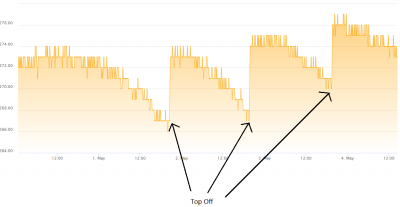
Now for the one that had me thinking for a little. I do not utilize an ATO system (I do not see a major gain in salinity stabilization - I run the numbers - and topping off daily has not become a nuisance to me yet). Every evening, I top off as needed, which at worst case could be half a gallon or so. The first day I installed the meter, it read 275 gph. Slowly, over the course of a day it gradually decreased to 268 gph. At the time I thought maybe the pump is stabilizing (I had just swapped the backup in place so I can clean the other one). As soon as I topped off the flow rate returned to ~275 gph. I scratched my head a little but since the bump coincided with my top off the prevailing theory was that the salinity made a difference. I started running the math and to my surprise it did actually make sense.
For the mathematically inclined, I will briefly explain the logic (I have a spreadsheet in google docs that I could share if you need). Initially the salinity is 1.024. Then, over the course of the day half a gallon of water is lost which brings the salinity to 1.0244 (as I mentioned before minute change). But, increasing the salinity, even by this minuscule amount, increases the weight of my 4 ft column. The higher weight increases the back-pressure to the pump which drops the flow rate. To put things into perspective, the change in pressure is about 0.01 psi which is apparently (using a modified Bernoulli equation) enough to drop the flow rate by ~7 gallons.
I am in the process of double checking my math and hydraulics calculations but this is a phenomenon I have observed again and again over the past week as shown in the next picture.
Now what does that mean exactly for the average reefer (assuming my explanation is accurate and correct):

The first interesting observation is that it's showing ~275 gph flow. That is at ~4 ft of head. It is a very suspicious number but it might as well be true since I have no other way of measuring and verifying.
Now for the one that had me thinking for a little. I do not utilize an ATO system (I do not see a major gain in salinity stabilization - I run the numbers - and topping off daily has not become a nuisance to me yet). Every evening, I top off as needed, which at worst case could be half a gallon or so. The first day I installed the meter, it read 275 gph. Slowly, over the course of a day it gradually decreased to 268 gph. At the time I thought maybe the pump is stabilizing (I had just swapped the backup in place so I can clean the other one). As soon as I topped off the flow rate returned to ~275 gph. I scratched my head a little but since the bump coincided with my top off the prevailing theory was that the salinity made a difference. I started running the math and to my surprise it did actually make sense.
For the mathematically inclined, I will briefly explain the logic (I have a spreadsheet in google docs that I could share if you need). Initially the salinity is 1.024. Then, over the course of the day half a gallon of water is lost which brings the salinity to 1.0244 (as I mentioned before minute change). But, increasing the salinity, even by this minuscule amount, increases the weight of my 4 ft column. The higher weight increases the back-pressure to the pump which drops the flow rate. To put things into perspective, the change in pressure is about 0.01 psi which is apparently (using a modified Bernoulli equation) enough to drop the flow rate by ~7 gallons.
I am in the process of double checking my math and hydraulics calculations but this is a phenomenon I have observed again and again over the past week as shown in the next picture.
Now what does that mean exactly for the average reefer (assuming my explanation is accurate and correct):
- A mathematical correlation could be developed for a system that given a flow rate would calculate salinity.
- Of course, since salinity and flow rate are not uniquely connected (other things come in play especially long term like tubing deposition, pump buildup etc) that would be a tentative estimation (but useful nonetheless in my opinion).
- Especially, if you measure the flow in liters per hour you will get an even finer number to work with.
- I am sure that many people have alarms for low flow rates but alarms could also be established for sudden high flow rates as well (which could indicate an ATO going haywire).
- Of course all this needs to be taken with a grain of salt and be seen as part of the big picture and not a single number.