REALLY :( 6 weeks fallows, thought it was velvet now spots are back...

Very interesting, have considered purchase before, may just do it now.
Najer. What size is your tank?
My 450 litres is recommended - aquariums: 400-800 L, 2 catalysts, solution: 12% - that would only last for 10 days, that would be 2160mg of o2. Would aquariums: 200-400 L, 2 catalysts, solution: 6%, operating time: 20 days, O2/day: 540 mg be better?
The webpage l could order the solution from only lists 6 and 12%, no 9%.
Appreciate any advice.

I don't understand the science, my big tank is 550 Litres water volume.
I run an A and a D with 2 catalysts and 6% solution which lasts 2 - 3 weeks.

 
Thanks Najer, l'll give it a try with an A at the same concentration on my 450 litres.
As Lasse pointed out, it could be good to use a higher concentration when new fish are introduced.
 
Thanks Najer, l'll give it a try with an A at the same concentration on my 450 litres.
As Lasse pointed out, it could be good to use a higher concentration when new fish are introduced.

It is hard to explain, possibly impossible without a scientific experiment to back it up, I would never run a tank without one , I put a D in the last tank I helped set up, reports back say it is great! ;)
D in my display, A is in the attached cube end! ;)

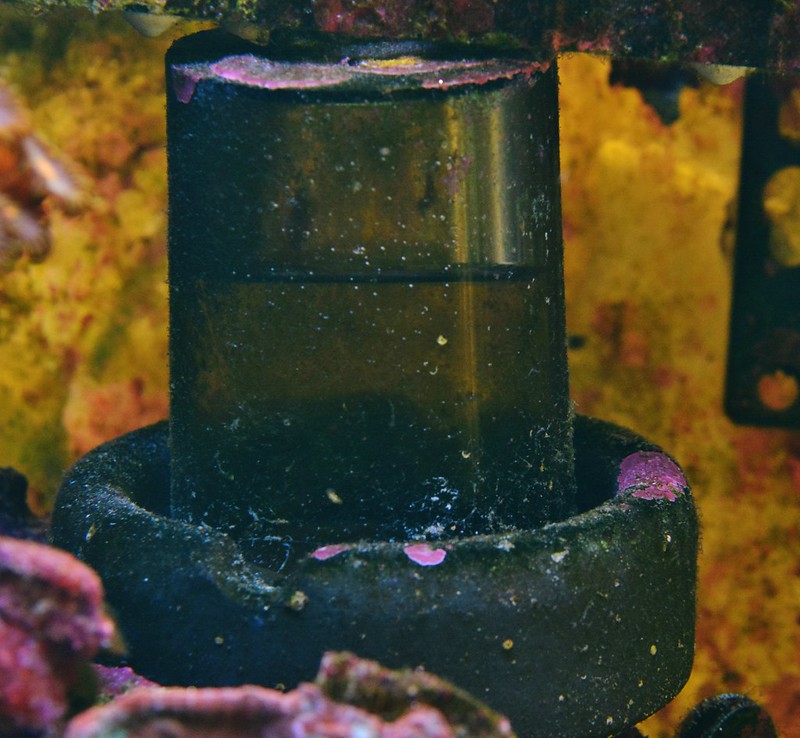
DSC_0005 by sshipuk, on Flickr
 
Oxydator A, 35% food grade peroxide that was mixed down to 9% on a 100 gallon tank, 1 catalyst.

Thank you for that information. In my old aquarium I introduce a red bubble tip (no oxidator) It spread like nothing else. In my new aquaria I bring a very little speciement of exactly that strain. After a couple of months - it disappeared from my aquaria. Maybe you experiences can have an explanation for this. I run 6 % and 3 catalyst - 80 gallon system. First example of any backslash I have heard but I´m not sure. My mushrooms - that is rather close to the anemones in the evolution tree - has never gone better. But it is good that you mentioned this.

Other with the same or different opinion?

If OP @Christopher Davis think that we drift to far away from the original question - please stop us and ask admins to break out the Oxidator post to a own thread

Sincerely Lasse
 
Hydrogen peroxide at proper concentrations, will reduce motility of theronts likely by inactivating proteins on the surface. There's still more research needed to understand whether hydrogen peroxides will actually kill theronts vs. "immobilize." However, theronts need to find a host within ~24hrs and reduced motility will directly impact the virulence. In some studies concentrations between 10-100 mg/L achieved up to 90% mortality over a short treatment period (1-3hrs). In vivo studies of hydrogen peroxide are lacking on ich but it's been used and is FDA approved for other parasitic diseases on fish farms. For example, Paramove is used widely for sea lice on salmon farms.

In theory, if an oxydator can maintain the somewhat unknown therapeutic dose it could help.
 
Hydrogen peroxide at proper concentrations, will reduce motility of theronts likely by inactivating proteins on the surface. There's still more research needed to understand whether hydrogen peroxides will actually kill theronts vs. "immobilize." However, theronts need to find a host within ~24hrs and reduced motility will directly impact the virulence. In some studies concentrations between 10-100 mg/L achieved up to 90% mortality over a short treatment period (1-3hrs). In vivo studies of hydrogen peroxide are lacking on ich but it's been used and is FDA approved for other parasitic diseases on fish farms. For example, Paramove is used widely for sea lice on salmon farms.

In theory, if an oxydator can maintain the somewhat unknown therapeutic dose it could help.

Thanks

There is another way that use of the Oxydator can help in the struggle against diseases. In theory - it will rise the oxygen gas concentration in the water outside the photoperiod (during the photoperiod - photosynthesis will produce a lot of oxygen) . Higher oxygen tension - better oxygen uptake through the gills - lesser stressful environment. However - I have not been able to measure my oxygen levels 24/7 and logg them - but in the future I hope to dot that.

Sincerely Lasse
 
Thanks Lasse. How do you plan to measure dissolved oxygen? I’ve been considering whether to get a Milwaukee sensor. Is there a probe that could be connected to the P4?

I’m going to try an oxydator as soon as I can find one to buy - on backorder for a while on the only site that seems to sell Sotchihg in the US.
 
I once enlisted the help of Adian Blundell regarding the release of peroxide into the aquarium outside the Oxydator. My question was forwarded to the manufacturers and the following is a copy of the replay Adrian got back.

Quote"Hi Les
Here is the reply from Söchting Biotechnik
Hi Les,
The catalyst inside pruduces oxygen for the pressure to push out H2O2 steadily.
The outside ceramic is also a catalyst and there part of the H2O2 get dossolved into
water and O2. But part of the H2O2 gets free into the water and oxidates,
and increase the Redoxpotential of the water - thats also important to increase water quality.
And thats also the reason that people have to stick to the manual,
so that no overdosing hapened.
Kind Regards, Uwe"

Unfortunately what I didn't get back which would have been useful is what % of peroxide escaped without being converted by the catalysts or the ceramic beaker but then that is hardly surprising given the many varying factors which would have a direct influence on such. Obviously, the higher the concentration of peroxide used along with the number of catalysts used the higher the % volume which will escape int the aquarium that will not be broken down into O2.
Regarding anemones and their dislike of the use of Oxydtaors. I have posted many times that the first things to show any negative effects of using a high concentration of peroxide and or too many catalysts. However, I have used 2 x Oxydator As with 9% peroxide with 2 catalysts in each in my 100gallon heavily stocks reef tank housing both RBTA and Magnifica nems without any signs of any detrimental effects, this is with both Oxydators in my sump not in the DT and sitting in the first compartment as the wather from the DT enters the sump.
 
I once enlisted the help of Adian Blundell regarding the release of peroxide into the aquarium outside the Oxydator. My question was forwarded to the manufacturers and the following is a copy of the replay Adrian got back.

Quote"Hi Les
Here is the reply from Söchting Biotechnik
Hi Les,
The catalyst inside pruduces oxygen for the pressure to push out H2O2 steadily.
The outside ceramic is also a catalyst and there part of the H2O2 get dossolved into
water and O2. But part of the H2O2 gets free into the water and oxidates,
and increase the Redoxpotential of the water - thats also important to increase water quality.
And thats also the reason that people have to stick to the manual,
so that no overdosing hapened.
Kind Regards, Uwe"

Unfortunately what I didn't get back which would have been useful is what % of peroxide escaped without being converted by the catalysts or the ceramic beaker but then that is hardly surprising given the many varying factors which would have a direct influence on such. Obviously, the higher the concentration of peroxide used along with the number of catalysts used the higher the % volume which will escape int the aquarium that will not be broken down into O2.
Regarding anemones and their dislike of the use of Oxydtaors. I have posted many times that the first things to show any negative effects of using a high concentration of peroxide and or too many catalysts. However, I have used 2 x Oxydator As with 9% peroxide with 2 catalysts in each in my 100gallon heavily stocks reef tank housing both RBTA and Magnifica nems without any signs of any detrimental effects, this is with both Oxydators in my sump not in the DT and sitting in the first compartment as the wather from the DT enters the sump.

Sorry Les, forgot it was you.
I can't keep nems, A and D running 6% and 2 catalysts, I need to read up on redox potential, a lot of years since I did chemistry and biology, I do remember the phrase, sort of! ;)
 

IF YOU HAD TO TAKE A REEFING EXAM, WOULD YOU PASS?

  • Yes!

    Votes: 32 45.7%
  • Not yet, but I have one that I want to buy in mind!

    Votes: 9 12.9%
  • No.

    Votes: 26 37.1%
  • Other (please explain).

    Votes: 3 4.3%
Back
Top