At the current time, my survival rate is about 15-20%. Larger ones have the best survival rate. They can come as large as pencil erasers.
For sperm, you look for the neck stretch of the male as it forms a chalice looking shape. Once you see this, it means that spawning time is either occurring or happening real soon. For babies, its really tricky but a lot of times, females will start to look sick or shrivel up. Some will even lose some color if they are holding a ton of offspring. As I type this right now, one of my females is rather shriveled and sickly looking but I know shes about to blow. I see a few babies at her lips, she's trying to hold them in for a bit longer it. When they are ready to release, their mouth opens up completely and dumps them.
Eggs, are very very rare to see. Here is a photo I took of a female pulling her eggs out during a spawn. You can see all the eggs piled up at her mouth.
It does not appear to be connected with the full moon. I have seen them spawning as early as mid-day.
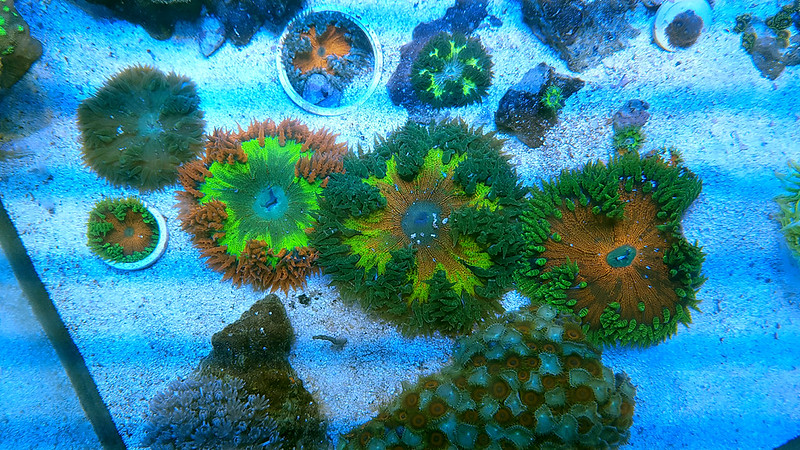
I have about ~40 adults. Many are 2-4 years old in a 20 nuvo. With that many, I have a high chance of seeing things occur. Below is a picture I took earlier in January.
Thanks for sharing your experiences here. I think many here will find it useful... I know for sure that I will! I wonder if my birth rate of about 15 per event is the result of a 15% or 20% survival rate? I'm absolutely going to have to start paying more attention.
I'd never seen a photo where you could see the females eggs before, that's very cool.
Your big tank photo is incredible! I'm looking forward to the day when my tank will look similar to yours. The only place I've seen more RFA at one time is at VIP Reef (an LFS) in Miami. The owner is also a collector and he sorts his into 3 quality levels. Each tank was about 36"x19" with a very shallow black sand bottom and the sand barely shows through for all the anemones!
Beautiful set up was thinking about doing something similar with a Nuvo 10. I might have missed it but what lighting did you have over it?
@Ron Reefman excellent information being shared here and almost has me confident enough to start my own RFA tank

I hope tankstudy will tell you what he uses (I'd like to know as well). I have a Reef Breeders Photon V2 over my 50g cube. My old 120g tank (just torn down and sold) had a Photon V2 as well as two 21ledusa strip fixtures. A blue and white one at the front of the tank running a bit more white than the Photon and an all blue one at the back of the tank addin a lot of blue. The extra light wasn't so much for the corals or anemones as to get the look of a bigger tank. The blue in back made the tank look more like it was 3' thick rather than just 2 feet thick.
If you want an RFA tank, I'm more than happy to share anything I can with you. IMHO RFA's are pretty hearty. And once they find a good location (usually attached to a rock or the bottom glass and at the sand) they rarely move. I've been keeping most of the adults in 1" PVC end caps and pushing them down into the sand. Once they are there for a day or two, none of mine have ever moved again. And this way they are pretty easy for you to move if you want, or to pull one out of the tank and give to somebody else.
So whats the cheat code for these bad boys to spawn? I absolutely love them. And I also live in Miami, I had no idea you can go to the keys and collect them...
'Cheat code'? I think they just need to be full grown adults and well fed in a mature tank. At least that's my experience.
Since you are in Miami, it would be easy for you to go to VIP Reef and talk to Frank, the owner, and see his inventory. He collects them in the Keys... but he won't tell you where in the Keys! Even I don't know for sure! I've collected a few over the years. I've done a lot of snorkeling (no scuba diving) in the Middle Keys over the last 15 years. I'd even share a couple of good snorkel spots.
However, my experience has been that the RFA's in shallow water are a lot less colorful and somewhat less fluorescent than the deep water RFA's that I've been told come from 30' to 50' deep. Given I don't know where the reef is for the colorful RFA's and that I don't scuba dive, I'm concentrating on breeding instead!
BTW, if you are just interested in snorkeling and collecting (legally) in the Florida Keys, I'm happy to share my experiences. You need a Florida Saltwater fishing license (unless you are over 65 years old) and you need to pay strict attention to the state mandated limits:
http://myfwc.com/fishing/saltwater/recreational/aquarium-species/
Stony corals, live rock and some other things are strictly prohibited. Fines are way worse than speeding tickets. And FWC does do checks both at boat ramps, beaches and even on the water! And there is very little out there that is worth a $1000 or bigger fine.
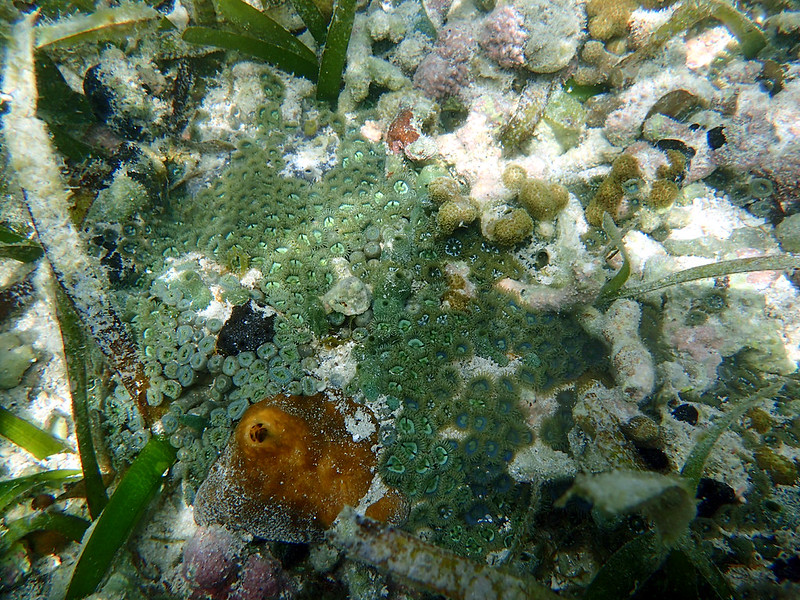
However, over the years I have collected: emerald crabs, hermit crabs, porcelain crabs, various snails, serpent stars, brittle stars, sea stars, sea cucumbers (sand sifters & filter feeders), rock flower anemones, curly-Q anemones, gorgonian corals, zoas, ricordia, coral banded shrimp, pistol shrimp, spaghetti worms, clams, flame scallops, juvenile tropical fish, nudibranchs, upside down jellyfish, urchins and sponges. But the limits on most of these are very low. Take zoas as an example. You are allowed to collect just 5 polyps per licensed collector per day! Plus the total 'bag' limit is just 20 animals per day. And it's been a rare day that I ever hit my limit. Not because I couldn't, but because I didn't have the need.
This photo is typical of a couple of acres of shallow water (1' to 3') off a small island in the Middle Keys.
 P5220020 R1
 by
Ron Lindensmith, on Flickr
















 20180622_144452 R1












