Saltwater Hobby Good or Bad (for preservation)

Every week or so there's a discussion post like this and I used to do the whole back and forth thing defending my position which I think I e made clear today but from now on I think I'm just gonna repost what I wrote earlier in this thread (I think it was the second post I made actually) because that pretty much sums up how I've felt about it for a long time
 
I think that the people that harvest from the ocean do have a strong desire to maintain the environment to further their own lifestyle. If they destroy what earns their living, then they won't make that living anymore.

This is true as long as you don't get "Tragedy of the commons". Where no ownership of any sort really exists on what is being consumed. Thus nobody has a reason to preserve or spend the time to preserve, because while they are spending time preserving, someone else is consuming them. The person who preserves doesn't get the benefit they should.

So when it comes to reefs, I'd prefer them to be mostly off limits, other than for select people to take samples of some sort. Then I'd like to see mariculture farms with areas of the coast licensed out to private businesses, and then those people can maintain their own farm to produce coral at a low environmental cost to consumers. These people would be the type that could be allowed to dive on reefs to get samples and so on.

Mariculture would seem to have less of an environmental impact than anything else.
For the most part corals already are being captive bred and sold or traded...it's actually probably more difficult to do it in the ocean than how it's done now
 
Everything we do as consumers contribute negatively to the environment. If you think our hobby has a positive effect on reef and the earth, you are delusional and just trying to make yourself feel better. Think of the amount of plastic used in this hobby, the electricity to run the lights and equipments, the amount of fuel and energy used to ship corals, the rate of death in collecting fish, the rate of death in your tanks, the amount of water we waste making RODI, etc. Those things do not outweigh the pros listed above.

Everything we do is killing the planet and there's no stopping it.

#teamthanos

This is a bit of a broad brush. The earth and nature is a balance. Plants consume Co2, produce oxygen and other organisms consume oxygen and produce Co2.

So not everything is a negative effect on the environment. Lots of fish in the ocean die naturally, they get eaten. We are just another consumer of many. It's a negative effect when the take is beyond the balance, but not until then. No doubt this is an issue, but you can't say ALL of it is a negative effect.
 
For the most part corals already are being captive bred and sold or traded...it's actually probably more difficult to do it in the ocean than how it's done now

Well you just need a place to put the corals in the ocean, then they will grow on their own. It's being done, but I agree aquaculture is much more common.

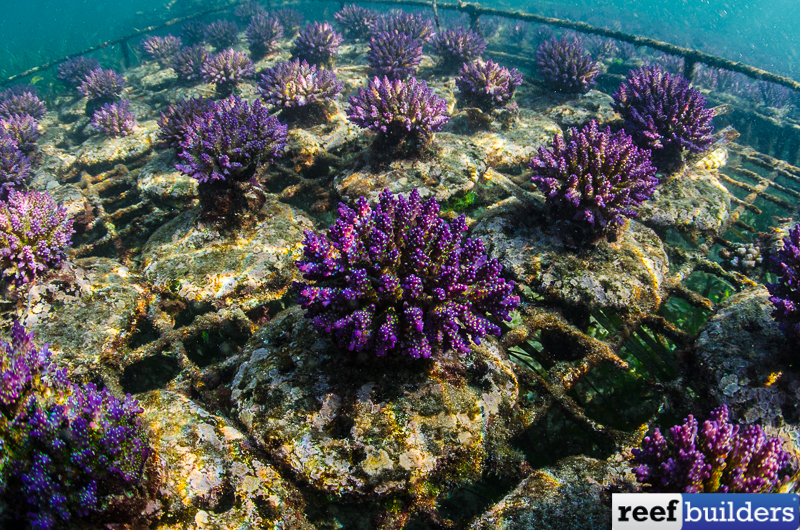
The thing with mariculture is you don't have to use electricity for your lighting, and you don't have to mine minerals/salt to grow the coral. However, I guess what you can do is limited to the area. I've seen videos or it being done successfully and it looks promising. Near 0 environmental impact.

Aquaculture can use a greenhouse for free lighting, and I know some do. But many are using tons and tons of electricity on lights.

Here's what they put the corals on for mariculture. Basically just a big ole frag rack.

sans-titre-15.jpg
 
This is true as long as you don't get "Tragedy of the commons". Where no ownership of any sort really exists on what is being consumed. Thus nobody has a reason to preserve or spend the time to preserve, because while they are spending time preserving, someone else is consuming them. The person who preserves doesn't get the benefit they should.
This is true and a great point.
 
We're consumers killing 95% of most things inside 5yrs. There are exceptions but not many
I have reefs over 8 years old. Many have tanks that are even 20 years old. If you spend the kind of money we do, you take care of it. Lumping people together like this is propaganda.
 
Interesting answers, I do think the educational value and the interest that it generates would help us preserve, or strive for preservation.

I like to be an optimist, we create a market, generate a need and give employment through this so I think it would create plenty of incentive for preservation, as people's livelihoods depend on it (not us the fish keepers) but the industry.

Interesting as well the part that some might be keeping species of corals for decades in their tanks, corals that have survived events and went through less than ideal conditions. Almost like a natural selection.

Perhaps similar to the selective breeding that scientists are doing, or to the super resistant corals in the red sea, we might contribute a bit to the natural selection of corals through our less than ideal tank conditions.

Also, remember this is an open discussion. There's no right or wrong, its just respectful talk with open minds. Disagreeing is healthy.
 
If what you believe is true - (and no - I'm not suggesting this) - give up your place on the planet?
I accepted that we are killing the environment and going to live with that...like everyone else. The only difference is that I am not lying to myself about it. I try to do whatever I can to save water, recycle, etc. But I also know that this hobby is very destructive to the environment.
 
I accepted that we are killing the environment and going to live with that...like everyone else. The only difference is that I am not lying to myself about it. I try to do whatever I can to save water, recycle, etc. But I also know that this hobby is very destructive to the environment.
But it simply isn't nearly as destructive as your first post implies
 
Also what separates the reef hobby from freshwater is that what most could contribute back are mostly in abundance anyway. Mutt clownfish aside (who do you know that produces pure specimens anymore?), only commercial places produce other fish and lots of them capture larva from the sea (or used to). Most coral that are super abundant in the hobby are also super abundant in the wild are most are not even true coral - true coral leave a skeleton and the rest are colonial nems or the like.

I have begged for years for people in Florida to send me some A. Plamatta since I have tanks that could likely raise it very well with the best possible lighting and other things. I would send them back all of the frags that I grow. I heard at a show that they could never allow this since hobbyists cannot care for this coral, but this is not true... I can. Some others can. The masses cannot. This could actually help... maybe. I do understand that jet fuel, styrofoam boxes, disposable stuff, electricity (although I have solar) and other things are in play here too that directly contribute.

I live in Colorado and next door in Utah is hundreds of miles of ancient coral reef that was chosen for extinction without the help of humans. I know that there are huge forces at play here beyond man and certainly beyond collection for this hobby, but IMO, we are not really helping them any.

Lastly, if our hobby does get killed sans captive raised/bred stuff, there are many other countries that do not adhere to CITES lists and can do damage. Look at the availability of some endangered and rare fish and corals in other parts of the world. Unfortunately, to stop them, we will be stopped too, most likely. I hope not, but I see no other way. This has happened already with many other types of collecting.
 
I accepted that we are killing the environment and going to live with that...like everyone else. The only difference is that I am not lying to myself about it. I try to do whatever I can to save water, recycle, etc. But I also know that this hobby is very destructive to the environment.
I guess the problem - which prompted my slightly snarky reponse to you was your comment about everything a consumer does hurts the environment. (you weren't just talking about 'reefing'). But - the general environment at least in the US - is cleaner today than it was in the 1960's - where smog blanketed every city, the Great Lakes were basically sewers. Now (largely due to proper regulation) - the environment is 'much better'. There was no recycling AT all when I was grown-up. IN THE CITY, there was 'trash burning day' - when all of the trash was just 'burned up' in every back-yard.

Pesticide use was rampant, DDT was kidding birds, etc - that is for the most part 'gone'. There have been doomsday predictors every decade probably for ever. IMHO. the biggest 'change' that needs to be made in the world is countries that currently dump raw sewage, chemicals,etc directly into the ocean should be punished. IMHO - in general the USA is not the problem. But IMHO - that is orders of magnitude worse for the 'environment' than reefing. Decades ago people predicted that basically the building in Europe were going to disintegrate due to acid rain - its been greatly diminished.

SO - I disagree fundamentally that "I am killing the environment". As to this hobby - I also disagree with you. If you use logic, using a cellphone - or the internet is also 'very destructive'. Car racing is 'destructive', basically anything that 'causes fun' - thats not absolutely necessary could be called 'destructive to the environment'. Right? The thing is 'part of the environment' is people's happiness. So - that suggests to me that not all of reefing is destructive.
 
I have begged for years for people in Florida to send me some A. Plamatta since I have tanks that could likely raise it very well with the best possible lighting and other things. I would send them back all of the frags that I grow. I heard at a show that they could never allow this since hobbyists cannot care for this coral, but this is not true... I can. Some others can. The masses cannot. This could actually help... maybe. I do understand that jet fuel, styrofoam boxes, dis
I agree 100 percent with your post. My understanding is that this is not allowed - for the simple reason that they do not want the chance of introducing other non-native parasites/diseases, etc - that might come from your non-florida corals. But your point is well taken - there is no reason NOT to aquaculture these corals in Florida waters - and there is also no reason not to aquaculture them in other 'pure' facilities.
 
The popularity has increased no doubt. For years, we saw many freshwater tanks at libraries, clinics and offices and now they are saltwater.
As for your question, sustainability has become much more easier and understood based on more information of foods, care and husbandry not to mentioned the advanced equipment available to us to make the hobby less work and more enjoyable.
 
I agree 100 percent with your post. My understanding is that this is not allowed - for the simple reason that they do not want the chance of introducing other non-native parasites/diseases, etc - that might come from your non-florida corals. But your point is well taken - there is no reason NOT to aquaculture these corals in Florida waters - and there is also no reason not to aquaculture them in other 'pure' facilities.

I am sure that I have not talked to everybody, but they have had some success with culturing in the ocean and greenhouses. Some have tried to culture them in facilites with substandard lighting, filtration, etc... something similar to what a hobbyist might consider a softie tank. These mostly failed.

I just want some A. Palmatta in my home since I saw a magnificent piece snorkeling in Florida once. :) It will probably never happen, but if it does, I would spread it around for free to anybody who could keep in just in the hopes of it surviving. I once saw a piece at an aquarium in St. Louis and it was actually quite nice under reef lighting - purple with a blueish tint. They look just brown in the ocean at 6500k. I would put 1000w MH over these at whatever spectrum necessary to get them to thrive. I would make a species only tank. I would make this like 2% about me and 98% about the A. Palmatta. C'mon Florida, send me a frag!

I seemed from talking to a few that the disease thing is mostly a red herring. Politics is the largest issue - no ship means no ship, right? If us hobbyists can figure out most diseases, quarantine, etc. then so could an actual pro.

I have had acropora spawn in my tank. What if a hobbyist could get an A. Palmatta to that size, transfer it to a solid AQ place (along with the experience and knowledge of how to keep it in captivity) and have it spawn there with all of the resources of the ocean. This is likely how this hobby helps the world one day... probably just not in my lifetime.
 
I am sure that I have not talked to everybody, but they have had some success with culturing in the ocean and greenhouses. Some have tried to culture them in facilites with substandard lighting, filtration, etc... something similar to what a hobbyist might consider a softie tank. These mostly failed.

I just want some A. Palmatta in my home since I saw a magnificent piece snorkeling in Florida once. :) It will probably never happen, but if it does, I would spread it around for free to anybody who could keep in just in the hopes of it surviving. I once saw a piece at an aquarium in St. Louis and it was actually quite nice under reef lighting - purple with a blueish tint. They look just brown in the ocean at 6500k. I would put 1000w MH over these at whatever spectrum necessary to get them to thrive. I would make a species only tank. I would make this like 2% about me and 98% about the A. Palmatta. C'mon Florida, send me a frag!

I seemed from talking to a few that the disease thing is mostly a red herring. Politics is the largest issue - no ship means no ship, right? If us hobbyists can figure out most diseases, quarantine, etc. then so could an actual pr
I have had acropora spawn in my tank. What if a hobbyist could get an A. Palmatta to that size, transfer it to a solid AQ place (along with the experience and knowledge of how to keep it in captivity) and have it spawn there with all of the resources of the ocean. This is likely how this hobby helps the world one day... probably just not in my lifetime.

Actually the reason I answered - was because I wanted a piece as well. So I researched the subject - give me a holler when you get a frag:). Frankly the whole law is a bit off - to me:)
 
Actually the reason I answered - was because I wanted a piece as well. So I researched the subject - give me a holler when you get a frag:). Frankly the whole law is a bit off - to me:)
Haha...if you think the American laws are screwy with stuff like that you should come visit Bangkok! It's technically illegal to even own hard corals! (But there are plenty of reefers here with hard corals... including me)
 
Haha...if you think the American laws are screwy with stuff like that you should come visit Bangkok! It's technically illegal to even own hard corals! (But there are plenty of reefers here with hard corals... including me)
I might use a private browser lol:) jk
 

IF YOU HAD TO TAKE A REEFING EXAM, WOULD YOU PASS?

  • Yes!

    Votes: 32 45.7%
  • Not yet, but I have one that I want to buy in mind!

    Votes: 9 12.9%
  • No.

    Votes: 26 37.1%
  • Other (please explain).

    Votes: 3 4.3%
Back
Top