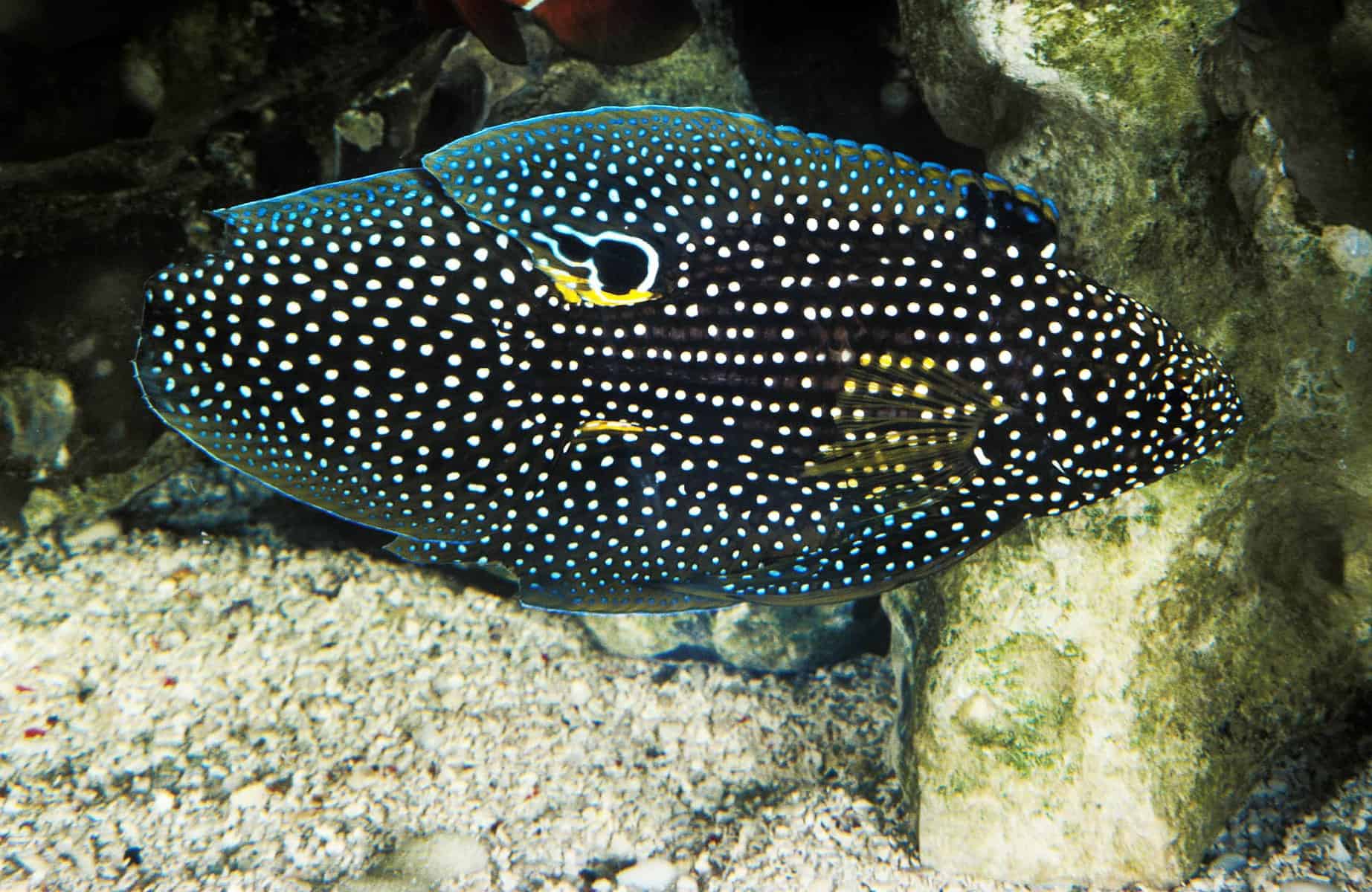
Sexing marine bettas

One of my all time favorite fish! I've had the pleasure of keeping a number of specimens. In my experience, females are smaller and much less shy. That's probably anecdotal though. I'll defer to @ThRoewer, they sound more experienced than myself.
 
Well, I'm glad you're here to share your knowledge about this beautiful fish, as it seems (looking at a number of different articles - linked below - from a number of different sites that all agree with most of the first article I linked above) that there is a lot of information needing clarified about this particular species!

I do have to say, though, seeing as how the only two ways for people to learn proper fish care is either from first-hand experience or by researching/learning from someone with that first-hand experience, I can't fault people for sharing what is presented to them as first-hand experience in an attempt to help others (even if that information is not entirely accurate). As someone who is still waiting to get a tank of their own up and running, this is why I greatly appreciate those who do have that actual first-hand information sharing it clearly and concisely with the community (as I hope to be able to in the future).

Just to clarify because I know it can be hard to read emotion/context in text, I genuinely do appreciate you and others sharing your firsthand knowledge, and it is sad to see so much inaccurate information being passed around about this fish (thankfully, from what I've seen, the hobby's knowledge is generally better about most fish than it seems to be about this one). I never intend to share inaccurate information, so I always appreciate being corrected.

The problem is when people without firsthand experience share false information they didn't properly research or verify as absolute truths. The grouper relation is easily researched and quickly found to be false, yet it is repeated over and over.
The second link was the only one pointing out that they are not related to groupers.

As for sexing by spot sizes - that doesn't work.
The spot sizes and patterns are either individual or geographic or age-related variations that have no relation to the sex of the individual. Keep in mind that the distribution range of these fish is vast and goes from the Red Sea to the Pacific. I have some pairs with identical spot sizes and very similar patterns and others that are quite different. Unfortunately, I wasn't able to find out the origins of all the individuals I have. However, those where I know the origin are usually very similar in spot sizes and patterns to the ones from the same region. Age may also play a role in this.
The only safe way to sex these fish is the shape of the genital papilla.
There are differences in body shape and ventral fin length, but those can be deceiving if the fish are not well fed or have damaged fins, which is unfortunately fairly common.
 
One of my all time favorite fish! I've had the pleasure of keeping a number of specimens. In my experience, females are smaller and much less shy. That's probably anecdotal though. I'll defer to @ThRoewer, they sound more experienced than myself.

Fully grown males will usually be larger than females, but since you generally don't know the age of the fish, this isn't a reliable way to sex them, not even when you get them as a pair.
I also found that females are more outgoing while males are far more reclusive to the point of being barely seen. This is particularly the case when keeping them as pairs. Single males can be as outgoing as females (you don't find a mate hiding inside a cave). With singles, it also depends a lot on the tankmates as well if a specific marine betta is rather shy or outgoing. So this can be an indicator, but not a reliable one.
 
I got a small one and an adult over 3 years ago precisely because I was mislead by popular articles.

First, it was stated that there was only 1 species and that the fine spots are an indication that the fish is mature.

Then it was stated that they can change sex.

As a result I now have an argus that almost hasn't grown since I got it (it's about 5") and an altivelis that is now much bigger than the argus. I have no idea what's their pronouns.

The 2 fish dislike each other but they share the same half of the tank.

I can't imagine how anyone could have thought they are the same species, they look, swim and behave differently.

The argus for me is on a league of its own, there's a sort of elegant majesty about it that the altivelis just doesn't have.

They also have a very long memory. The altivelis was the most extrovert and would eat from the pincers without any fear. One day it injured its mouth when I picked the food and from that day on he never took any food I try to hang in front of him, no matter what I use.

One year ago, still believing that they can change sex, I ordered another argus. When it arrived it was literally the size of my index fingernail !

I put it in the refugium because otherwise even a Banggai would eat it. I was pretty sure that fish hadn't eaten anything since it was caught, he was tiny and absurdly shy.

A few months ago I moved it to a 100 gallon tank with 2 young banggais and it's now eating frozen food.

It's about 2" now and I'm afraid of putting him in the tank with the other 2 adults.
 

IF YOU HAD TO TAKE A REEFING EXAM, WOULD YOU PASS?

  • Yes!

    Votes: 32 45.7%
  • Not yet, but I have one that I want to buy in mind!

    Votes: 9 12.9%
  • No.

    Votes: 26 37.1%
  • Other (please explain).

    Votes: 3 4.3%
Back
Top