Sump is Leaking

cronosx99

Community Member
View Badges
Joined
Jun 5, 2018
Messages
30
Reaction score
6
Rating - 0%
0   0   0
I just filled a brand new tank and sump, got the return going and noticed a leak from the corner of the sump. What can I do? This is a bad situation considering I would have to break down the entire tank to get the sump out as it will not come out of the cabinet without removing the tank. Can I repair it? If so how? Any help or suggestions would be appreciated.

IMG_20180623_104203.jpg
IMG_20180623_104220.jpg
IMG_20180622_194848.jpg
 
Since its acrylic, you can see where its leaking. It should look almost clear. You'll have to drain the sump for a good 24 hours though to fix it. You can get some weldon #16 and use it like silicon to fill the spot where its leaking. What I'd do is raise up the sump a few inches and just put the weldon all over the corner and up the edge to be on the safe side. It'll fully cure in 24 hours. It won't look clean but it should fix the small leak.

Also for future.. even if things are new, it's still a good idea to leak test.
 
The bottom looks to have a Crack near that corner? On the bottom piece. I purchased the weldon from home Depot.
 
Ya I see the crack now.. I was never able to find weldon at my home depot. You can call local plastic shops around you to see if they are open today.

I'd take a small piece of acrylic square and put weldon like super glue and just put the patch right over it. Then use weldon around the edges of the patch like you would silicon around a glass edge. Once cured it should hold. The best crack to have is at the bottom since there isn't really pressure from the water on it.
 
I can't take the sump out without breaking down the tank. I'm hoping to avoid that
 
Weld on 16 will for sure fix this with ease... You just need to get it dry first to fix it Remember weld on is a Solvent not a adhesive . Weld on 16 has mico bits of plastic in it to make it thicker and fill the gaps.. Its best to tape the bottom of the tank and push the weld on product into the crack filling it with no air bubbles.. Let it sit for a few hours and it will be like new.

More is NOT BETTER . If you use to much and put it on as if you were using silicon you can weaken the surface of the plastic around the repair. Similar to over heating a Copper pipe when Brazing...

Just put a small bead over the crack or leaking area and work it into the crack..

MOST IMPORTANT.. Doing this in the sump.. WEAR A MASK OVER YOUR NOSE AND MOUTH.. Run a FAN .. This stuff WILL Cause serious breathing issues used in closed areas .. Keep any Children or anyone with breathing problems out of the area until the smell has been dissipated..


Good Luck..... Its actually Quite easy to use... LESS IS MORE with this stuff
 
Yup. Amazing goop has the correct name. It’s like magic. Have it in place for 10 years and as good as day one. Apply it as you would caulking

Might want to get a small piece of plexi to go over crack as a patch
 
Ok, so I applied a liberal amount of Goop to the area on the inside and outside. Have the sump raised and mostly drained. The affected compartment is dry. Will fill with water in 24 hours and we'll see how the Goop does. Thanks everyone for the support
 
The leak is fixed. Been running the tank for 2 hours now without moisture from the crack. Amazing Goop worked flawlessly. Many thanks for everyone's support!
 
I can't take the sump out without breaking down the tank. I'm hoping to avoid that

You don't have to break down the tank. You just need to rig a temporary sump somewhere adjacent to the stand. Again; rig it. It doesn't have to be pretty, just functional.

Once that's done, you can empty the sump, allow it to dry right there in the stand. Do the repair in the stand and then do a LEAK TEST. If it is fixed, you can then return everything back to the repaired sump.
 
You don't have to break down the tank. You just need to rig a temporary sump somewhere adjacent to the stand. Again; rig it. It doesn't have to be pretty, just functional.

Once that's done, you can empty the sump, allow it to dry right there in the stand. Do the repair in the stand and then do a LEAK TEST. If it is fixed, you can then return everything back to the repaired sump.

To add to this, for removing the sump without tearing the tank down is not all that difficult. Cut a pair of 2X4's the same length as the cabinet door openings. You want them to just barely fit and place each one near the sides by the hinges. Then remove the screws holding the stand's center brace in place and remove the brace. After that the sump can easily be pulled out.
 
If I may, here is a recommendation for you and anybody else who is concerned about a similar situation.

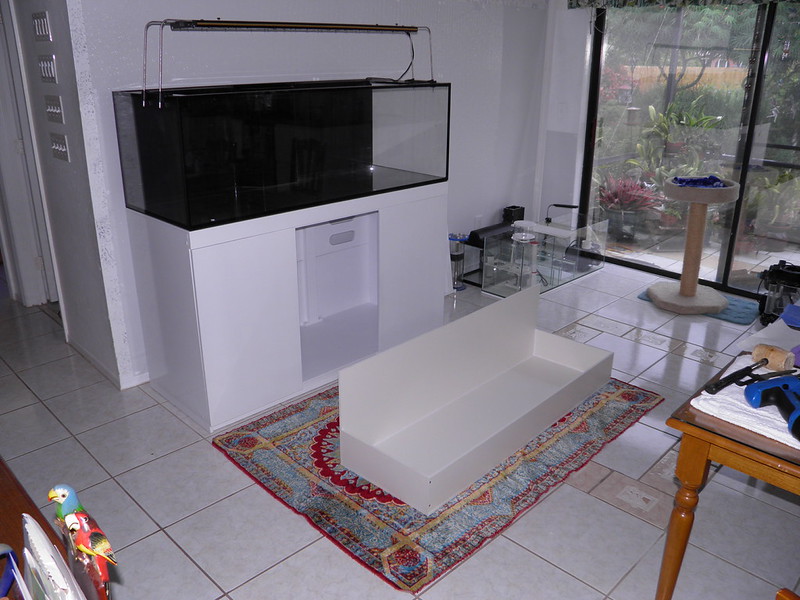
I built a PVC 'drip tray' that fills my stand and the the sump sits in. It can catch drips, spills, and overflows. I happened to install a bulkhead in mine and then ran a hose out through the wall to my backyard in case of a major leak (the drip tray can't hold all the water that the sump would leak out). It serves two purposes, it keeps spills from getting out onto the floor (I have tile so not as big a deal as for others with carpet or wood) and it protects the stand (wood finishes all fail over time and water under the sump is nearly impossible to clean up).

I'm just in the process of setting up a drip tray and new sump/refugium under my 50g cube. I'm upgrading the cube with a sump after I disconnected it from the sump it shared with the 120g tank I sold. Here are pics of the drip tray I had in the old stand.

Here is the PVC tray sitting outside the stand.
P8180002 by Ron Lindensmith, on Flickr

Here is the try inside the stand.
P8180004 by Ron Lindensmith, on Flickr

Here is the sump and hardware all installed inside the drip tray. In the back right hand corner you can see the bulkhead I installed for drainage.
P8270002 by Ron Lindensmith, on Flickr
 
If I may, here is a recommendation for you and anybody else who is concerned about a similar situation.

I built a PVC 'drip tray' that fills my stand and the the sump sits in.

Wow; I absolutely love this solution.

I had an idea that involved fashioning a box out of 3/4 plywood, big enough to sit the footprint of the tank/stand in. This would be lined with tile (completed like a shower stall) with a drain so that in the event of a failure, water would be contained and diverted to a drain pipe.
 
If I may, here is a recommendation for you and anybody else who is concerned about a similar situation.

I built a PVC 'drip tray' that fills my stand and the the sump sits in. It can catch drips, spills, and overflows. I happened to install a bulkhead in mine and then ran a hose out through the wall to my backyard in case of a major leak (the drip tray can't hold all the water that the sump would leak out). It serves two purposes, it keeps spills from getting out onto the floor (I have tile so not as big a deal as for others with carpet or wood) and it protects the stand (wood finishes all fail over time and water under the sump is nearly impossible to clean up).

Here is the sump and hardware all installed inside the drip tray. In the back right hand corner you can see the bulkhead I installed for drainage.
P8270002 by Ron Lindensmith, on Flickr

This by far has to be the cleanest sump area design I have ever seen. I tried to make mine as organized and clean as I could, but this.. ;Wideyed
 

IF YOU HAD TO TAKE A REEFING EXAM, WOULD YOU PASS?

  • Yes!

    Votes: 32 45.7%
  • Not yet, but I have one that I want to buy in mind!

    Votes: 9 12.9%
  • No.

    Votes: 26 37.1%
  • Other (please explain).

    Votes: 3 4.3%

New Posts

Back
Top