The DSR Method (Dutch Synthetic Reefing)

  • Thread starter Thread starter glennf
  • Start date Start date
  • Tagged users None
i am busy with a new challenge. Renovating a complete 3 storage building (build 1933), just for the fun of it.
so excuse my absence lately:tongue:


16397327399_67fac6042a.jpg


15961046584_0b9b9ba3d1.jpg


16557201106_97873e171c.jpg


15963418513_d3e62e7ca0.jpg
 
Last edited:
Hi Glenn,

Whats your thoughts on manganese, do you ever dose it? With the DSR and the absence of the element as a trace element in water changes, do you feel its not required?

Also regarding iron, for those whos phosphate is well under control and never have to dose iron to reduce phosphate, do you feel iron is still required as a trace element? Have you ever witnessed any deficiency in any organisms if iron is not dosed? I am wondering about irons function as a trace element for the bacterial populations we grow when we dose carbon heavily. These bacteria seem to have a substantial iron requirement so iron would probably end up being skimmed, so I imagine iron can become depleted in a carbon dosed aquarium.

Thanks, Pete
 
When phosphate is on target or wel below taget, i use another iron supplement (i named it Fe Trace).
I dose this at 0,02-0,15ppm per day.
I believe iron wether used as po4 remover or trace is responseable for the health for many coral in my tank.

I am experimenting with manganese now, but can see any direct reaction yet.

Ik have put out about 70 samples.
Some people see more polyp extension on LPS. Especialy people not following the DSR program (and Fe trace) benefit the most, the see te great polyp extension since starting to dose manganese. I have yet to collect all data, but the first feedback seems promising
 
Last edited:
Question:

Dear Glennf
Just to confirm and more understand of dosing DSR Carbon to reduce Nitrate.
My Nitrate is 25 PPM, and I need to dose Carbon to reduce it to 2.5 PPM
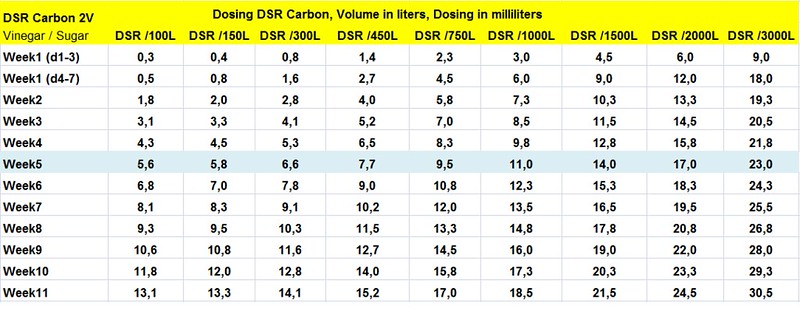
From the Carbon table (DSR/3000L), I can see different dose per week, does this mean first week (d1-3) I have to dose 9 ml, and (d4- 7) I have to dose 18 ml, and on week 2 I have to dose 19.3 ml and so on until week 11?
I am waiting your response urgently please

Answer :
How to lower nitrate?
The way to reduce nitrate is to use a Carbon source.
Known carbon sources include Vodka, vinegar, sugar, citric acid, honey, dextrose, but also bio-pellets is a carbon source
In DSR I opted for the approach with vinegar, later i extended it with a mix of sugar (the Carbon V/S mix). I also have a customised dosing table for this Carbon V/S mix.
The condition to be able to reduce nitrate using a carbon source, is that there must be some Phosphate present. Preferably to be kept at level 0,03-0,08ppm. It sounds very contradictory, but at lower levels (0,0<0,02ppm) dosing Phosphate will help to reduce nitrate to lower levels. I have experience this a few time myself, and others who followed up on my advice also experienced this.
The dosing of a Carbon source, especially vinegar/sugar can encourage the growth of sponges. I therefore i dose nitrate to stabilize my nitrate at a desired level. Keep nitrate at levels between 0,5-2,5ppm
When dosing carbon watch out for stress signals (bacteria bloom): this can be recongnised by cloudy water, fish breathing heavily, slime on the corals, rocks and display. Stop with carbon dosing or half the carbon dosing when this happens. Also turning of the light may help in preventing bacteria bloom.

DSR CarbonVS Dosing Table
9630273239_4471404de4_c.jpg

The dosing advice mentioned in this table is for daily dosing.

for a 3000 liter system this means:

- first 3 days, daily 9ml
- day 4-7, daily 18ml
- week2, day 8-14 , daily 19,3ml
- week3, day 15-21, daily 20,5ml
- week4, day 22-29, daily 21,8ml
you get the idea .....?

you can speed up the dosing by increasing every dosing half time.
i.e.
- day1-2, daily 9ml
- day3-4, daily 18ml
- day 5-9, daily 19,3ml
- day 10-13, daily 20,5ml
- day 14-17, daily 21,8ml
- day 18-21, daily 23ml
and so on....

after 5 week Carbon dosing ther should be result, other wise you need to reevaluate you setup. (i.e. RO device, DI resin, skimmer, powerfilter, feeding pattern, lighting.)
 
Last edited:
I am wanting to dose vinegar (possible with sugar later) to lower my nitrates. My system is a mix reef 75gallon. My nitrates have consistently been 25ppm-40ppm, and my phosphates have measured 0 consistently using Hanna checker as test kit. Since my nitrates are high I suspect there are phosphates in my water that my test is not picking up, and maybe I will be able to see them on my test when the nitrates are lowered a bit? My questions are: what substance do you suggest for raising phosphate level and what substance for raising nitrate level? I would like to dose these after lowering nitrate and phosphate to maintain at optimal levels. Thank you
 
I am wanting to dose vinegar (possible with sugar later) to lower my nitrates. My system is a mix reef 75gallon. My nitrates have consistently been 25ppm-40ppm, and my phosphates have measured 0 consistently using Hanna checker as test kit. Since my nitrates are high I suspect there are phosphates in my water that my test is not picking up, and maybe I will be able to see them on my test when the nitrates are lowered a bit? My questions are: what substance do you suggest for raising phosphate level and what substance for raising nitrate level? I would like to dose these after lowering nitrate and phosphate to maintain at optimal levels. Thank you

Not sure what you mean by detecting phosphate only when you lower nitrate. Nitrate doesn't interfere with phosphate testing and/or detection.

It is possible that your phosphate might be low enough to limit nitrate reduction when using methods that require both (as vinegar does). There are many products suitable for raising phosphate, but I personally wouldn't add it unless you determine the vinegar is actually not working to lower nitrate adequately.

As to products, Seachem Flourish Phosphorus is suitable:

Seachem. Flourish Phosphorus
 
Not sure what you mean by detecting phosphate only when you lower nitrate. Nitrate doesn't interfere with phosphate testing and/or detection.

It is possible that your phosphate might be low enough to limit nitrate reduction when using methods that require both (as vinegar does). There are many products suitable for raising phosphate, but I personally wouldn't add it unless you determine the vinegar is actually not working to lower nitrate adequately.

As to products, Seachem Flourish Phosphorus is suitable:

Seachem. Flourish Phosphorus

I wasn't sure if my high nitrate had something to do with my undetectable phosphates, but it appears that is unlikely (or impossible if they are unrelated as you say). For the five years this tank has been running the nitrates have always been high (at least 5ppm). My phosphates were high and I used to use GFO to lower it; a year and a half ago I took the GFO offline and setup a biopellet reactor to try and reduce nitrates. That never worked (the pellets did nothing for me), and I took that offline after about 8 months. Since then my phosphates have been undetectable to my surprise. I will give dosing vinegar a go. Thank you Randy for chiming in; that's what I needed to know to get started. I will start dosing vinegar and monitor the results, especially before dosing any phosphate supplement. Have you written a guide to dosing vinegar for those just starting this process (as I know this is what you dose for n03)? Thank you
 
Yeah, I am using red sea, salifert, and API nitrate tests which all give very similar results. Thanks for the link, I'll check it out
 
I am wanting to dose vinegar (possible with sugar later) to lower my nitrates. My system is a mix reef 75gallon. My nitrates have consistently been 25ppm-40ppm, and my phosphates have measured 0 consistently using Hanna checker as test kit. Since my nitrates are high I suspect there are phosphates in my water that my test is not picking up, and maybe I will be able to see them on my test when the nitrates are lowered a bit? My questions are: what substance do you suggest for raising phosphate level and what substance for raising nitrate level? I would like to dose these after lowering nitrate and phosphate to maintain at optimal levels. Thank you

i advice you read the Nitrate posting thoroughly
https://www.reef2reef.com/forums/re...thod-dutch-synthetic-reefing.html#post2285391

before you start PO4 dosing for that purpose (lowering NO3), you need to make sure you can measure your PO4 lower than 0,02ppm.

suitable test are:
- Redsea PO4 test
- Hanna Phosphorus ulr checker (hi736)
most test i have tried before were not accurate in the low range (0,02-0,08ppm), so not suitable to be used for PO4 dosing.
using those inaccurate tests for PO4 dosing is waiting for an accident to happen.
i have see people ruin their tank, using inferior testkits just because the test were cheaper.

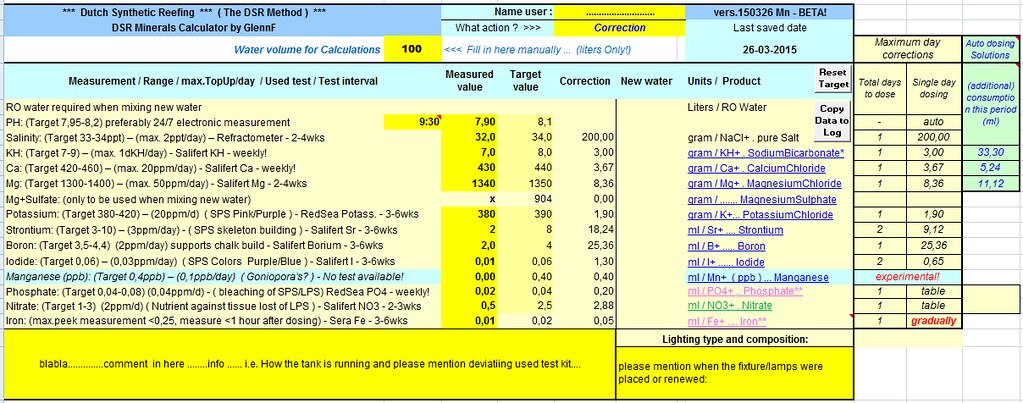
in the DSR calculator i recommend to use certain test kits. Please try to use those test, because the result/accuracy may depend on the choosen testkits.

to raise PO4 and NO3 you can use pure product derived from SodiumPhosphate or CalciumNitrate.
i will explain the methodology, but i won't place mixing formulas here because it serves no purpose, because asking people with no knowledge and acces to pure chemical is an accident waiting to happen. People with the right knowlegde and access can do the math themselves.
in The Netherlands all stuff used in the DSR calculator are made available to the reefers through the local LFS.
 
Last edited:
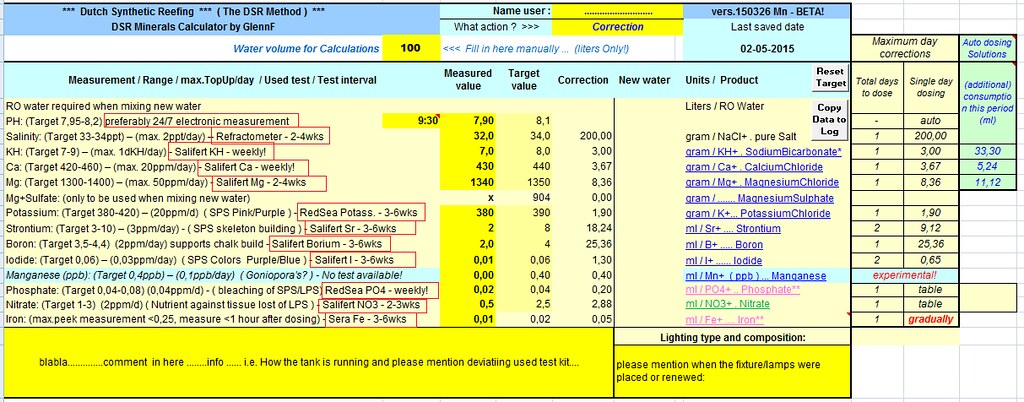
When developing DSR i used the following tests :

17160936249_3f09deb0ff_b.jpg


Salinity: Refracto meter, Calibrated at 35ppt with salifert Refracto check

KH: Salifert KH
Calcium: Salifert Ca
Magnesium: Salifert Mg
Potassium: RedSea Reef Care Potassium test
make sure titrant D is above 25 Celcius when using the potassium test. Otherwise there will be precipitation on the bottom of the bottle which look like crystals. This wil make the test and future test result useless.
if you put the bottle for 10 minutes (before each test) into a pocket close to your body it wil heat up and the crystals will go back into solution.
Strontium: Salifert Sr
Boron: Salifert Borium
Iodine: Salifert I2
Phosphate* (PO4): RedSea Reef care PO4 test
Nitrate: Salifert NO3*
Iron*: Sera Fe test (it works fine, I calibrated it with my own Fe solution on fresh and saltwater)
Redsea Fe test works fine, but it is a little slow, at 20-22 Celsius i takes one hour to get the right result.

* both marked are strongly recommended.
 
Last edited:
Are you confident your nitrate kit is reading correctly?


good point Randy.

- make sure to use testkits that are accurate (the recommende ones.)
- make you you never use outdated testkits.
- make sure you replace your testkist when there is less than 10% liquid left. i have observed with a few test kits, that they become more inaccurate when the liquids reach the bottom region. (don't ask why, it's just an observation)
 
Last edited:
Here's a blurb on dosing vinegar, although the dosing chart should be ignored as it seems odd to me. Too slow to ramp up and doesn't scale properly with tank size.

Reefkeeping Magazine - Vinegar Dosing Methodology for the Marine Aquarium

i suppose this is te be found out experimentaly, because we dont ha've than many tanks with that volume to test with.
also i suppose that we should be cautious to ramp up to fast, because doing a emergency wc (in case of i.e. bacteria bloom) for such a large system is not than easy to do as with a smaller systems. i also guess large system have less bacterie/water ratio compared to smaller systems. (it's just a theory)
 
How to lower Phosphate?
Phosphate can be lowered by several commercial aids which contains Aluminum or Iron Oxide (GFO). Both are substrate which must be placed in a bedfilter. (with the water streaming up).
in this tube water pas through the media exchanging one PO43- with three OH1- ions.

I use Iron Citrate to control phosphate because it work instantly in the water column. No need to pass through the reactor (tube) to exchange PO4 anymore.
The Iron solution contains Iron(II/III)Hydoxide:
The Fe(OH)3 wil exchange his OH1- ion with PO43- , 3x OH1- released 1x PO43- ion is being absorbed.
Fe(OH)3 + PO43- => FePO4 + 3OH1-
FePO4 is precipitated and will be skimmed off, or filtered out by the power filters i use. It can be recognized by de rust (orange) color in the filter wool and in the skimmer.
Sometimes the Precipitation can be recognized by a haze, which stay for about 2-4 hours.
When using Iron Citrate never dose over 0,15ppm at one time( measurable 30 minute after dosing). Iron measurement will half within 6 hours and after 24 hour less than 0,02ppm is measured. Use the DSR Calculator to calculate the dose.

Some zebrasoma Tang’s, Butterfly’s, angelfish and Tridacna clams can be extremely sensitive for high (over) doses of iron. For this reason you need to explore the level which they accept carefully. They seem to adapt after a while.

I recommend to start with:
day1 = 0,03ppm
day2= 0,06ppm
day3= 0,09ppm
day4= 0,12ppm
day5= 0,15ppm max. dosing/day

for a faster dosing schedule (very high PO4, > 0,64ppm)
day1 = 0,03ppm, after 12 hours another 0,03ppm
day2 = 0,06ppm, after 12 hours another 0,06ppm
day3 = 0,09ppm, after 12 hours 0,06ppm
day4 = 0,12ppm, after 12 hours 0,03ppm
day5 = 0,15ppm max. dosing /day

To translate ppm to ml for you tank, use the DSR Calculator.
Fill in the volume, iron measures value 0ppm (0%), target value 0,15ppm (100%)
The latest DSR calculator adjust the Fe target value according to the relation measured/targeted PO4.


At all time carefully watch the fish behavior.

To use Iron as trace element only, dose <0,02ppm at frequency what you see fit it's purpose (daily-weekly, watch your phosphate not to drop below 0,02ppm)

The purpose of regular Fe measurements is to make you your iron does not build up to toxic levels. it's a fail save just in case . although i have never seen it happen unless you're overdose yourself. most of the measureable iron will be gone out of the watercolumn in 6 hours, making is less of a chance to build up to toxic levels

the Iron target value is not a real target value, but it purpose is to limit it's maximum value for dosing calculations.

 
Last edited:
Glennf
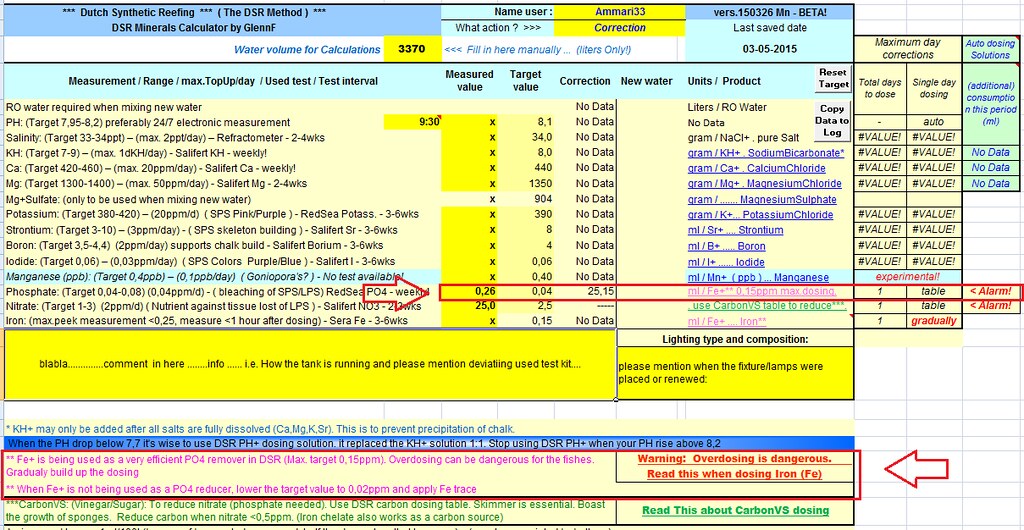
I was running PhosBan reactor in order to reduce phosphate. I decided to stop the reactor and depend on DSR Carbon and Fe+ to control phosphate and nitrate.
When I saw the DSR Calculator I got confused. I do not know how many quantity do I have to dose [emoji53]
My phosphate concentration is 0.26 PPM
My Nitrate concentration is 25 PPM
Would you please explain in details the quality that I should dose for both Fe+ and Carbon V/S?
My tank Is 3370 Litre
I can see a stress on my SPS and some of the SPS are losing colour

this i how it work for a 3360 Liter system

16727266603_4216121f06_b.jpg


the maximum single dosing for 3360liter is determined at 25 ml


"Fe dosing" tab
here is how you go about building up the dosing staring at day 1 = 20% which is 5ml Fe+
please read all text thoroughly !


17321534166_e4ccf37d81_b.jpg
 
Last edited:
Thank you Glenn for your response. I do believe I am using quality test kits to measure the basics (phosphate, n03, alk, cal, salinity, magnesium), and strongly believe i have the correct readings of nitrate and phosphate. I have salifert and red sea (all non expired) kits both for each of these parameters, and when comparing results, they are close. I also use a Hanna checker for alkalinity and the Hanna Phosphorus ulr checker for phosphate. I do need to get a new red sea phosphate test. Thank you for your advice with the other test kits to use for other parameters (potassium, strontium, boron, iodine, etc...). I have been using the red sea package kit to test potassium, iodine, and iron, but see you suggest salifert for some and the sera Fe test so will grab those kits as well. Any reason in particular you suggest salifert to measure iodine instead of the red sea kit?

I totally understand why you won't get into the precise formula mixtures for a phosphate and nitrate additive, as well as others used in the DSR method. My plan is to first dose vinegar (starting slowly) for nitrate reduction. If I find after time that a higher phosphate in my system is needed I will follow Randy's advice and use Seachems product.
After gaining experience dosing vinegar and getting a handle on the acurate measurements of other parameters like boron, potassoum, iron, iodine, etc.. I plan on implementing more methodology of the DSR method. Again, thank you
 
When I started with DSR, all used test were compared to a reference and they passed.

So did the salifert I test.
 
Last edited:
Here's a blurb on dosing vinegar, although the dosing chart should be ignored as it seems odd to me. Too slow to ramp up and doesn't scale properly with tank size.

Reefkeeping Magazine - Vinegar Dosing Methodology for the Marine Aquarium

Are you confident your nitrate kit is reading correctly?

Randy, yes I do think the n03 level I'm getting is correct as I have used several different kits to verify that number. And thank you for the article, has lots of great and relative info. If I should not follow this chart, what do you advise I follow for beginning dosing vinegar for a system with roughly 75 gallons total (amounts for days 1-3, days 4-7, week2, and how much to increase each week like the chart in the article displays)?
Also, in the article you said that the bacteria from vinegar dosing tended to accumulate on your used GAC. Would you suggest (or would it be beneficial) if I ran one reactor with fresh GAC and another reactor with used GAC? Could this help contain the bacteria from the display and into the reactor which is near my sump. Thanks again for the help, and sorry Glenn for using your thread to communicate with Randy
 
Last edited:

IF YOU HAD TO TAKE A REEFING EXAM, WOULD YOU PASS?

  • Yes!

    Votes: 32 45.7%
  • Not yet, but I have one that I want to buy in mind!

    Votes: 9 12.9%
  • No.

    Votes: 26 37.1%
  • Other (please explain).

    Votes: 3 4.3%
Back
Top