Last edited:

Follow along with the video below to see how to install our site as a web app on your home screen.
Note: This feature may not be available in some browsers.




I think I got mine under control.
I brushedSaturday and Sunday, got about 99% of it off. I brushed extensively for like two hours each night. I used a battery powered (eheim) vacuum both days to get all the stuff out of the sand and cleaned the filter sock after each brushing. Then I dosed peroxide both Saturday and Sunday night.
I've been turkey basting twice a day since, last night and this morning I got almost nothing floating after the basting. The rocks look great... I'm going to keep turkey basting the rocks each night for the next few weeks.
All corals closed up Sunday after the second peroxide dose. The stayed closed for two days. They Look good today and it would appear that this stuff isn't growing back.

Some years back, a friend operated a reef tank with constant peroxide drip.
The German reefers have a gadget called oxygenator which uses an o2 meter to fine tune peroxide dose. I consider this “good science” and have invested in a laboratory grade o2 meter.
Thank you for your research.
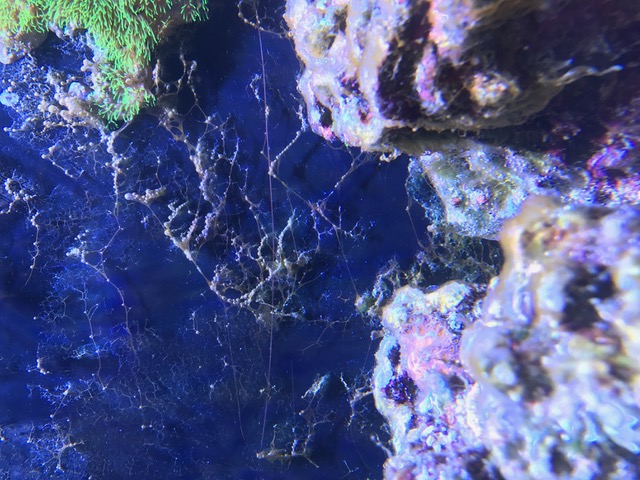

That is basically the exact opposite of what I would do lol.Dinoflagellates
This light brownish menace feels like snot growing up from the rock or sand, with trapped air bubbles in it. Not to be confused with algae that has an air bubble that has landed on it, dinos make them. Not all species of dinos are bad the one pictured is though, and has caused many aquarists to tear down their tanks. If you are in doubt as to what you have send us a picture, there are many similar looking species that are easily removed.
Manual Removal - Remove the rock and place it in a large saucepan. Add water enough to cover the rock. Boil the tar out of it. Rinse and repeat with scrubbing in between. Let dry for 3 days in sun. Okay maybe not that far, but.... it is hard to remove. Scrub it as best you can. We do not have cleaners that will remove it.
Starving it out - Increase skimming, use a phosban reactor, or a macro like chaeto to take down nutrients. Some people have had success treating it by raising their ph and alk, but if you do so, do it with caution.
Photo by Brooks
Does this help?
I was actually considering a peroxide dosing regiment... My understanding is it breaks down to oxygen and water shortly after dosing so should pose no long term ill effects.
Do you recall the percentage and saturation level used by your friend?
That is basically the exact opposite of what I would do lol.

Dino’s tend to thrive in low nutrient environments. I wouldn’t use phosban or any of that stuff. I had dino’s in my 90. My nutrients were always low, struggling to get them detectable. I ended up just getting another fish. The nutrient increase from the fish made my dinos completely gone in about 2 weeks and they haven’t returned since.Can you explain why? I don’t always concur with John Mahoney, particularly on this point.
Dino’s tend to thrive in low nutrient environments. I wouldn’t use phosban or any of that stuff. I had dino’s in my 90. My nutrients were always low, struggling to get them detectable. I ended up just getting another fish. The nutrient increase from the fish made my dinos completely gone in about 2 weeks and they haven’t returned since.
Yep.Put Cynobacteria in that same category, “thrives in low nutrients” where desirable algae struggles.

I'm not 100% sure this was dino, could have possibly been a brown cyano... either way - the peroxide dosing has had positive effects.
I think I may experiment with a long term, low level peroxide dose. I am thinking 1/2ml per 10 gallon nightly (2.5ml for this tank). Though I have no way of directly testing the O2 level, I have noticed the peroxide directly affects my ORP readings, a drastic reduction immediately following the dose. I can possibly use this to discern if the H2O2 isn't being processed in the tank. I would also expect that an increased O2 level would increase fish respiration thereby increasing CO2 which should be measurable by a drop in pH.