



Ron Reefman
Lets Go Snorkeling!
View Badges
Reef Squad
Excellence Award
Reef Tank 365
Article Contributor
Tampa Bay Reef Keepers
MAC of SW Florida
Compare the number of leds to the wattage and the new Pro system is still just a bit lower than 0.6 watts per led. And I have not seen or tested PAR on a new system.
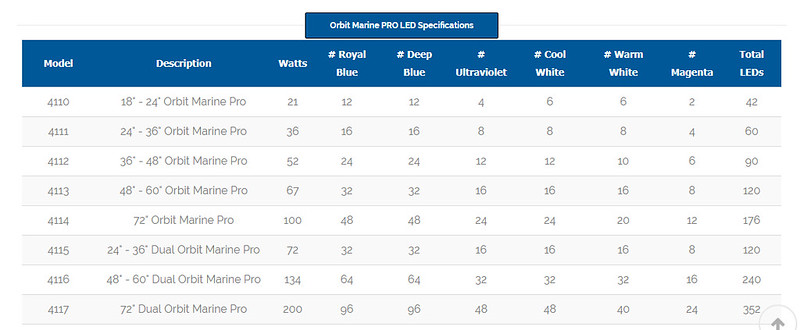 Current Orbit Pro led vs watts by Ron Lindensmith, on Flickr
And now they show PAR of between 70 and 100 at 24" deep. That's not half bad, especially if their prices (I didn't bother to look) are below what other fixtures with similar features are charging. But it's still less PAR than any black box fixture gets at 24" deep. And it's still a long way from 200 PAR at 30+ inches deep. And I get 200 PAR at 20" deep running my leds at 80% power on the blue and violet channels, 30% on the white channel and zero on the red & green channels.
 Current Orbit PAR chart by Ron Lindensmith, on Flickr
Current Orbit Pro led vs watts by Ron Lindensmith, on FlickrAnd now they show PAR of between 70 and 100 at 24" deep. That's not half bad, especially if their prices (I didn't bother to look) are below what other fixtures with similar features are charging. But it's still less PAR than any black box fixture gets at 24" deep. And it's still a long way from 200 PAR at 30+ inches deep. And I get 200 PAR at 20" deep running my leds at 80% power on the blue and violet channels, 30% on the white channel and zero on the red & green channels.
Current Orbit PAR chart by Ron Lindensmith, on Flickr
Last edited:








 ), so it's watts are the least spread out, only covering less than a 10" diameter area of less than 80 square inches.



















