PARwise

Given BRS' data, I'd like to see the spectrums align better. For me, it's just too far off to be of value, but I'd expect that tuning the result via software could be a thing. If they aligned those peaks, I'd absolutly recommend it for hobbyist use.

1702841402982.jpeg


But if you just need a PAR meter, this is a better deal - https://a.co/d/6fljHKN
Looks decent.. I quickly skimmed thre description, it says good for all types of lights.. would you say it reads halides accurately? I don't understand why there's a difference in measuring differencelight source types... if we were measuring flow, it doesn't matter if I poured water out a bucket or pumped it, gph is gph. Why is par different? And how do you feel this device compares to the popular apogee 510?
 
As an Amazon Associate we earn from qualifying purchases.

Looks decent.. I quickly skimmed thre description, it says good for all types of lights.. would you say it reads halides accurately? I don't understand why there's a difference in measuring differencelight source types... if we were measuring flow, it doesn't matter if I poured water out a bucket or pumped it, gph is gph. Why is par different? And how do you feel this device compares to the popular apogee 510?
When my PARwise comes home, I'll directly compare it to the Apogee and VBR. I've already shared an Apogee vs VBR comparison. https://humble.fish/community/index.php?threads/need-a-par-meter.17795/
 
Not when you're using that data to suggest that 450nm diode ain't 450nm. There's a better chance that your meter reading is off, not the diode.
Let it go. Let it go. Let it go. Time will tell if I'm accurate enough for my needs.

BTW, the measurements I made yesterday of my Radions in single-color mode were almost exactly as advertised, so I'm confident the PARwise is close enough, and the Chinese Aliexpress LEDs are not as advertised. Either way, I can put together the LED spectrum I want (plus or minus) and get the results I want.
 
Given BRS' data, I'd like to see the spectrums align better. For me, it's just too far off to be of value, but I'd expect that tuning the result via software could be a thing. If they aligned those peaks, I'd absolutly recommend it for hobbyist use.

1702841402982.jpeg


But if you just need a PAR meter, this is a better deal - https://a.co/d/6fljHKN
Why is that difference significant enough to justify $3,000 more than the $240 cost of a new PARwise? I'm still waiting to see a comparison of a single blue LED with each meter.
 
As an Amazon Associate we earn from qualifying purchases.
BTW, if you're reading sub-400nm data with your PARwise, it most likely isn't there.
Well, this Chinese Aliexpress LED was sold as 395nm. The PARwise says the peak is 383nm. Either way, it's supposed to be below 400nm.
#3 384nm LED.png
 
Looks decent.. I quickly skimmed thre description, it says good for all types of lights.. would you say it reads halides accurately? I don't understand why there's a difference in measuring differencelight source types... if we were measuring flow, it doesn't matter if I poured water out a bucket or pumped it, gph is gph. Why is par different? And how do you feel this device compares to the popular apogee 510?
See #115 in this thread. Unless using a lab grade PAR meter, I think they're all just for warm fuzzies. That's what we need, right?
 
Well, this Chinese Aliexpress LED was sold as 395nm. The PARwise says the peak is 383nm. Either way, it's supposed to be below 400nm.
Letting go or not letting go?
Why is that difference significant enough to justify $3,000 more than the $240 cost of a new PARwise? I'm still waiting to see a comparison of a single blue LED with each meter.
Or $300. The difference is not significant enough. Users just need to know what they're getting. I was gifted data showing how much UV a light was generating. A PARwise user showed me so. The light didn't have UV diodes.

As long as PARwise buyers are buying a PAR meter with some spectrometer function, then cool, but that device should not be used to prove a point other than it has spectrometer functionality.
See #115 in this thread. Unless using a lab grade PAR meter, I think they're all just for warm fuzzies. That's what we need, right?
Agreed, and our warm fuzzies should align as well as the VBR and Apogee.

So, still letting go?
 
I was just talking with him in another thread... he'll pop in
Hello... :)

Not sure what you want covered?
As to the old days and old sensors (see affordable) most had poor resolution in the blue and red end of the spectrum.
Many cut off completely before 660nm red (important to plants)

Also some over sampled in the green region.
Under in blue over in green it sort of averaged out for "normal" types of light especially true black body types (sun and tungsten filaments types) but not for leds with its blue spike.

And to sort of add to the above it is used mostly as a comparator. What is your light today vs last year sort of thing.

Parwise has a big sis that does 1nm increments. Parwise is 5nm..
 
Hello... :)

Not sure what you want covered?
As to the old days and old sensors (see affordable) most had poor resolution in the blue and red end of the spectrum.
Many cut off completely before 660nm red (important to plants)

Also some over sampled in the green region.
Under in blue over in green it sort of averaged out for "normal" types of light especially true black body types (sun and tungsten filaments types) but not for leds with its blue spike.

And to sort of add to the above it is used mostly as a comparator. What is your light today vs last year sort of thing.

Parwise has a big sis that does 1nm increments. Parwise is 5nm..
So these newer, mentioned in this thread, sensors can accurately read halides and leds? Or at least close enough for my purpose(blending leds to mh and judging bulb decline)?
 
Parwise has a big sis that does 1nm increments. Parwise is 5nm..
I'm getting 1nm increments with the PARwise. For example, LED#1 measured 443nm in each of several measurements. LED#2 measured 444nm multiple times. Back to LED #1 and it showed 443nm.

While it doesn't prove that the peak wavelength was accurate (reflecting the true wavelength), it did prove dead-on consistency when measuring individual LEDs.
 
You mean the non-lab grade Hopoocolor from Aliexpress/China? LOL
Roger. Not letting go.

Personal experience suggests that the non-lab grade Hopoocolor is better than the non-lab grade PARwise, and I can say that the Hopoocolor does align quite well, but not exactly, with the once NIST traceable UPRtek. Where the PARwise misses is the alignment of peaks. The Hopoocolor and the UPRtek are close enough for me.

So these newer, mentioned in this thread, sensors can accurately read halides and leds? Or at least close enough for my purpose(blending leds to mh and judging bulb decline)?
If I may, PARwise, no. I'd go Hopoocolor for this comparison. When comparing MH to LED, the dimming method used for the LED may matter. You might need to alter the capture period to compensate for slow PWM. That, and the PARwise will cartoon-ize the very specific peaks that MH emits.
 
Frankly, as long as the PARwise measurements are consistent, I'd be more than happy with a 5nm error.
 
Roger. Not letting go.

Personal experience suggests that the non-lab grade Hopoocolor is better than the non-lab grade PARwise, and I can say that the Hopoocolor does align quite well, but not exactly, with the once NIST traceable UPRtek. Where the PARwise misses is the alignment of peaks. The Hopoocolor and the UPRtek are close enough for me.


If I may, PARwise, no. I'd go Hopoocolor for this comparison. When comparing MH to LED, the dimming method used for the LED may matter. You might need to alter the capture period to compensate for slow PWM. That, and the PARwise will cartoon-ize the very specific peaks that MH emits.
Not to be lazy(ok maybe a little bit), can you please link the specific device you would recommend
 
I can't imagine
Not to be lazy(ok maybe a little bit), can you please link the specific device you would recommend
I'm sure he's leaning toward the Hopoocolor HPCS320 ($580 plus shipping), OHSP350 ($830 plus), or OHP350C ($700 plus) on Amazon. Funny, but none of them provide non-cartoon granularity.

I just can't see the utility that any hobbyist would get from something so high priced, much less something in the $3000+ range. Maybe something to show off when your reefing buddies come over? Then what? There are only a couple people in the hobby who do actual reef lighting research that has purpose.
 
So these newer, mentioned in this thread, sensors can accurately read halides and leds? Or at least close enough for my purpose(blending leds to mh and judging bulb decline)?
They should.. except for one thing.. The "intangable" part of a mh.. IR/UV.
you can add t5's since their UV/IR is usually inconsequential (opinion).

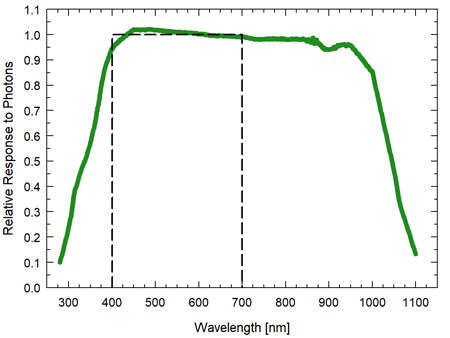
I noticed Apogee makes whats called a light pollution sensor..

note the disclaimer..
The Quantum Light Pollution Sensor uses a detector that is sensitive to radiation up to about 1100 nm, well beyond the range of wavelengths that influence photosynthesis and plant responses. This means this particular sensor should only be used for photon flux density measurements under LEDs.
Of course no spectrum as usual.
I have a hard time with "all in one" devices really.

sq-620-spectral-response.jpg


One thing though that hasn't been asked.. does the "new" cloud restrictions on the Seneye (no temp if no slide) have any bearing on the parwise?
 

IF YOU HAD TO TAKE A REEFING EXAM, WOULD YOU PASS?

  • Yes!

    Votes: 32 45.7%
  • Not yet, but I have one that I want to buy in mind!

    Votes: 9 12.9%
  • No.

    Votes: 26 37.1%
  • Other (please explain).

    Votes: 3 4.3%

New Posts

Back
Top