Do you really think you can keep a coral or a reef system for it's normal life expectancy without water changes?
But what about the bacteria, sponges, archea, protists, fungii and phages?
And what about the various Labile and refractory DOCs, particularly the Dissolved Combined Neutral Sugars (DCNS) that promote pathogenic bacterial shifts in the coral holobiont?
(for those who want to learn more about DOC, bacteria and corals start with Forest Rohwer's
Coral Reefs in the Microbial Seas.)
My background:
Started keeping saltwater in '87. Was lucky to bump into two aquarists in '91 who had been keeping saltwater since the mid 70's who mentored me. As I learned it, water changes are needed to reduce all the various waste products, not just nitrates and phosphates. Three givens then were, there is a lot of stuff we can't test for, skimmers only remove hydrophobic stuff and leave hydrophilllic stuff behind and even GAC likely won't grab everything.
In '97 ,a couple years after I started my aquarium maintenenace business I had a very short but seminal conversation with a Dr. Mary Jane Ashby, Ph.D RN, director of an infectious disease department of a local hospital about bacteria. Gist of it was whether a bacteria was "good" or "bad" depended largely on whether it was thriving where it was supposed to be or thriving where it wasn't supposed to be. (I didn't learn of Paul B's posts about bacteria until a few years ago but he's been saying something similar.) Along with what I was seeing in my tanks I shifted from thinking strictly nutrients and nutrient export to holistically about bacteria thinking of a reef system as a single entity. WHile testing for bacteria is just now becoming available (See AquaBiomic's posts) one simple thing I realized then I could do that help significantly at times was use water from a "Healthy" reef system to help a reef system that was having problems. It seemed obvious even then other bacteria than those involved in nitrification and denitrification were a factor in a healthy reef ecosystem.
. . . So religious Waterchanger ppl might say "What about nitrate/Phosphate control? You gotta change your water every 2 weeks!"
In some mild researching, I'm reading how dosing the strain of Blue-Green Phytoplankton OUTCOMPETES nuisance algae and makes for a more balanced tank.
I'm reeeeally starting to think regular waterchanges is dumping good biochemical water down the drain that worked so hard to achieve a balance.
If I can control my NO3 and PO4 thru heavy skimming, dosing phytoplankton .... why would I do a waterchange UNLESS smthg like Calcium or Carbonate or Magnesium was off?
And if I can dose major and minor elements to keep them within range...AND my no3/po4 are in check... why do a waterchange? . . .
There is now huge amounts of research showing to bacteria are critical. It doesn't matter if it's sustainable farming, a healthy natural ecosystem or our own physical and mental health the proper balance of microbial life is essential. Additionally, the research done with nitrogen and phosphates make it clear to me we need to look at totals in a system, organic, inorganic and particulate carbon, organic and inorganic and particulate nitrogen as well as organic and inorganic and particulate phosphorus, not just nitrates and phosphates.
Undoubtidly there are dogmatic individuals who stick to a set recomendation and decry all else as heresy but as a "Religious Water Changer" I like to do weekly water changes. And it's to reduce all waste products not just Nitrate and Phosphate. But weekly is personal prefference not some dictum or dogma. If I had to say, the number I most frequently come across or have been told is probably monthly and the volume percentage varies.
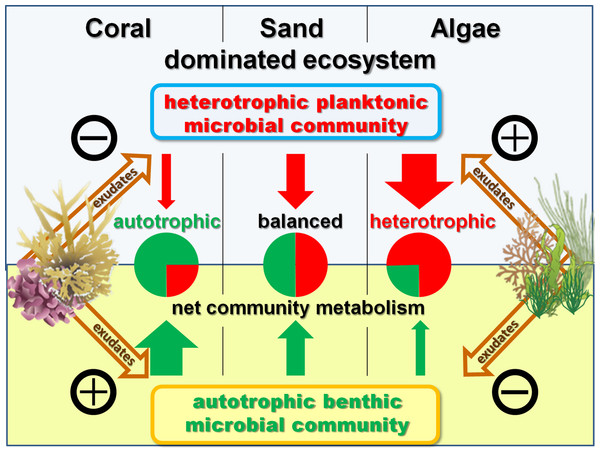
Some years I was better than other years but I've always tried to keep abreast of current research done on reefs and corals. Albiet most of the research has been with benthic algae but it is clear algae and corals have antagonistic roles on a reef system. Both are proactively manipulating the microbial processes around them to benefit themselves and there is some pretty complex biological warfare being conducted on the part of algae. Algae release labile DOC promoting heterotrophic bacteria (oxygen consuming) which includes promoting pathogenic bacteria in the coral holobiont. While coral release labile DOC promoting autotrophic bacteria (oxygen conserving).
(Ironicly the only time researchers could not find any DOC on reefs is when the system had been completely taken over by algae providing enough labile DOC for heterotrophic bacteria to completely consume the refractory portion.)
A system may have lots of coral and a minimum of algae and might be able to go a long time without water changes but without water changes refractory DOC will be building up in a system and we do not know what the consequences are when it gets to 80% or 90%. There will always be some algae releasing the types of labile DOC particularly the DCNS component which from what I've been able to determine is not removed by either activated carbon or skimming and can only be diluted by water changes.
As I see it water changes remove a certain percentage of ALL the microbial life in an ecossytem. Corals and algae exudates will help replenish the bacteria. Depending on what is dominate the bacteria populations will lean towards autotrophic bacteria species (good) or heterotrophic bacteria (bad). I expect someday we'll be able to monitor the holobiont's of the corals in our systems and say "We don't nned a water change" or "We need a water change" but we're not there yet.
And for those who want to dig into more research after reading Rohwer's book here's some links:
Sugar enrichment provides evidence for a role of nitrogen fixation in coral bleaching

onlinelibrary.wiley.com
Phosphate Deficiency:
Nutrient enrichment can increase the susceptibility of reef corals to bleaching:
http://www.indiaenvironmentportal.org.in/files/file/Nutrient enrichment.pdf
Ultrastructural Biomarkers in Symbiotic Algae Reflect the Availability of Dissolved Inorganic Nutrients and Particulate Food to the Reef Coral Holobiont:
https://www.frontiersin.org/articles/10.3389/fmars.2015.00103/full
Phosphate deficiency promotes coral bleaching and is reflected by the ultrastructure of symbiotic dinoflagellates
https://www.sciencedirect.com/science/article/pii/S0025326X17301601?via=ihub
Effects of phosphate on growth and skeletal density in the scleractinian coral Acropora muricata: A controlled experimental approach
https://www.sciencedirect.com/science/article/pii/S0022098111004588
High phosphate uptake requirements of the scleractinian coral Stylophora pistillata
http://jeb.biologists.org/content/214/16/2749.full
Decadal Environmental Memeory in a Coral.
West sides of the coral Coelastrea aspera, which had achieved thermo-tolerance after previous experience of high solar irradiance in the field, were rotated through 180o on a reef flat in Phuket, Thailand (7o50´N, 98o25.5´E), in 2000 in a
www.academia.edu
Indirect effects of algae on coral: algae‐mediated, microbe‐induced coral mortality
Coral seperated from algae with a .02 µm filter die. Treatment with aampicillan prevents death.
onlinelibrary.wiley.com
Influence of coral and algal exudates on microbially mediated reef metabolism.
Coral DOC improves oxygen (autotrophy), algae DOC reduces oxygen (heterotrophy).
Benthic primary producers in tropical reef ecosystems can alter biogeochemical cycling and microbial processes in the surrounding seawater. In order to quantify these influences, we measured rates of photosynthesis, respiration, and dissolved organic carbon (DOC) exudate release by the dominant...

peerj.com
Effects of Coral Reef Benthic Primary Producers on Dissolved Organic Carbon and Microbial Activity
Algae releases significantly more DOC into the water than coral.
Benthic primary producers in marine ecosystems may significantly alter biogeochemical cycling and microbial processes in their surrounding environment. To examine these interactions, we studied dissolved organic matter release by dominant benthic taxa and subsequent microbial remineralization in...

journals.plos.org
Pathologies and mortality rates caused by organic carbon and nutrient stressors in three Caribbean coral species.
Starchs and sugars (doc) caused coral death
Microbial ecology: Algae feed a shift on coral reefs
Human pressures on coral reefs are giving macroalgae a competitive advantage over reef-building corals. These algae support larger, and potentially pathogenic, microbial populations that are metabolically primed for less-efficient, yet faster, carbohydrate remineralization, perpetuating a...

www.nature.com
Coral and macroalgal exudates vary in neutral sugar composition and differentially enrich reef bacterioplankton lineages.
Increasing algal cover on tropical reefs worldwide may be maintained through feedbacks whereby algae outcompete coral by altering microbial activity. We hypothesized that algae and coral release compositionally distinct exudates that differentially alter bacterioplankton growth and community...

www.ncbi.nlm.nih.gov
Sugar enrichment provides evidence for a role of nitrogen fixation in coral bleaching
onlinelibrary.wiley.com
Elevated ammonium delays the impairment of the coral-dinoflagellate symbiosis during labile carbon pollution
(here's an argument for maintaining heavy fish loads if you're carbon dosing)
Labile dissolved organic carbon (DOC) is a major pollutant in coastal marine environments affected by anthropogenic impacts, and may significantly con…

www.sciencedirect.com
Excess labile carbon promotes the expression of virulence factors in coral reef bacterioplankton
Coastal pollution and algal cover are increasing on many coral reefs, resulting in higher dissolved organic carbon (DOC) concentrations. High DOC concentrations strongly affect microbial activity in reef waters and select for copiotrophic, often potentially virulent microbial populations. High...
www.nature.com
Unseen players shape benthic competition on coral reefs.
Recent work has shown that hydrophilic and hydrophobic organic matter (OM) from algae disrupts the function of the coral holobiont and promotes the invasion of opportunistic pathogens, leading to coral morbidity and mortality. Here we refer to these dynamics as the (3)DAM [dissolved organic...
www.ncbi.nlm.nih.gov
Allelochemicals Produced by Brown Macroalgae of the Lobophora Genus Are Active against Coral Larvae and Associated Bacteria, Supporting Pathogenic Shifts to Vibrio Dominance.
Diverse microbial communities associate with coral tissues and mucus, providing important protective and nutritional services, but once disturbed, the microbial equilibrium may shift from a beneficial state to one that is detrimental or pathogenic. Macroalgae (e.g., seaweeds) can physically and...
www.ncbi.nlm.nih.gov
Macroalgae decrease growth and alter microbial community structure of the reef-building coral, Porites astreoides.
With the continued and unprecedented decline of coral reefs worldwide, evaluating the factors that contribute to coral demise is of critical importance. As coral cover declines, macroalgae are becoming more common on tropical reefs. Interactions between these macroalgae and corals may alter the...
www.ncbi.nlm.nih.gov
Macroalgal extracts induce bacterial assemblage shifts and sublethal tissue stress in Caribbean corals.
Benthic macroalgae can be abundant on present-day coral reefs, especially where rates of herbivory are low and/or dissolved nutrients are high. This study investigated the impact of macroalgal extracts on both coral-associated bacterial assemblages and sublethal stress response of corals. Crude...
www.ncbi.nlm.nih.gov
Biophysical and physiological processes causing oxygen loss from coral reefs.
Global microbialization of coral reefs
Rohwer's DDAM Theory Proven
Analysis of 60 sites in three ocean basins suggests that overgrowth of fleshy algae on coral reefs supports higher microbial abundances dominated by copiotrophic, potentially pathogenic bacteria via the provision of dissolved inorganic carbon.
www.nature.com
Because sponges are essential players in the carbon, nitrogen and phosphorus cycle(s) on reefs here's some links to research done with them.
Element cycling on tropical coral reefs.
This is Jasper de Geoij's ground breaking research on reef sponges. (The introduction is in Dutch but the content is in English.)
Sponge symbionts and the marine P cycle
Marine sponges are ubiquitous colonizers of shallow, clear-water environments in the oceans (1, 2). Sponges have emerged as significant mediators of biogeochemical fluxes in coastal zones by virtue of respiring organic matter and facilitating both the consumption and release of nutrients (3, 4)...

www.pnas.org
Phosphorus sequestration in the form of polyphosphate by microbial symbionts in marine sponges
(Chris Kenndall had a problem with low PO4 and had problems raising it with Neophos. Samples sent off showed phosphorus crystals developing in some of the sponges in his system accounting for at least some of his systems consumption.)
Coral reefs are highly productive ecosystems that raise a conundrum called “Darwin’s paradox”: How can high production flourish in low-nutrient conditions? We show here that in three abundant Caribbean sponges, the granules that have been commonly observed in sponge tissue for decades are...
www.pnas.org
Differential recycling of coral and algal dissolved organic matter via the sponge loop.
Sponges treat DOC from algae differently than DOC from corals

besjournals.onlinelibrary.wiley.com
Surviving in a Marine Desert The Sponge Loop Retains Resources Within Coral Reefs
Dissolved organic carbon and nitrogen are quickly processed by sponges and released back into the reef food web in hours as carbon and nitrogen rich detritus.
PDF | On Jun 23, 2015, Jasper M de Goeij and others published 2013 deGoeij Science Sponge loop | Find, read and cite all the research you need on ResearchGate

www.researchgate.net
Natural Diet of Coral-Excavating Sponges Consists Mainly of Dissolved Organic Carbon (DOC)
The Role of Marine Sponges in Carbon and Nitrogen Cycles of COral Reefs and Nearshore Environments.
Explore millions of resources from scholarly journals, books, newspapers, videos and more, on the ProQuest Platform.

search.proquest.com
And since we're discussing favorable and not so favorable bacteria here's a paper looking at how different corals and polyps are influencing the bacteria in the water column.
Aura-biomes are present in the water layer above coral reef benthic macro-organisms
As coral reef habitats decline worldwide, some reefs are transitioning from coral- to algal-dominated benthos with the exact cause for this shift remaining elusive. Increases in the abundance of microbes in the water column has been correlated with an increase in coral disease and reduction in...
www.ncbi.nlm.nih.gov