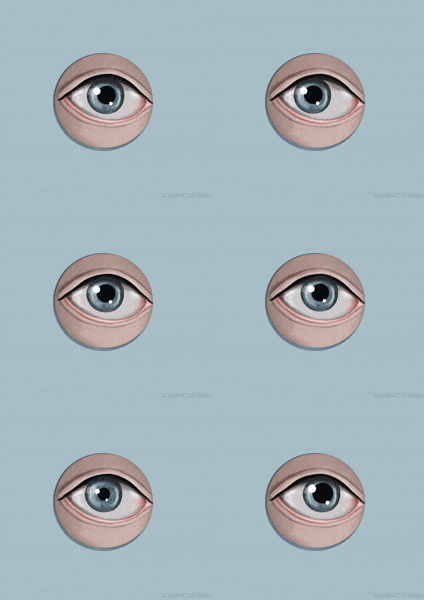
You have too much light.....

We blast our corals with too much light...

  • TRUE

    Votes: 75 38.5%
  • FALSE

    Votes: 43 22.1%
  • UNSURE

    Votes: 71 36.4%
  • OTHER

    Votes: 6 3.1%

  • Total voters
    195

revhtree

Owner Administrator
View Badges


Joined
May 8, 2006
Messages
49,234
Reaction score
98,071
Rating - 100%
1   0   0
Your corals just don't seem to do well and all your parameters are all in check? You have too much light.

Raise your lights or turn down the intensity.

Change my mind...

blasting corals.jpg
 
I have to answer unsure. I bought a par meter to record what the par is at my corals, but I can only go by the par ranges that people say corals should be at. I don't have any idea what it would be in an actual reef. I wonder if anyone has ever recorded a par value for corals in the ocean?
I just realized I haven't watched a Steven Crowder video in a long time.
 
I think controlling light intensity is key to intercepting bleach events.
 
I use par meter as general rule of thumb and guide especially when setting up new lights you can quickly burn a coral up. There are going to be corals that are exception to all the rules across the board. I say find sweet spot. They all kinda have one.
After that I vote other and feel like it comes down more to healthy spectrum.
I can run my lights all blue or white or anywhere in between at same par and do same damage I could at high or low par.
Highly reccomend anyone running a led that has brs reccomended settings. Give it a shot. You won't be disappointed.
 
Your corals just don't seem to do well and all your parameters are all in check? You have too much light.

Raise your lights or turn down the intensity.

Change my mind...

blasting corals.jpg
According to Dana Riddle's article (that states PAR is probably not the best measurement) - at noon - at the ocean surface ON A CLOUDY DAY - the PAR is 950. at 10 feet its 550. It levels off at 250 PAR at 30 feet or so. At 10 feet on a sunny day the PAR is higher than 400 for 80+ percent of the day. So - I think that tells a story.

 
I think you can never have too much light. Just an inappropriate light source or too impatient to acclimate the corals.

In the end, I think it’s up to individual corals. Many frags we have today are acclimated to artificial light and have never seen natural light. So naturally, us blasting them with 900 par is of course going to cause issues.

However, having an inappropriate light source can be issue too in my opinion. I’ve read a lot of issues with hotspotting with certain LEDs on the whites soo there’s that too

ETA: Not a dig at LEDs either…with the wrong reflector you can have hotspotting with Halides too
 
Last edited:
I need a par meter , 5x orphek or3 90 over 40b at 12-16 inches above water , sometimes I feel like I’m cooking them but idk
 
According to Dana Riddle's article (that states PAR is probably not the best measurement) - at noon - at the ocean surface ON A CLOUDY DAY - the PAR is 950. at 10 feet its 550. It levels off at 250 PAR at 30 feet or so. At 10 feet on a sunny day the PAR is higher than 400 for 80+ percent of the day. So - I think that tells a story.
EDIT - and during the peak of the day - at 10 feet on a sunny day the PAR is above 1000. Thats not to say (as I think Dana would agree) - that much PAR is NECESSARY - but - that the levels in our tanks are not 'harmful', depending on the exact length of time they are set. Its interesting another thread suggested corals did better if for a couple days a month - lights were left off (like a cloudy day) - perhaps thats true
 
Higher nutrient systems can fair better with higher par...and lower nutrient with lower par? Has anyone found this to be true? This was something Sanjay said on a podcast I stumbled upon recently.
 
Generally, we give too much light to many corals and maybe not enough to others. Often this is because we don't know the conditions where many corals originate. Aquacultured corals can be determined easily, original location in the wild not so much. Beside light, flow is as critical and often unknown in the hobby compared to origin location.

I recently asked my partner in Tonga what depths he was typically (not exclusively) collecting:

Scolys 150 feet
Euphyllia Ancora/Paranacora 120 ft
Glabrescen and cristata 120 ft
Pavona maldivensis 120 ft
Mushrooms-usually found under other corals in shade
Lobophyllia 100 ft
Montipora 60 ft
Ritteri and malu Anemones 120 ft
Favia 100 ft
Acan echinata 80 ft
Micromussa 10 ft
Acropora 5-20 ft
Bowerbanki 150+ ft
Goniopora 120-150 ft

Zoanthids 1-60 ft in turbulent areas such as this
waters-island-group-Haapai-Tonga~4.jpg
 

IF YOU HAD TO TAKE A REEFING EXAM, WOULD YOU PASS?

  • Yes!

    Votes: 32 45.7%
  • Not yet, but I have one that I want to buy in mind!

    Votes: 9 12.9%
  • No.

    Votes: 26 37.1%
  • Other (please explain).

    Votes: 3 4.3%
Back
Top